暇
| ||||||||
Translingual
Han character
暇 (Kangxi radical 72, 日+9, 13 strokes, cangjie input 日口尸水 (ARSE), four-corner 67047, composition ⿰日叚)
References
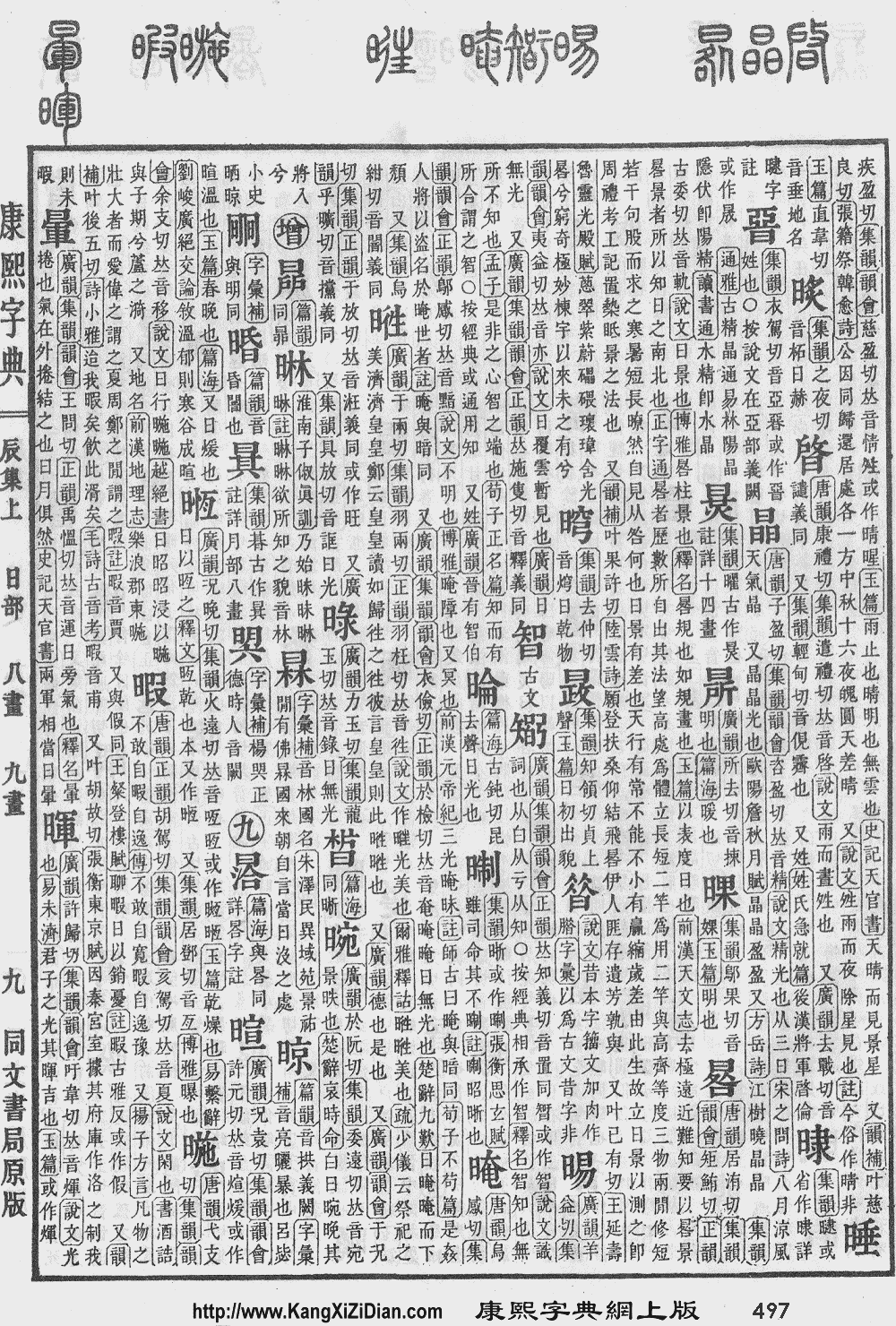
- Kangxi Dictionary: page 497, character 36
- Dai Kanwa Jiten: character 14036
- Dae Jaweon: page 865, character 27
- Hanyu Da Zidian (first edition): volume 2, page 1527, character 2
- Unihan data for U+6687
Chinese
| simp. and trad. |
暇 | |
|---|---|---|
| 2nd round simp. | ⿰日下 | |
Glyph origin
| Historical forms of the character 暇 |
|---|
| Shuowen Jiezi (compiled in Han) |
| Small seal script |
 |
Phono-semantic compound (形聲/形声, OC *ɡraːs) : semantic 日 (“sun”) + phonetic 叚 (OC *kraːʔ)
Etymology
(This etymology is missing or incomplete. Please add to it, or discuss it at the Etymology scriptorium. Particularly: “Any relation to 假 ("vacation")?”)
Pulleyblank (1973) suggests that it is cognate with 閒 (OC *ɡreːn, “idle, unoccupied, relaxed, etc.”).
Sagart (2023b) relates it to 夏 (OC *[ɡ]ˤraʔ) "summer" and Burmese အား (a:, “to be free (not in use; without obligations)”).
Pronunciation 1
Compounds
Pronunciation 2
References
- “暇”, in 漢語多功能字庫 (Multi-function Chinese Character Database), 香港中文大學 (the Chinese University of Hong Kong), 2014–
Japanese
Inflection
| Stem forms | |||
|---|---|---|---|
| Imperfective (未然形) | 暇だろ | ひまだろ | hima daro |
| Continuative (連用形) | 暇で | ひまで | hima de |
| Terminal (終止形) | 暇だ | ひまだ | hima da |
| Attributive (連体形) | 暇な | ひまな | hima na |
| Hypothetical (仮定形) | 暇なら | ひまなら | hima nara |
| Imperative (命令形) | 暇であれ | ひまであれ | hima de are |
| Key constructions | |||
| Informal negative | 暇ではない 暇じゃない |
ひまではない ひまじゃない |
hima de wa nai hima ja nai |
| Informal past | 暇だった | ひまだった | hima datta |
| Informal negative past | 暇ではなかった 暇じゃなかった |
ひまではなかった ひまじゃなかった |
hima de wa nakatta hima ja nakatta |
| Formal | 暇です | ひまです | hima desu |
| Formal negative | 暇ではありません 暇じゃありません |
ひまではありません ひまじゃありません |
hima de wa arimasen hima ja arimasen |
| Formal past | 暇でした | ひまでした | hima deshita |
| Formal negative past | 暇ではありませんでした 暇じゃありませんでした |
ひまではありませんでした ひまじゃありませんでした |
hima de wa arimasen deshita hima ja arimasen deshita |
| Conjunctive | 暇で | ひまで | hima de |
| Conditional | 暇なら(ば) | ひまなら(ば) | hima nara (ba) |
| Provisional | 暇だったら | ひまだったら | hima dattara |
| Volitional | 暇だろう | ひまだろう | hima darō |
| Adverbial | 暇に | ひまに | hima ni |
| Degree | 暇さ | ひまさ | himasa |
Pronunciation
References
- Matsumura, Akira, editor (2006), 大辞林 [Daijirin] (in Japanese), Third edition, Tōkyō: Sanseidō, →ISBN
Korean
Etymology
(This etymology is missing or incomplete. Please add to it, or discuss it at the Etymology scriptorium. Particularly: “Middle Korean readings, if any”)
Pronunciation
- (SK Standard/Seoul) IPA(key): [ka̠]
- Phonetic hangul: [가]
Hanja
Wikisource 暇 • (ga) (hangeul 가, revised ga, McCune–Reischauer ka, Yale ka)
- This term needs a translation to English. Please help out and add a translation, then remove the text
{{rfdef}}.