假
| ||||||||
Translingual
| Stroke order | |||
|---|---|---|---|
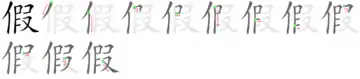 | |||
| Japanese | 仮 |
|---|---|
| Simplified | 假 |
| Traditional | 假 |
Han character
假 (Kangxi radical 9, 人+9, 11 strokes, cangjie input 人口卜水 (ORYE), four-corner 27247, composition ⿰亻叚)
Derived characters
- 𠽙, 𪝪, 𫖄, 𦹜, 𣘟
References
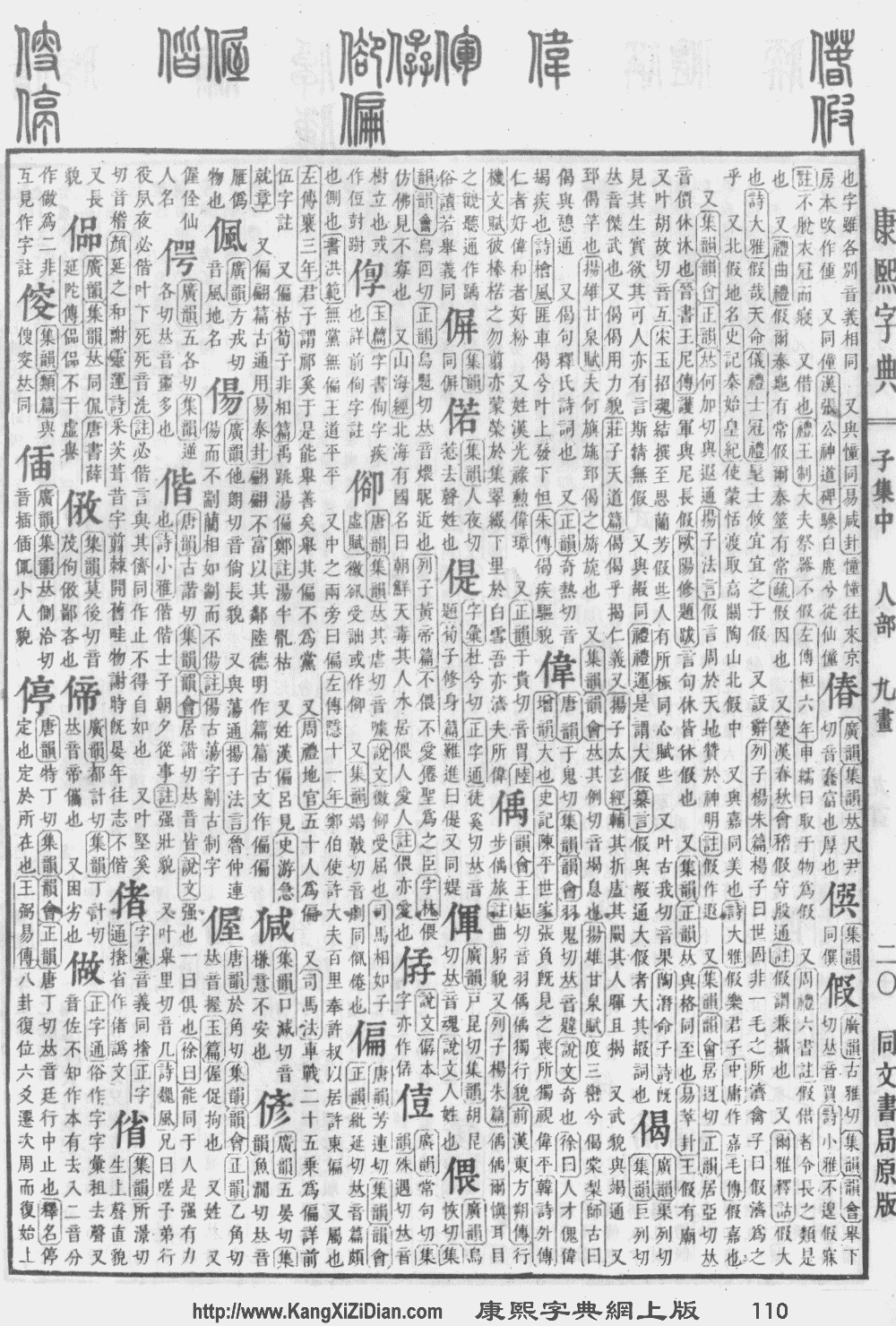
- Kangxi Dictionary: page 110, character 3
- Dai Kanwa Jiten: character 835
- Dae Jaweon: page 233, character 16
- Hanyu Da Zidian (first edition): volume 1, page 196, character 2
- Unihan data for U+5047
Chinese
| simp. and trad. |
假 | |
|---|---|---|
| 2nd round simp. | 𬽥 | |
| alternative forms | 叚 暇 “to borrow” | |
Glyph origin
| Historical forms of the character 假 | |||||||||||||||||||||||
|---|---|---|---|---|---|---|---|---|---|---|---|---|---|---|---|---|---|---|---|---|---|---|---|
| Shuowen Jiezi (compiled in Han) | Liushutong (compiled in Ming) | ||||||||||||||||||||||
| Small seal script | Transcribed ancient scripts | ||||||||||||||||||||||
 |
 | ||||||||||||||||||||||
|
|
References: Mostly from Richard Sears' Chinese Etymology site (authorisation),
| |||||||||||||||||||||||


Characters in the same phonetic series (叚) (Zhengzhang, 2003)
Phono-semantic compound (形聲/形声, OC *kraːʔ, *kraːs) : semantic 人 + phonetic 叚 (OC *kraːʔ).
Etymology
Pronunciation 1
Definitions
假
- to lend; to borrow; to loan
- (archaic, historical, politics) acting
- to make use of
- to disguise; to fake; to pretend
- forged; artificial; false
- falsehood; deception
- 真假 ― zhēnjiǎ ― real and fake; authenticity
- 假作真時真亦假,無為有處有還無。 [Written Vernacular Chinese, trad.]
- From: Cao Xueqin, Dream of the Red Chamber, mid-18th century CE
- Jiǎ zuò zhēn shí zhēn yì jiǎ, wú wéi yǒu chù yǒu huán wú. [Pinyin]
- When falsehood stands for truth, truth likewise becomes false[hood]; where naught be made to aught, aught changes into naught.
假作真时真亦假,无为有处有还无。 [Written Vernacular Chinese, simp.]
- if; assuming
- a surname
Compounds
- 不假
- 不假思索 (bùjiǎ-sīsuǒ)
- 不假辭色/不假辞色
- 久假不歸/久假不归 (jiǔjiǎbùguī)
- 以假為真/以假为真
- 作假 (zuòjiǎ)
- 便假若
- 假仁假義/假仁假义 (jiǎrénjiǎyì)
- 假仙
- 假以辭色/假以辞色
- 假以顏色/假以颜色
- 假似
- 假使 (jiǎshǐ)
- 假借 (jiǎjiè)
- 假借義/假借义
- 假充
- 假公濟私/假公济私 (jiǎgōngjìsī)
- 假冒 (jiǎmào)
- 假分數/假分数 (jiǎfēnshù)
- 假力
- 假力於人/假力于人
- 假名 (jiǎmíng)
- 假唱 (jiǎchàng)
- 假嗓子
- 假執行/假执行
- 假女
- 假如 (jiǎrú)
- 假子
- 假定 (jiǎdìng)
- 假寐 (jiǎmèi)
- 假寓
- 假寵/假宠
- 假對/假对
- 假局子
- 假山 (jiǎshān)
- 假平等
- 假座
- 假廝兒/假厮儿
- 假性 (jiǎxìng)
- 假性近視/假性近视
- 假息
- 假想 (jiǎxiǎng)
- 假意 (jiǎyì)
- 假意周旋
- 假惺惺 (jiǎxīngxīng)
- 假想敵/假想敌 (jiǎxiǎngdí)
- 假戲真做/假戏真做
- 假手
- 假手他人
- 假手於人/假手于人 (jiǎshǒuyúrén)
- 假托 (jiǎtuō)
- 假扣押 (jiǎ kòuyā)
- 假扮 (jiǎbàn)
- 假批子
- 假招子
- 假捏
- 假撇清
- 假果
- 假根
- 假榻
- 假正經/假正经 (jiǎzhèngjing)
- 假死 (jiǎsǐ)
- 假決議/假决议
- 假洋鬼子
- 假父
- 假牙 (jiǎyá)
- 假稱/假称 (jiǎchēng)
- 假節/假节
- 假聲/假声 (jiǎshēng)
- 假若 (jiǎruò)
- 假葉/假叶
- 假藉/假借
- 假處分/假处分
- 假裝/假装 (jiǎzhuāng)
- 假言命題/假言命题
- 假設/假设 (jiǎshè)
- 假話/假话 (jiǎhuà)
- 假象 (jiǎxiàng)
- 假貨/假货 (jiǎhuò)
- 假貸/假贷
- 假造 (jiǎzào)
- 假途滅虢/假途灭虢
- 假道 (jiǎdào)
- 假道學/假道学
- 假釋/假释 (jiǎshì)
- 假鈔/假钞 (jiǎchāo)
- 假面 (jiǎmiàn)
- 假面具 (jiǎmiànjù)
- 假面劇/假面剧 (jiǎmiànjù)
- 假食
- 假館/假馆
- 假饒/假饶
- 假髮/假发 (jiǎfà)
- 優假/优假
- 喬文假醋/乔文假醋
- 因公假私
- 天假之年
- 天假因緣/天假因缘
- 天假良緣/天假良缘
- 寬假/宽假
- 將假作真/将假作真
- 將假當真/将假当真
- 平假名 (píngjiǎmíng)
- 弄假成真 (nòngjiǎchéngzhēn)
- 弄虛作假/弄虚作假 (nòngxūzuòjiǎ)
- 強文假醋/强文假醋
- 打假球 (dǎjiǎqiú)
- 搬假戲/搬假戏
- 摻假/掺假 (chānjiǎ)
- 撇假
- 攙假/搀假 (chānjiǎ)
- 枵鬼假細膩/枵鬼假细腻 (iau-kúi ké sè-jī)
- 片假名 (piànjiǎmíng)
- 狐假虎威 (hújiǎhǔwēi)
- 狐假鴟張/狐假鸱张
- 理論假設/理论假设
- 當真假/当真假
- 真假 (zhēnjiǎ)
- 真真假假 (zhēnzhēnjiǎjiǎ)
- 糊假棺
- 虎威狐假
- 虛假/虚假 (xūjiǎ)
- 虛情假意/虚情假意
- 衿假
- 袂博假博 (bē-phok-ké-phok) (Min Nan)
- 裝假/装假 (zhuāngjiǎ)
- 言真道假
- 調假/调假
- 造假 (zàojiǎ)
- 通假 (tōngjiǎ)
- 酸文假醋
- 附會假借/附会假借
Descendants
- → Lingao: ke¹ (via Hainanese)
Pronunciation 2
Compounds
- 不假外出
- 乞假 (qǐjià)
- 予假 (yǔjià)
- 事假 (shìjià)
- 休假 (xiūjià)
- 例假 (lìjià)
- 例假日
- 假日 (jiàrì)
- 假日花市
- 假期 (jiàqī)
- 假樂/假乐
- 公假
- 准假 (zhǔnjià)
- 參假/参假 (cānjià)
- 告假 (gàojià)
- 告謊假/告谎假
- 國定假日/国定假日
- 寒假 (hánjià)
- 年假 (niánjià)
- 度假勝地/度假胜地
- 度假村 (dùjiàcūn)
- 彈性放假/弹性放假 (tánxìng fàngjià)
- 放假 (fàngjià)
- 放假日
- 春假 (chūnjià)
- 暑假 (shǔjià)
- 求假
- 渡假 (dùjià)
- 無薪假/无薪假 (wúxīnjià)
- 產假/产假 (chǎnjià)
- 病假 (bìngjià)
- 節假/节假
- 給假/给假
- 續假/续假 (xùjià)
- 羅馬假期/罗马假期
- 補假/补假 (bǔjià)
- 請假/请假 (qǐngjià)
- 賜假/赐假
- 連續假日/连续假日
- 銷假/销假 (xiāojià)
- 長假/长假 (chángjià)
Pronunciation 3
Compounds
References
- “假”, in 漢語多功能字庫 (Multi-function Chinese Character Database), 香港中文大學 (the Chinese University of Hong Kong), 2014–
Korean
Etymology 1
From Middle Chinese 假 (MC kaeX).
| Historical Readings | ||
|---|---|---|
| Dongguk Jeongun Reading | ||
| Dongguk Jeongun, 1448 | 강 (Yale: {{{2}}}) | |
| Middle Korean | ||
| Text | Eumhun | |
| Gloss (hun) | Reading | |
| Gwangju Cheonjamun, 1575 | 빌 (Yale: {{{2}}}) | 가 (Yale: {{{2}}}) |
| Sinjeung Yuhap, 1576 | 빌 (Yale: {{{2}}}) | 가 (Yale: {{{2}}}) |
| Seokbong Cheonjamun, 1583 | 빌 (Yale: {{{2}}}) | 가 (Yale: {{{2}}}) |
Pronunciation
- (SK Standard/Seoul) IPA(key): [ka̠(ː)]
- Phonetic hangul: [가(ː)]
- Though still prescribed in Standard Korean, most speakers in both Koreas no longer distinguish vowel length.
Compounds
Compounds
- 가가 (假家, gaga)
- 가골 (假骨, gagol)
- 가과 (假果, gagwa)
- 가관 (假官, gagwan)
- 가교 (假橋, gagyo)
- 가구 (假構, gagu)
- 가대 (假貸, gadae)
- 가도 (假道, gado)
- 가량 (假量, garyang)
- 가령 (假令, garyeong)
- 가면 (假面, gamyeon)
- 가명 (假名, gamyeong)
- 가발 (假髮, gabal)
- 가분 (假扮, gabun)
- 가불 (假拂, gabul)
- 가상 (假象, gasang)
- 가상 (假想, gasang)
- 가상 (假像, gasang)
- 가설 (假設, gaseol)
- 가설 (假說, gaseol)
- 가성 (假性, gaseong)
- 가수 (假數, gasu)
- 가식 (假飾, gasik)
- 가장 (假裝, gajang)
- 가정 (假定, gajeong)
- 가족 (假足, gajok)
- 가차 (假借, gacha)
- 가칭 (假稱, gaching)
- 가함 (假銜, gaham)
- 진가 (眞假, jin'ga)
- 가건물 (假建物, gageonmul)
- 가결의 (假決議, gagyeorui)
- 가계정 (假計定, gagyejeong)
- 가면극 (假面劇, gamyeon'geuk)
- 가상적 (假想敵, gasangjeok)
- 가석방 (假釋放, gaseokbang)
- 가수요 (假需要, gasuyo)
- 가압류 (假押留, gaamnyu)
- 가정법 (假定法, gajeongbeop)
- 가정적 (假定的, gajeongjeok)
- 가종피 (假種皮, gajongpi)
- 가처분 (假處分, gacheobun)
- 가감역관 (假監役官, gagamyeokgwan)
- 가도멸괵 (假道滅㶁, gadomyeolgoek)
- 가롱성진 (假弄成眞, garongseongjin)
- 가언판단 (假言判斷, ga'eonpandan)
- 가호위호 (假虎威狐, gahowiho)
- 농가성진 (弄假成眞, nonggaseongjin)
- 호가호위 (狐假虎威, hogahowi)
Etymology 2
From Middle Chinese 假 / 遐 (MC hae).
Pronunciation
- (SK Standard/Seoul) IPA(key): [ha̠]
- Phonetic hangul: [하]
Etymology 3
From Middle Chinese 假 / 格 (MC kak|kaek).
Pronunciation
- (SK Standard/Seoul) IPA(key): [kjʌ̹k̚]
- Phonetic hangul: [격]
Vietnamese
Compounds
References
- Thiều Chửu (1942).
- Nguyễn (1974).
- Trần (1999).
- Trần (2004).
This article is issued from Wiktionary. The text is licensed under Creative Commons - Attribution - Sharealike. Additional terms may apply for the media files.