閑
| ||||||||
Translingual
| Traditional | 閒 |
|---|---|
| Simplified | 闲 |
| Japanese | 閑 |
| Korean | 閑 |
Han character
閑 (Kangxi radical 169, 門+4, 12 strokes, cangjie input 日弓木 (AND), four-corner 77904, composition ⿵門木)
Descendants
References
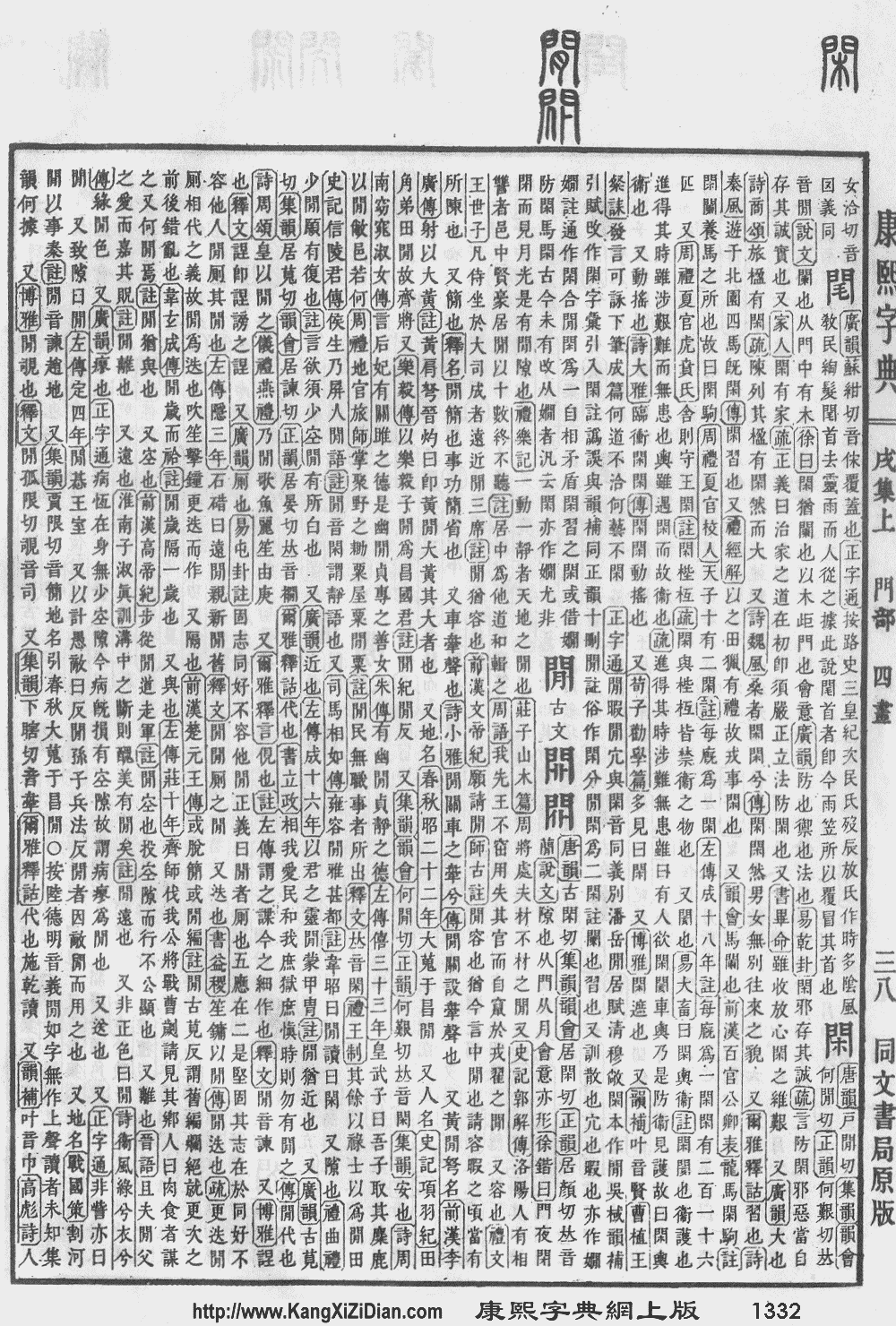
- Kangxi Dictionary: page 1332, character 2
- Dai Kanwa Jiten: character 41247
- Dae Jaweon: page 1837, character 14
- Hanyu Da Zidian (first edition): volume 7, page 4287, character 3
- Unihan data for U+9591
Chinese
Glyph origin
| Historical forms of the character 閑 | |
|---|---|
| Western Zhou | Shuowen Jiezi (compiled in Han) |
| Bronze inscriptions | Small seal script |
 |
 |
Characters in the same phonetic series (閑) (Zhengzhang, 2003)
Ideogrammic compound (會意/会意) : 門 (“door”) + 木 (“wood”) – a fence.
Etymology 1
| For pronunciation and definitions of 閑 – see 閒 (“not busy; idle; vacant; unoccupied; unused; etc.”). (This character is a variant traditional form of 閒). |
Etymology 2
| trad. | 閑 | |
|---|---|---|
| simp. | 闲* | |
Related to 闌 (OC *ɡ·raːn, “railing; balustrade”), 欄 (OC *ɡ·raːn, “fence; railing”) and 攔 (OC *ɡ·raːn, “to obstruct”), and perhaps related to 練 (OC *ɡ·reːns, “to train”) (Schuessler, 2007). External comparanda may include Burmese ရန်း (ran:, “to erect railings, barriers”) or Mizo khâr (“to shut; to close; to shut off”) (ibid.).
Pronunciation
Definitions
閑
Compounds
- 不閑/不闲
- 心閑/心闲
- 明媚閑雅/明媚闲雅
- 熟閑/熟闲
- 舉止閑冶/举止闲冶
- 蕩檢踰閑/荡检逾闲
- 踰閑/逾闲
- 踰閑蕩檢/逾闲荡检
- 閑邪存誠/闲邪存诚
- 閑雅/闲雅
- 防閑/防闲
Etymology 3
Probably cognate with 介 (OC *kreːds, “to increase; to become great”) and perhaps derived from 嘏 (OC *kraːʔ, “large; great”) (Schuessler, 2007).
Pronunciation
Definitions
閑
- † large; great
- 松桷有梴,旅楹有閑,寢成孔安。 [Pre-Classical Chinese, trad.]
- From: The Classic of Poetry, c. 11th – 7th centuries BCE, translated based on James Legge's version
- Sōngjué yǒu chān, lǚyíng yǒu xián, qǐn chéng kǒng ān. [Pinyin]
- Long are the projecting beams of pine;
Large are the many pillars.
The temple was completed, – the tranquil abode [of his tablet].
松桷有梴,旅楹有闲,寝成孔安。 [Pre-Classical Chinese, simp.]
Japanese
Readings
Etymology 2
| Kanji in this term |
|---|
| 閑 |
| ひま Grade: S |
| kun’yomi |
| For pronunciation and definitions of 閑 – see the following entry. | ||
| ||
| (This term, 閑, is an alternative spelling of the above term.) |
Pronunciation
- IPA(key): [no̞do̞]
Inflection
Inflection of 閑
| Stem forms | |||
|---|---|---|---|
| Imperfective (未然形) | 閑だろ | のどだろ | nodo daro |
| Continuative (連用形) | 閑で | のどで | nodo de |
| Terminal (終止形) | 閑だ | のどだ | nodo da |
| Attributive (連体形) | 閑な | のどな | nodo na |
| Hypothetical (仮定形) | 閑なら | のどなら | nodo nara |
| Imperative (命令形) | 閑であれ | のどであれ | nodo de are |
| Key constructions | |||
| Informal negative | 閑ではない 閑じゃない |
のどではない のどじゃない |
nodo de wa nai nodo ja nai |
| Informal past | 閑だった | のどだった | nodo datta |
| Informal negative past | 閑ではなかった 閑じゃなかった |
のどではなかった のどじゃなかった |
nodo de wa nakatta nodo ja nakatta |
| Formal | 閑です | のどです | nodo desu |
| Formal negative | 閑ではありません 閑じゃありません |
のどではありません のどじゃありません |
nodo de wa arimasen nodo ja arimasen |
| Formal past | 閑でした | のどでした | nodo deshita |
| Formal negative past | 閑ではありませんでした 閑じゃありませんでした |
のどではありませんでした のどじゃありませんでした |
nodo de wa arimasen deshita nodo ja arimasen deshita |
| Conjunctive | 閑で | のどで | nodo de |
| Conditional | 閑なら(ば) | のどなら(ば) | nodo nara (ba) |
| Provisional | 閑だったら | のどだったら | nodo dattara |
| Volitional | 閑だろう | のどだろう | nodo darō |
| Adverbial | 閑に | のどに | nodo ni |
| Degree | 閑さ | のどさ | nodosa |
References
- Matsumura, Akira, editor (2006), 大辞林 [Daijirin] (in Japanese), Third edition, Tōkyō: Sanseidō, →ISBN
Korean
Vietnamese
This article is issued from Wiktionary. The text is licensed under Creative Commons - Attribution - Sharealike. Additional terms may apply for the media files.