煤
| ||||||||
Translingual
Han character
煤 (Kangxi radical 86, 火+9, 13 strokes, cangjie input 火廿一木 (FTMD), four-corner 94894, composition ⿰火某)
References
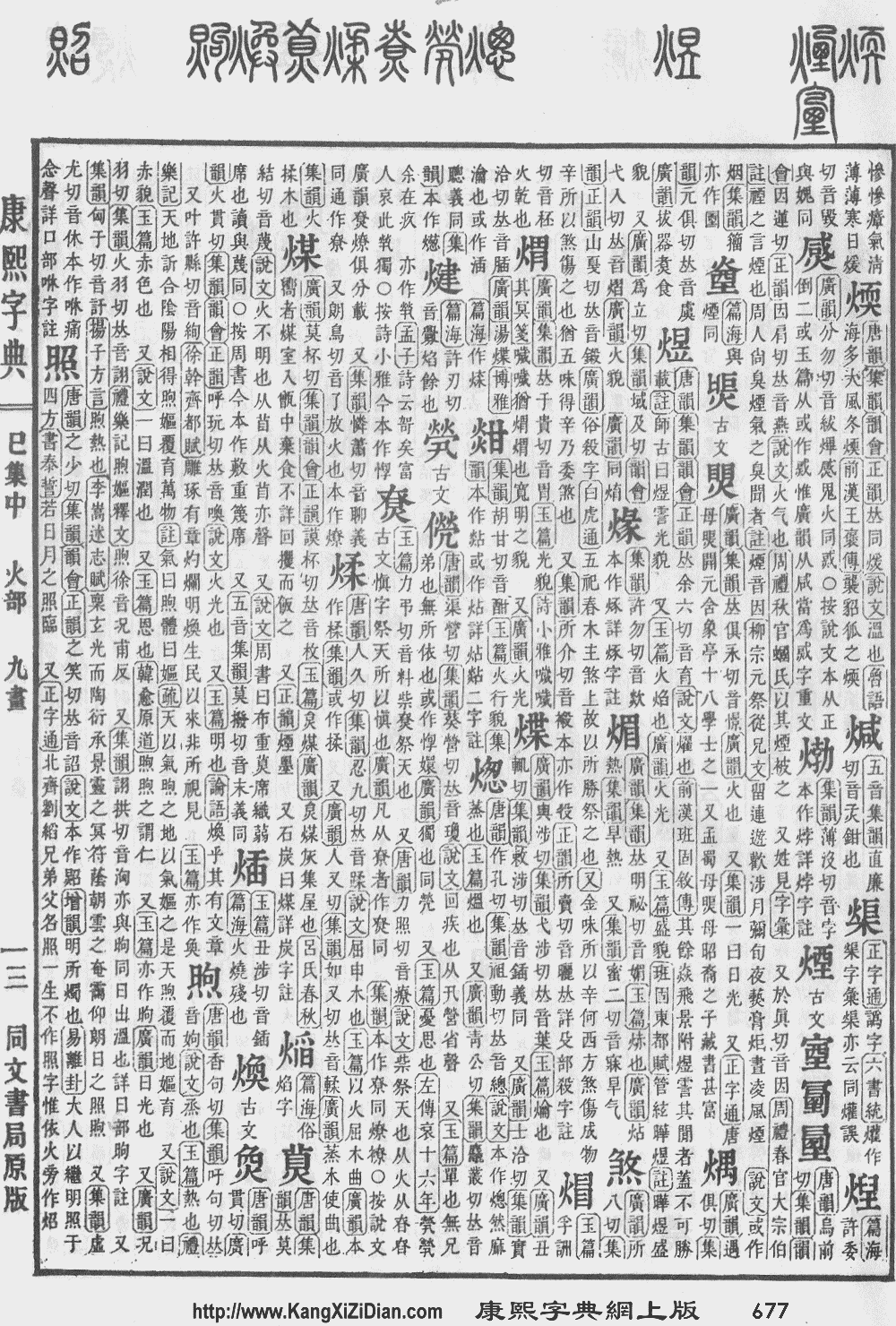
- Kangxi Dictionary: page 677, character 29
- Dai Kanwa Jiten: character 19220
- Dae Jaweon: page 1088, character 13
- Hanyu Da Zidian (first edition): volume 3, page 2214, character 2
- Unihan data for U+7164
Chinese
| trad. | 煤 | |
|---|---|---|
| simp. # | 煤 | |
| 2nd round simp. | 𭳿 | |
Glyph origin
Characters in the same phonetic series (某) (Zhengzhang, 2003)
Phono-semantic compound (形聲/形声, OC *mɯː) : semantic 火 (“fire”) + phonetic 某 (OC *mɯʔ).
Etymology
Sino-Tibetan. Schuessler (2007) proposes two possibilities:
- Cognate with Proto-Lolo-Burmese *ʔ-mu² (“soot; acrid (smoke)”). If related, a merger of Minimal Old Chinese *ə with *o must have occurred.
- Cognate with Mizo mang (maŋᴿ), man (manᴸ, “sooty”), Mizo mang (maŋᴴ, “partially burnt wood”).
文 (OC *mɯn) may be a derivation with -n nominal suffix. 黑 (OC *hmlɯːɡ, “black”) may be an allofam. Unrelated to 晦 (OC *hmɯːs, “dark”) according to Schuessler (2007).
Pronunciation
Definitions
煤
- coal (Classifier: 塊/块 m c; 嚿 c)
- † dust of smoke; soot
- 向者煤室入甑中,棄食不祥,回攫而飯之。 [Classical Chinese, trad.]
- From: Lü Buwei, Master Lü's Spring and Autumn Annals, 239 BCE
- Xiàngzhě méi shì rù zèng zhōng, qì shí bùxiáng, Huí jué ér fàn zhī. [Pinyin]
- Just now some dust and soot fell into the steamer. Ill fortune befalls those who throw away food; so I grabbed those grains and ate them.
向者煤室入甑中,弃食不祥,回攫而饭之。 [Classical Chinese, simp.]
- † ink
Synonyms
Dialectal synonyms of 煤 (“coal”) [map]
Compounds
- 乏煤
- 二煤
- 倒煤
- 原煤 (yuánméi)
- 天然煤氣/天然煤气 (tiānrán méiqì)
- 搖煤/摇煤
- 木煤氣/木煤气
- 松煤
- 氣煤/气煤
- 水煤氣/水煤气 (shuǐméiqì)
- 泥煤 (níméi)
- 洗煤
- 淨化燃煤/净化燃煤
- 火煤子
- 火紙煤兒/火纸煤儿
- 焦煤 (jiāoméi)
- 無煙焦煤/无烟焦煤
- 無煙煤/无烟煤 (wúyānméi)
- 煤井
- 煤化
- 煤坑
- 煤塵/煤尘
- 煤層/煤层 (méicéng)
- 煤山
- 煤搭
- 煤末
- 煤核
- 煤毒
- 煤氣/煤气 (méiqì)
- 煤氣燈/煤气灯
- 煤氣爐/煤气炉 (méiqìlú)
- 煤氣表/煤气表
- 煤水車/煤水车
- 煤油 (méiyóu)
- 煤油燈/煤油灯
- 煤渣 (méizhā)
- 煤炭 (méitàn)
- 煤焦油 (méijiāoyóu)
- 煤煙/煤烟
- 煙煤/烟煤 (yānméi)
- 煤球
- 煤田 (méitián)
- 煤砟子
- 煤磚/煤砖 (méizhuān)
- 煤礦/煤矿 (méikuàng)
- 煤精 (méijīng)
- 煤都
- 煤黑子
- 煤黑油
- 燈煤/灯煤
- 燭煤/烛煤
- 生煤
- 瘦煤
- 白煤 (báiméi)
- 省煤器
- 硬煤
- 紅煤/红煤
- 紙煤子/纸煤子
- 紙煤管子/纸煤管子
- 肥煤
- 蛛煤
- 褐煤 (hèméi)
- 麝煤
- 黑煤
Descendants
- → Guiqiong: mɛi (“coal”)
References
- “煤”, in 漢語多功能字庫 (Multi-function Chinese Character Database), 香港中文大學 (the Chinese University of Hong Kong), 2014–
Japanese
Etymology 1
| Kanji in this term |
|---|
| 煤 |
| すす Jinmeiyō |
| kun’yomi |
From Old Japanese, first attested in the Kojiki (712 CE).
Pronunciation
Noun
煤 • (susu)
Derived terms
Derived terms
- 煤ける (susukeru)
- 煤ぶ (susubu)
- 煤ばむ (susubamu)
- 煤びる (susubiru)
- 煤ぶる (susuburu)
- 煤ぼる (susuboru)
- 煤ぼける (susubokeru)
- 煤市 (Susuichi)
- 煤色 (susuiro)
- 煤男 (susuotoko)
- 煤賀 (Susuga)
- 煤ヶ谷 (Susugaya)
- 煤川 (Susugawa)
- 煤籠もり (susugomori)
- 煤田 (Susuta)
- 煤田 (Susuda)
- 煤竹 (susudake)
- 煤取り (susutori)
- 煤掃き (susuhaki)
- 煤払い (susuharai)
- 煤病 (susubyō)
- 煤埃 (susubokori)
- 煤孫 (Susumago)
- 煤本 (Susumoto)
- 煤谷 (Susuya)
- 煤湯 (susuyu)
- 煮煤 (nisusu)
Etymology 2
| Kanji in this term |
|---|
| 煤 |
| ばい Jinmeiyō |
| kan’on |
From Middle Chinese 煤 (MC mwoj). Compare modern Min Nan reading bôe.
References
- Matsumura, Akira, editor (2006), 大辞林 [Daijirin] (in Japanese), Third edition, Tōkyō: Sanseidō, →ISBN
- NHK Broadcasting Culture Research Institute, editor (1998), NHK日本語発音アクセント辞典 [NHK Japanese Pronunciation Accent Dictionary] (in Japanese), Tōkyō: NHK Publishing, →ISBN
Okinawan
Old Japanese
Etymology
(This etymology is missing or incomplete. Please add to it, or discuss it at the Etymology scriptorium.)
Noun
煤 (susu) (kana すす)
Descendants
- Japanese: 煤 (susu)
References
- Donald L. Philippi (2015) Kojiki (Princeton Legacy Library), Princeton University Press, →ISBN, page 136
Vietnamese
Yonaguni
Pronunciation
- IPA(key): [t͡ɕit͡ɕi]
This article is issued from Wiktionary. The text is licensed under Creative Commons - Attribution - Sharealike. Additional terms may apply for the media files.