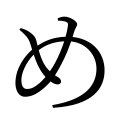
め
 | ||||||||
Japanese
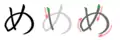
| Stroke order | |||
|---|---|---|---|
 | |||
Pronunciation
- IPA(key): [me̞]
Etymology 1
Derived in the Heian period from writing the man'yōgana kanji 女 in the cursive sōsho style.
Syllable
め • (me)
See also
Etymology 2
| Alternative spellings |
|---|
| 目 眼 |
⟨me2⟩ → */məɨ/ → /me/
From Old Japanese,[1] from Proto-Japonic *may. Cognate with 目 (ma, bound form). Now the modern Japanese term for eye.
Probably cognate with 見る (miru, “to see, to look”).[1]
May also be cognate with 芽 (me, “bud, shoot”),[1] perhaps from the “visually prominent feature” sense, and with suppositional / volitional verb suffix む (mu) (presenting in modern Japanese verb conjugations as the -ō or -yō endings), perhaps from the “seem like, look like” sense.
Alternative forms
- (non-productive, bound form)
- (prefixal) ま (ma)
Noun
- [from 712] 目, 眼: eye
- [from 720] 目: visually prominent feature of something:
- [from 720] 目: small hole, like those inherent to a net-like material (between the warp and the weft)
- [from 759] 目: short for 賽の目 (sai no me, “dice pip”).
- 2015 January 10, “悪魔のサイコロ [Demon’s Die]”, in 決闘者の栄光 -記憶の断片- side:武藤遊戯 [Duelist Road -Piece of Memory- side: Mutō Yūgi], Konami:
- ①:サイコロを1回振る。相手フィールドのモンスターの攻撃力・守備力は、ターン終了時まで出た目の数×100ダウンする。
- Ichi: Saikoro o ikkai furu. Aite fīrudo no monsutā no kōgekiryoku shubiryoku wa, tān shūryōji made deta me no kazu kakeru hyaku daun suru.
- 1: Roll a die once. Until the end of this turn, the attack and defense strength of the monsters on your opponent’s field decreases by the result ×100.
- ①:サイコロを1回振る。相手フィールドのモンスターの攻撃力・守備力は、ターン終了時まで出た目の数×100ダウンする。
- 2015 September 19, “サイコロン [Dicyclone]”, in STRUCTURE DECK R -真帝王降臨- [STRUCTURE DECK R -Advent of the True Sovereign-], Konami:
- ①:サイコロを1回振り、出た目の効果を適用する。
- Ichi: Saikoro o ikkai furi, deta me no kōka o tekiyō suru.
- 1: Roll a die once, then apply an effect accordingly to the result.
- ①:サイコロを1回振り、出た目の効果を適用する。
- [from late 900s] 目: (by extension) experience
Derived terms
- 目垢 (meaka, “eye gunk”)
- 眼医者 (meisha, “an eye doctor”)
- 眼鏡 (megane, “glasses”)
- 目糞 (mekuso), 目屎 (mekuso, “eye gunk”)
- 盲 (mekura, “blindness”)
- 目尻 (mejiri, “the corner of an eye”)
- 目玉 (medama, “eyeball”)
- 目付き (metsuki, “look#Noun, expression of the eyes”)
- 目脂 (meyani, “eye gunk”)
- 赤目 (akame, “red eyes”)
- 片目 (katame, “one eye”)
- 生真面目 (kimajime, “person who is too serious”)
- 黒目 (kurome, “black iris, an eye with large pupils or irises”)
- 血眼 (chime, “bloodshot eyes”)
- 近眼 (chikame, “nearsightedness”)
- 茶目 (chame, “playfulness”)
- 猫目石 (nekomeishi, “cat's eye (jewel)”)
- パンダ目 (pandame, “black eye”)
- 一目 (hitome)
- 雪目 (yukime, “snow blindness”)
- 横目 (yokome, “sidelong glance”)
Suffix
- [from early 1400s] 目: -st, -nd, -rd, or -th, for ordinal numbers (e.g. 8th or eighth, 9th or ninth)
- 三本目のボトル
- sanbon-me no botoru
- third bottle
- 三本目のボトル
- [from late 1800s] 目: visually prominent feature of something
- め: (attached to verb or i-adjective roots to produce na-adjectives, not productive with verbs) to a more exaggerated degree
Etymology 3
| Alternative spelling |
|---|
| 芽 |
From Old Japanese. First attested in the Kojiki of 712 CE.[1]
Possibly cognate with 目・眼 (me),[1] perhaps from the “visually prominent feature” sense of that term.
Noun
Etymology 4
| Alternative spelling |
|---|
| 奴 (uncommon) |
First cited to The Tale of the Heike from the early 1300s.[1]
Might be a shift in usage of 目 (me, “visually prominent feature”). The 奴 spelling does not appear to be common, and this is not included in all dictionaries.[1][4]
Pronunciation
- IPA(key): [me̞]
- (pitch accent depends on the entire suffixed word)
Suffix
め • (-me)
- [from early 1300s] 奴: derogatory suffix attached to people's names or words that refer to people, animals, etc.
- ばか奴!
- Baka-me!
- Idiot!
- ばか奴!
References
- Shōgaku Tosho (1988) 国語大辞典(新装版) [Unabridged Dictionary of Japanese (Revised Edition)] (in Japanese), Tōkyō: Shogakukan, →ISBN
- Matsumura, Akira, editor (2006), 大辞林 [Daijirin] (in Japanese), Third edition, Tōkyō: Sanseidō, →ISBN
- NHK Broadcasting Culture Research Institute, editor (1998), NHK日本語発音アクセント辞典 [NHK Japanese Pronunciation Accent Dictionary] (in Japanese), Tōkyō: NHK Publishing, →ISBN
- Kindaichi, Kyōsuke et al., editors (1997), 新明解国語辞典 [Shin Meikai Kokugo Jiten] (in Japanese), Fifth edition, Tōkyō: Sanseidō, →ISBN