突
| ||||||||
 | ||||||||
Translingual
| Stroke order | |||
|---|---|---|---|
 | |||
| Japanese | 突 |
|---|---|
| Simplified | 突 |
| Traditional | 突 |
Han character
突 (Kangxi radical 116, 穴+4 in Chinese, 穴+3 in Japanese, 9 strokes in Chinese, 8 strokes in Japanese, cangjie input 十金戈大 (JCIK), four-corner 30430, composition ⿱穴犬(GHTKV) or ⿱穴大(J))
References
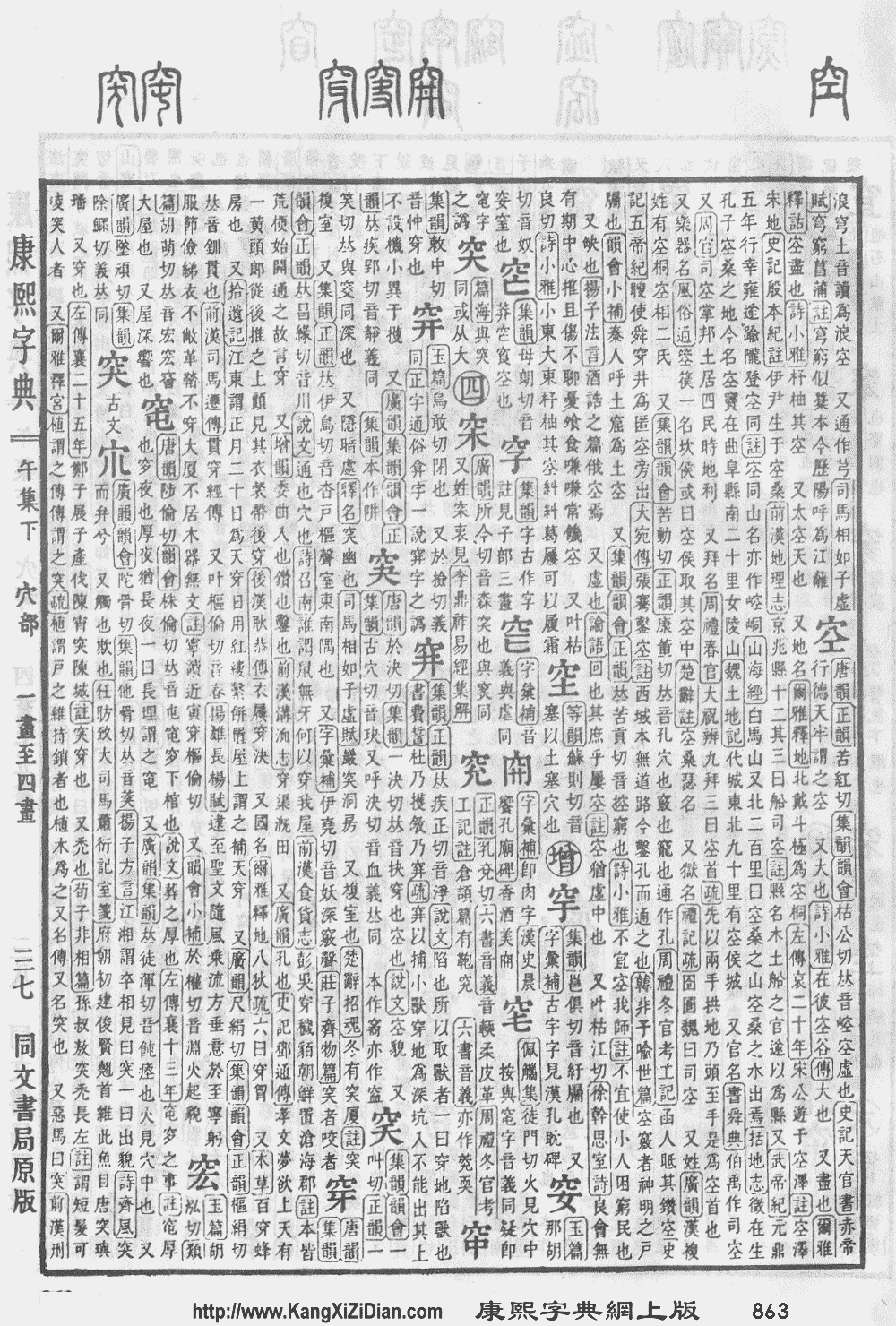
- Kangxi Dictionary: page 863, character 21
- Dai Kanwa Jiten: character 25424
- Dae Jaweon: page 1291, character 8
- Hanyu Da Zidian (first edition): volume 4, page 2722, character 4
- Unihan data for U+7A81
- Unihan data for U+FA55
Chinese
| trad. | 突 | |
|---|---|---|
| simp. # | 突 | |
| alternative forms | ||
Glyph origin
| Historical forms of the character 突 | ||
|---|---|---|
| Shang | Shuowen Jiezi (compiled in Han) | Liushutong (compiled in Ming) |
| Oracle bone script | Small seal script | Transcribed ancient scripts |
 |
 |
 |
Characters in the same phonetic series (突) (Zhengzhang, 2003)
Ideogrammic compound (會意/会意) : 穴 (“cave; den”) + 犬 (“dog”) – a dog suddenly coming out of a den.
Etymology
(This etymology is missing or incomplete. Please add to it, or discuss it at the Etymology scriptorium.)
Pronunciation 1
Definitions
突
- to dash forward; to break through; to charge
- suddenly; abruptly; unexpectedly
- to go against; to offend
- to stick out; to protrude
- (historical) flue; chimney
- (onomatopoeia) pit-a-pat (tapping sounds)
- to chug; to gulp liquid
- (Cantonese) to be in excess; to have extra
- (Cantonese) with excess
- (obsolete) to penetrate; to pierce
Compounds
- 價值衝突/价值冲突
- 冒煙突火/冒烟突火 (mào yān tūhuǒ)
- 冒突
- 冒鋒突圍/冒锋突围
- 努牙突嘴
- 努睛突眼
- 唐突 (tángtū)
- 唐突西施
- 囊囊突突
- 基因突變/基因突变 (jīyīn tūbiàn)
- 大突破
- 奔突 (bēntū)
- 左衝右突/左冲右突 (zuǒchōngyòutū)
- 怛突
- 怒突
- 惑突
- 把突兒/把突儿
- 拔突
- 排突
- 搪突
- 曲突徙薪 (qūtūxǐxīn)
- 枉突徙薪
- 東衝西突/东冲西突
- 滑稽突梯
- 灶突
- 煙突/烟突
- 狄良突盧/狄良突卢
- 狼奔豕突
- 猾猾突突
- 異軍突起/异军突起 (yìjūntūqǐ)
- 碭突/砀突
- 突兀 (tūwù)
- 突出 (tūchū)
- 突厥 (tūjué)
- 突厥文
- 突厥語族/突厥语族 (tūjué yǔzú)
- 突圍/突围 (tūwéi)
- 突地
- 突如其來/突如其来 (tūrúqílái)
- 突尼斯 (tūnísī)
- 突尼西亞/突尼西亚
- 突怒
- 突擊/突击 (tūjī)
- 突擊檢查/突击检查
- 突梯
- 突梯滑稽
- 突火 (tūhuǒ)
- 突然 (tūrán)
- 突然襲擊/突然袭击 (tūránxíjī)
- 突發/突发 (tūfā)
- 突發奇想/突发奇想 (tūfāqíxiǎng)
- 突眼
- 突破 (tūpò)
- 突破口 (tūpòkǒu)
- 突破瓶頸/突破瓶颈
- 突磨
- 突禿/突秃
- 突突 (tūtū)
- 突突噥噥/突突哝哝
- 突突囔囔
- 突突摸摸
- 突突的
- 突襲/突袭 (tūxí)
- 突變/突变 (tūbiàn)
- 突起 (tūqǐ)
- 突進/突进 (tūjìn)
- 突顯/突显 (tūxiǎn)
- 突飛猛進/突飞猛进 (tūfēiměngjìn)
- 突騎/突骑
- 突高
- 立突
- 米突 (mǐtū)
- 米釐米突
- 糊突
- 糊突神
- 糊突突
- 胡突
- 衝突/冲突 (chōngtū)
- 角色衝突/角色冲突
- 觸突/触突
- 豕突
- 豕突狼奔
- 豨突
- 趵突泉
- 趵突泉詩/趵突泉诗
- 軸突/轴突 (zhóutū)
- 隳突 (huītū)
- 隳突叫號/隳突叫号
- 雄飛突進/雄飞突进
- 霸突
- 風雲突變/风云突变
- 馳突/驰突
- 鶻突/鹘突
- 墨突
- 黔突暖席
Pronunciation 2
References
- “突”, in 漢語多功能字庫 (Multi-function Chinese Character Database), 香港中文大學 (the Chinese University of Hong Kong), 2014–
Japanese
| Shinjitai | 突 | |
| Kyūjitai [1] |
突 突or 突+ ︀? |
|
| 突󠄁 突+ 󠄁?(Adobe-Japan1) | ||
| 突󠄃 突+ 󠄃?(Hanyo-Denshi) (Moji_Joho) | ||
| The displayed kanji may be different from the image due to your environment. See here for details. | ||
Readings
Compounds
Usage notes
A CJK compatibility ideograph (U+FA55) exists for the kyūjitai form of 突.
References
- “突”, in 漢字ぺディア (Kanjipedia) (in Japanese), 日本漢字能力検定協会, 2015–2024
Korean
Etymology
From Middle Chinese 突 (MC dwot|thwot).
Compounds
Compounds
- 격돌 (激突, gyeokdol, “collision; clash”)
- 돌격 (突擊, dolgyeok, “dash, assault”)
- 돌궐 (突厥, dolgwol, “Turk”)
- 돌기 (突起, dolgi, “protrusion; projection”)
- 돌발 (突發, dolbal, “outbreak; outburst”)
- 돌변 (突變, dolbyeon, “sudden change”)
- 돌연 (突然, doryeon, “suddenly”)
- 돌진 (突進, doljin, “dash; rush”)
- 돌출 (突出, dolchul, “protrusion”)
- 돌파 (突破, dolpa, “breakthrough”)
- 돌풍 (突風, dolpung, “gust”)
- 연돌 (煙突, yeondol, “flue; chimney”)
- 온돌 (溫突, ondol, “underfloor heating”)
- 충돌 (衝突, chungdol, “clash; collision”)
- 돌파구 (突破口, dolpagu, “breakthrough”)
Vietnamese
This article is issued from Wiktionary. The text is licensed under Creative Commons - Attribution - Sharealike. Additional terms may apply for the media files.