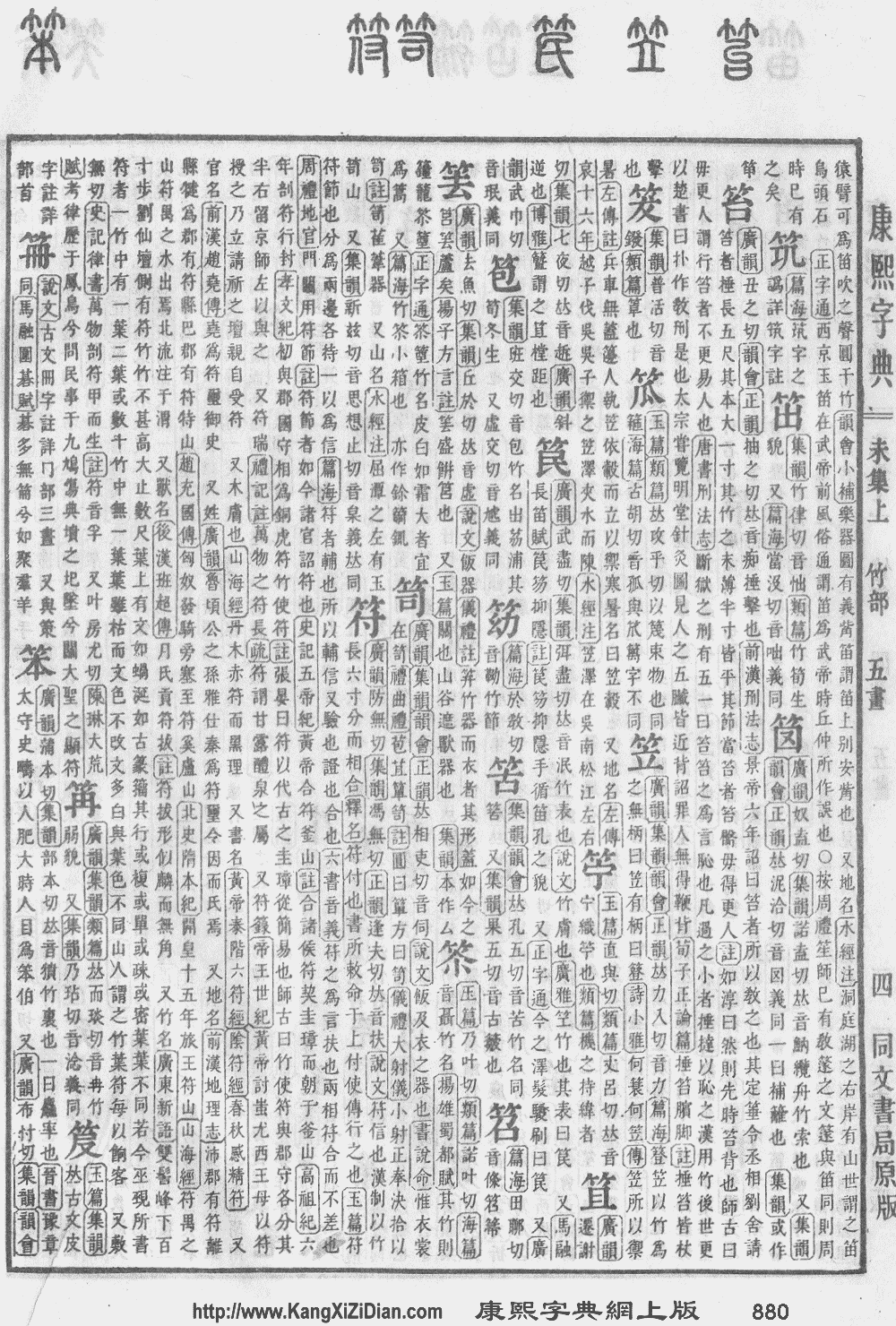
笥

笥 U+7B25, 笥
CJK UNIFIED IDEOGRAPH-7B25
← 笤
[U+7B24]
CJK Unified Ideographs 符 →
[U+7B26]

Translingual

Han character

笥 (Kangxi radical 118, 竹+5, 11 strokes, cangjie input 竹尸一口 (HSMR), four-corner 88627, composition ⿱𥫗司)

Derived characters

  • 𥯱

References

  • Kangxi Dictionary: page 880, character 17
  • Dai Kanwa Jiten: character 25934
  • Dae Jaweon: page 1308, character 12
  • Hanyu Da Zidian (first edition): volume 5, page 2959, character 6
  • Unihan data for U+7B25

Chinese

trad. 笥
simp. # 笥

Glyph origin

Pronunciation


Rime
Character 笥
Reading # 1/1
Initial (聲) 心 (16)
Final (韻) 之 (19)
Tone (調) Departing (H)
Openness (開合) Open
Division (等) III
Fanqie 相吏切
Baxter siH
Reconstructions
Zhengzhang
Shangfang
/sɨH/
Pan
Wuyun
/sɨH/
Shao
Rongfen
/sieH/
Edwin
Pulleyblank
/sɨH/
Li
Rong
/siəH/
Wang
Li
/sĭəH/
Bernard
Karlgren
/siH/
Expected
Mandarin
Reflex
sì
Expected
Cantonese
Reflex
si3
Zhengzhang system (2003)
Character 笥 笥
Reading # 1/2 2/2
No. 11954 11956
Phonetic
component
司 司
Rime
group
之 之
Rime
subdivision
0 0
Corresponding
MC rime
思 笥
Old
Chinese
/*slɯ/ /*slɯs/

Definitions

笥

  1. hamper, wicker basket

Japanese

Kanji

笥

(uncommon “Hyōgai” kanji)

  1. lunchbox
  2. clothes chest

Readings

  • Go-on: し (shi)
  • Kan-on: し (shi)
  • Tō-on: す (su)
  • Kun: け (ke, 笥); はこ (hako, 笥)

Compounds

Etymology

Kanji in this term
笥
け
Hyōgaiji
kun’yomi

⟨ke2⟩ → */kəɨ/ → /ke/

From Old Japanese.

Noun

笥(け) • (ke) 

  1. a container, especially for foodstuffs or tableware
    Synonym: 容器 (yōki)

Derived terms

Korean

Hanja

笥 • (sa) (hangeul 사, revised sa, McCune–Reischauer sa, Yale sa)

  1. This term needs a translation to English. Please help out and add a translation, then remove the text {{rfdef}}.
This article is issued from Wiktionary. The text is licensed under Creative Commons - Attribution - Sharealike. Additional terms may apply for the media files.