桶
| ||||||||
Translingual
Han character
桶 (Kangxi radical 75, 木+7, 11 strokes, cangjie input 木弓戈月 (DNIB), four-corner 47927, composition ⿰木甬)
Derived characters
- 𮅸
References
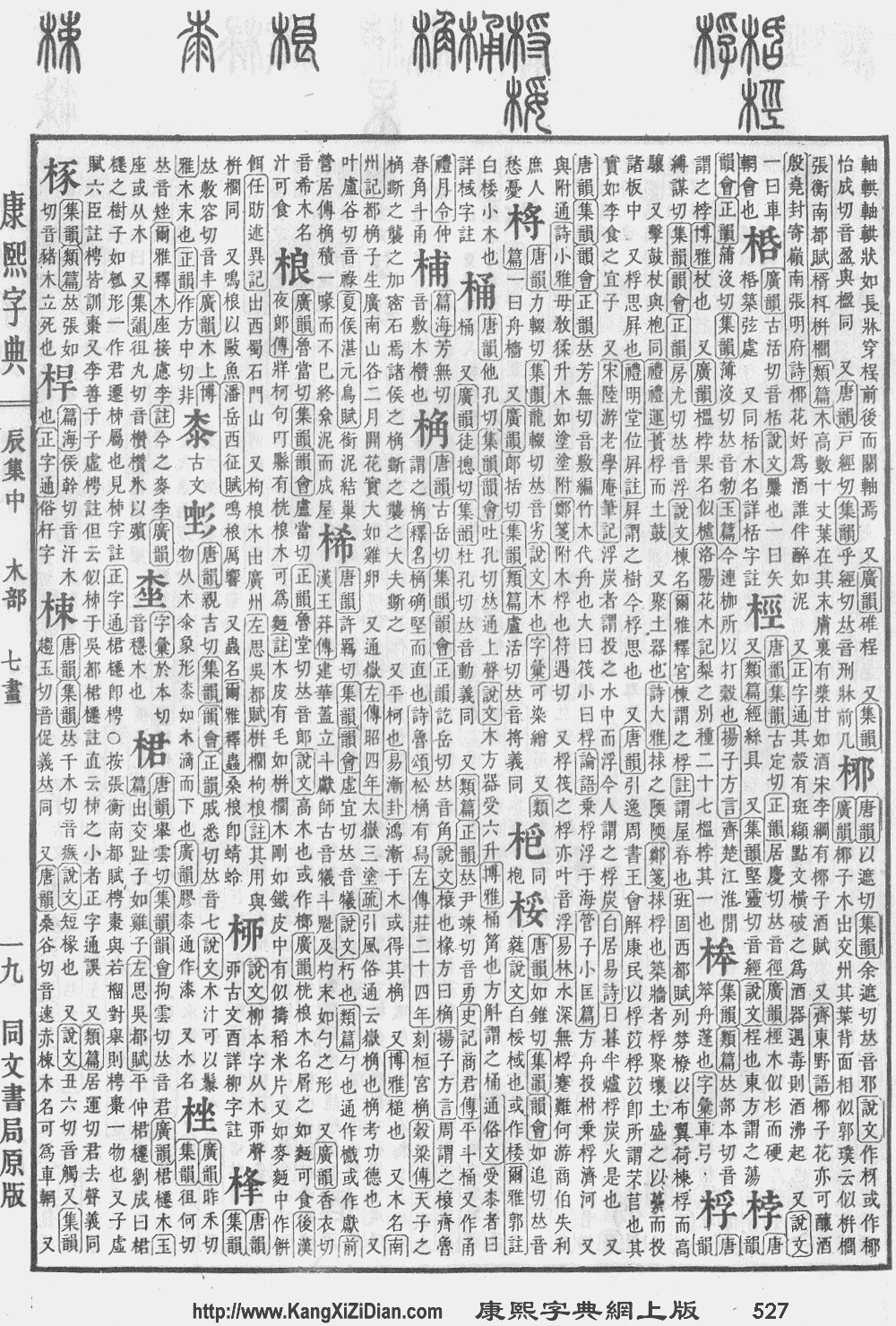
- Kangxi Dictionary: page 527, character 10
- Dai Kanwa Jiten: character 14811
- Dae Jaweon: page 916, character 4
- Hanyu Da Zidian (first edition): volume 2, page 1222, character 6
- Unihan data for U+6876
Chinese
| simp. and trad. |
桶 | |
|---|---|---|
Glyph origin
Characters in the same phonetic series (用) (Zhengzhang, 2003)
Phono-semantic compound (形聲/形声, OC *l̥ʰoːŋʔ, *l'oːŋʔ) : semantic 木 (“wood”) + phonetic 甬 (OC *loŋʔ).
Pronunciation
Definitions
桶
- pail; bucket; tub
- cask; keg
- barrel (unit)
- (Philippine Hokkien) million
- 一桶 [Philippine Hokkien] ― chi̍t-tháng [Pe̍h-ōe-jī] ― one million
Synonyms
See also
| Chinese numbers | |||||||||||||||||
|---|---|---|---|---|---|---|---|---|---|---|---|---|---|---|---|---|---|
| 0 | 1 | 2 | 3 | 4 | 5 | 6 | 7 | 8 | 9 | 10 | 102 | 103 | 104 | 106 | 108 | 1012 | |
| Normal (小寫/小写) |
〇, 零, 空 | 一, 蜀 | 二, 兩/两 | 三 | 四 | 五 | 六 | 七 | 八 | 九 | 十 | 百 | 千 | 萬/万, 十千 (Malaysia, Singapore) |
百萬/百万, 桶(Philippines), 面桶 (Philippines) |
億/亿 | 兆 (Taiwan) 萬億/万亿 (Mainland China) |
| Financial (大寫/大写) |
零 | 壹 | 貳/贰 | 參/叁 | 肆 | 伍 | 陸/陆 | 柒 | 捌 | 玖 | 拾 | 佰 | 仟 | ||||
Compounds
- 乏桶
- 便桶 (biàntǒng)
- 傳桶/传桶
- 冤桶
- 冰桶
- 可桶兒的/可桶儿的
- 吊桶 (diàotǒng)
- 噴桶/喷桶
- 圊桶
- 垃圾桶 (lājītǒng)
- 太平水桶
- 子孫桶/子孙桶
- 弔桶/吊桶
- 弔桶底/吊桶底
- 恭桶
- 扮桶
- 抽水馬桶/抽水马桶 (chōushuǐ mǎtǒng)
- 摸米桶
- 撲桶/扑桶
- 斗桶
- 料桶
- 桶勾子
- 桶匠
- 桶子 (tǒngzi)
- 桶子帽
- 桶子花
- 桶底脫/桶底脱
- 梢桶
- 桶盤/桶盘 (tǒngpán)
- 桶裙
- 榪桶/杩桶
- 水桶 (shuǐtǒng)
- 沒梁桶
- 油桶
- 泔水桶
- 浴桶
- 淨桶/净桶
- 漆桶底脫/漆桶底脱
- 火桶
- 無梁桶
- 痰桶 (tántǒng)
- 皮桶兒/皮桶儿
- 皮桶子
- 直桶桶
- 直籠桶/直笼桶
- 禾桶
- 窬桶
- 窯桶子/窑桶子
- 筆桶/笔桶
- 筲桶
- 箍桶
- 糊突桶
- 襪桶/袜桶
- 觸桶/触桶
- 酒桶 (jiǔtǒng)
- 酸桶
- 金漆飯桶/金漆饭桶
- 金漆馬桶/金漆马桶
- 鉛桶/铅桶
- 鐵桶/铁桶 (tiětǒng)
- 鐵桶江山/铁桶江山
- 面桶
- 靴桶
- 鞭桶
- 飯桶/饭桶 (fàntǒng)
- 餘桶/余桶
- 香桶兒/香桶儿
- 馬子桶/马子桶
- 馬桶/马桶 (mǎtǒng)
- 馬桶刷/马桶刷 (mǎtǒngshuā)
- 馬桶蓋/马桶盖 (mǎtǒnggài)
- 鹵桶/卤桶
- 麵糊桶/面糊桶
Japanese
Readings
Etymology 1
| Kanji in this term |
|---|
| 桶 |
| おけ Jinmeiyō |
| kun’yomi |
| Alternative spelling |
|---|
| 麻笥 (uncommon) |
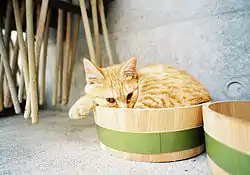
桶 (oke): A small oke holding a cat.

桶 (oke): A workman building a large oke.
From Old Japanese. First cited in the Man'yōshū of 759.[1]
Originally a compound of 麻 (o, “flax, ramie”) + 笥 (ke, “a container, especially for foodstuffs or tableware”).[2][3]
Noun
- [from 759] a tube-shaped container for holding split flax or hemp, usually made of thin cypress wood bent to shape
- [from early 800s] by extension, a pail, bucket, tub, or basin similar to a barrel in construction, made of long thin pieces of cedar or cypress extending up from a base and held in place with hoops; may be small enough to carry in one hand, or large enough to bathe in
- [from 1513] (Noh theater) a stool on stage, on which an actor sits
Idioms
Idioms
- 桶な物打ち明ける (おけなものうちあける, oke na mono uchiakeru), 桶の物打ち明ける (おけのものうちあける, oke no mono uchiakeru): "open up what's in your bucket" → to come clean to someone, with no hard feelings and no subterfuge
- 桶が腐れば菜が腐る (おけがくさればながくさる, oke ga kusareba na ga kusaru): "if the bucket rots, the greens rot" → if the surrounding is bad, it affects the inside
Derived terms
Derived terms
- 桶越し (okegoshi): using an oke to cross a river
- 桶屋 (okeya): a person or store that makes, fixes, and/or sells oke and well walls
- 桶火 (okebi): the fire in a hioke
- 火桶 (hioke): a type of wooden hibachi
- 桶狭間 (Okehazama): a place in the south of Midori-ku, Nagoya
- 桶狭間焼き (Okehazama-yaki): a style of pottery originating near Okehazama
- 桶結い (okeyui): tying cord bands around an oke; an oke maker, an okeya
- 桶絞り (okeshibori): a cloth dying process whereby the sections to leave undyed are put into oke and closed in with lids
- 桶酸い (okesui): alternate name for 酢の木, 酢木 (sunoki): Vaccinium smallii, var. glabrum, a bush with edible (though sour) berries
- 桶取り (oketori): a scene in a kyōgen farce presented between Noh plays; a woman working as a water carrier
- 桶尻 (okejiri): the aft edge of the hull of a ship in traditional Japanese shipbuilding
- 桶据え (okesue): the hipbone
- 桶川 (Okegawa): a river in southeast Saitama Prefecture
- 桶側 (okegawa): the sides of an oke, the staves; a bowl-shaped container for holding trawling lines on a fishing boat
- 桶側胴 (okegawa dō): a type of breastplate made of steel strips bound together, somewhat similar to how okegawa are bound together to make an oke
- 桶大工 (okedaiku): a cooper, a woodworker who specializes in making barrels, oke, and well walls
- 桶胴 (oke dō): alternate name for 桶側胴 (okegawa dō); a type of taiko drum
- 桶風呂 (okeburo): an oke fitted with a firebox for heating bathwater: a traditional Japanese wooden ofuro hottub
- 桶伏せ (okebuse): wearing an oke on one's head: a mob punishment in the pleasure districts of early Edo-period Japan, where non-paying customers would be forced to wear an oke on their heads, were sat down on the side of the street, and forced to pay up
Etymology 2
| Kanji in this term |
|---|
| 桶 |
| こが Jinmeiyō |
| kun’yomi |
| Alternative spelling |
|---|
| 榼 (rare) |
Unknown. First cited to a work from the late 1100s.[6]
Pronunciation
- IPA(key): [ko̞ɡa̠]
Noun
桶 • (koga)
References
- “桶・麻笥”, in 日本国語大辞典 (Nihon Kokugo Daijiten, “Nihon Kokugo Daijiten”) (in Japanese), concise edition, Tōkyō: Shogakukan, 2000
- Shōgaku Tosho (1988) 国語大辞典(新装版) [Unabridged Dictionary of Japanese (Revised Edition)] (in Japanese), Tōkyō: Shogakukan, →ISBN
- Matsumura, Akira, editor (2006), 大辞林 [Daijirin] (in Japanese), Third edition, Tōkyō: Sanseidō, →ISBN
- NHK Broadcasting Culture Research Institute, editor (1998), NHK日本語発音アクセント辞典 [NHK Japanese Pronunciation Accent Dictionary] (in Japanese), Tōkyō: NHK Publishing, →ISBN
- Kindaichi, Kyōsuke et al., editors (1997), 新明解国語辞典 [Shin Meikai Kokugo Jiten] (in Japanese), Fifth edition, Tōkyō: Sanseidō, →ISBN
- “榼・桶”, in 日本国語大辞典 (Nihon Kokugo Daijiten, “Nihon Kokugo Daijiten”) (in Japanese), concise edition, Tōkyō: Shogakukan, 2000
Korean
Vietnamese
This article is issued from Wiktionary. The text is licensed under Creative Commons - Attribution - Sharealike. Additional terms may apply for the media files.