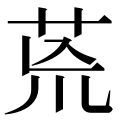
荒
See also: 㐬
| ||||||||
 | ||||||||
Translingual
Han character
荒 (Kangxi radical 140, 艸+6, 9 strokes, cangjie input 廿卜女山 (TYVU), four-corner 44211, composition ⿱艹巟)
References
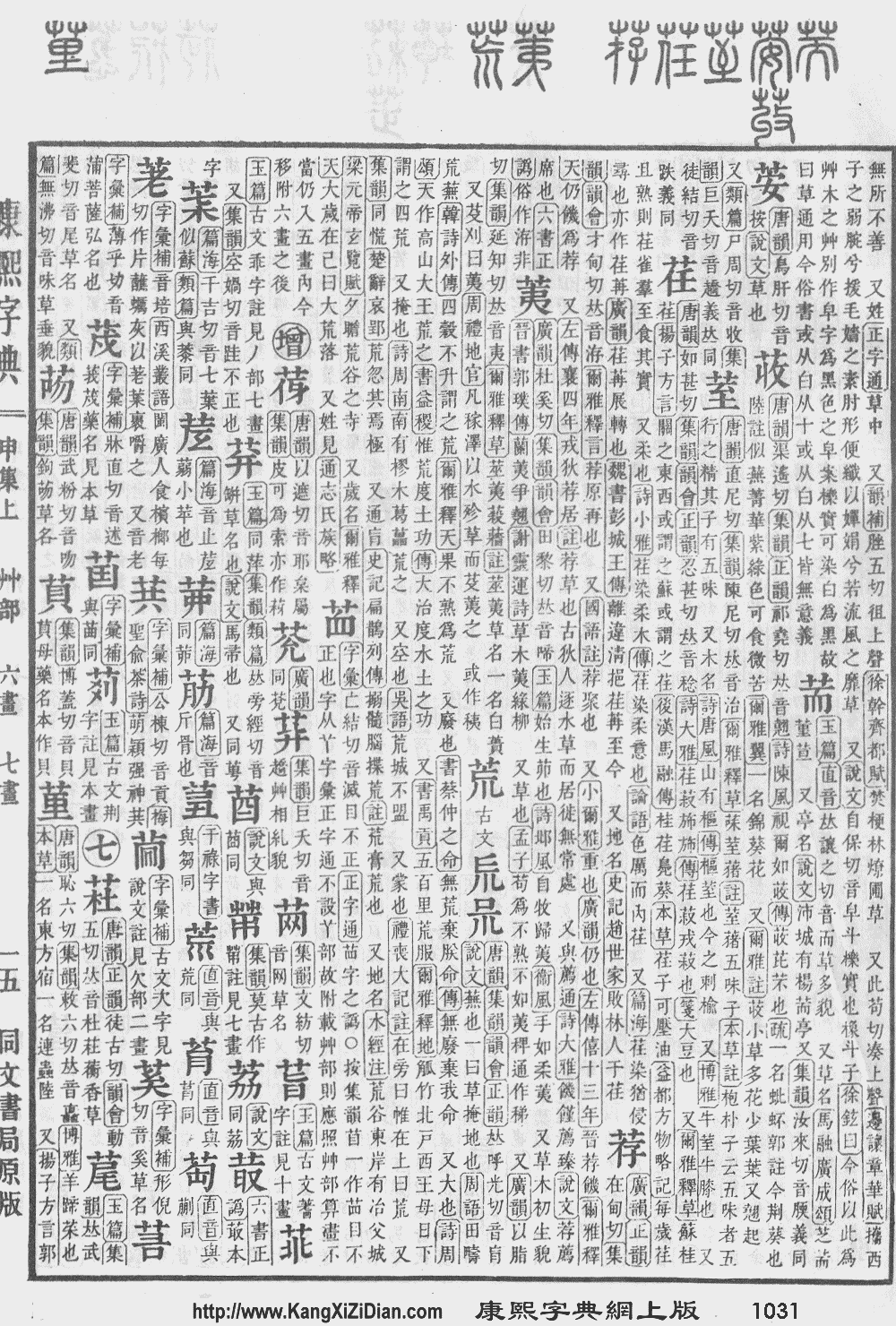
- Kangxi Dictionary: page 1031, character 8
- Dai Kanwa Jiten: character 30953
- Dae Jaweon: page 1490, character 8
- Hanyu Da Zidian (first edition): volume 5, page 3209, character 2
- Unihan data for U+8352
- Unihan data for U+FAB3
Chinese
| trad. | 荒 | |
|---|---|---|
| simp. # | 荒 | |
| alternative forms | 㐬 𮎰 𠃤 𠯚 𦮋 | |
Glyph origin
| Historical forms of the character 荒 | |
|---|---|
| Warring States | Shuowen Jiezi (compiled in Han) |
| Bronze inscriptions | Small seal script |
 |
 |
Characters in the same phonetic series (亡) (Zhengzhang, 2003)
| Old Chinese | |
|---|---|
| 忙 | *maːŋ |
| 芒 | *maːŋ, *maŋ |
| 茫 | *maːŋ |
| 恾 | *maːŋ |
| 吂 | *maːŋ, *maːŋs |
| 汒 | *maːŋ, *maŋs |
| 朚 | *maːŋ, *hmaːŋ, *maŋ, *mraːŋ, *mraːŋs |
| 邙 | *maːŋ, *maŋ |
| 杗 | *maːŋ, *maŋ |
| 荒 | *hmaːŋ, *hmaːŋs |
| 肓 | *hmaːŋ |
| 衁 | *hmaːŋ |
| 巟 | *hmaːŋ |
| 詤 | *hmaːŋ, *hmaːŋʔ, *hmaŋʔ |
| 慌 | *hmaːŋ, *hmaːŋʔ |
| 謊 | *hmaːŋʔ |
| 喪 | *smaːŋs, *smaːŋ |
| 亡 | *maŋ |
| 望 | *maŋ, *maŋs |
| 莣 | *maŋ |
| 朢 | *maŋ, *maŋs |
| 鋩 | *maŋ |
| 硭 | *maŋ |
| 忘 | *maŋ, *maŋs |
| 网 | *mlaŋʔ |
| 罔 | *mlaŋʔ |
| 蛧 | *maŋʔ |
| 網 | *mlaŋʔ |
| 輞 | *maŋʔ |
| 棢 | *maŋʔ |
| 惘 | *maŋʔ |
| 菵 | *maŋʔ |
| 誷 | *maŋʔ |
| 魍 | *maŋʔ |
| 妄 | *maŋs |
| 盲 | *mraːŋ |
| 蝱 | *mraːŋ |
| 虻 | *mraːŋ |
| 氓 | *mraːŋ |
| 甿 | *mraːŋ |
Phono-semantic compound (形聲/形声, OC *hmaːŋ, *hmaːŋs) : semantic 艹 (“grass, plant”) + phonetic 巟 (OC *hmaːŋ). Note: The middle part could be found as 亾 instead of 亡.
Etymology
From Proto-Sino-Tibetan *ma (“not”). Cognate with 亡 (OC *maŋ, “to disappear”). The voiceless initial is possibly from the devoicing effect of an early (i.e. Proto-Sino-Tibetan) causative prefix *s- on 亡 (i.e. PST *s-maŋ > *hmaŋ > Middle Chinese hwɑŋ) which was subsequently lost.
Pronunciation
Definitions
荒
Compounds
- 不荒不忙
- 作荒
- 備荒/备荒 (bèihuāng)
- 八荒 (bāhuāng)
- 兵荒
- 兵荒將亂/兵荒将乱
- 兵荒馬亂/兵荒马乱 (bīnghuāngmǎluàn)
- 凶荒
- 包荒
- 北大荒 (Běidàhuāng)
- 卹荒
- 古陌荒阡
- 四荒
- 地老天荒 (dìlǎotiānhuāng)
- 地荒
- 坵荒
- 墾荒/垦荒 (kěnhuāng)
- 大荒 (dàhuāng)
- 天荒
- 天荒地老 (tiānhuāngdìlǎo)
- 忽荒
- 房荒
- 打飢荒/打饥荒
- 打饑荒/打饥荒
- 投荒
- 拋荒/抛荒 (pāohuāng)
- 拓荒 (tuòhuāng)
- 拓荒者 (tuòhuāngzhě)
- 拉飢荒/拉饥荒
- 拾荒 (shíhuāng)
- 撂荒
- 放肆荒唐
- 放荒 (fànghuāng)
- 救荒 (jiùhuāng)
- 柴荒米貴/柴荒米贵
- 樂而不荒/乐而不荒
- 歲荒/岁荒 (suìhuāng)
- 水荒 (shuǐhuāng)
- 沙荒
- 洪荒 (hónghuāng)
- 洪荒時代/洪荒时代
- 流連荒亡/流连荒亡
- 活饑荒/活饥荒
- 滿目荒涼/满目荒凉
- 災荒/灾荒 (zāihuāng)
- 熟荒
- 燒荒/烧荒
- 生荒 (shēnghuāng)
- 破天荒 (pòtiānhuāng)
- 神奇荒怪
- 禽荒
- 耄荒
- 腹熱腸荒/腹热肠荒
- 色荒
- 荒亂/荒乱 (huāngluàn)
- 荒亡
- 荒佚
- 荒信
- 荒傖/荒伧
- 荒僻 (huāngpì)
- 荒冗冗
- 荒功好頑/荒功好顽
- 荒原 (huāngyuán)
- 荒唐 (huāngtáng)
- 荒唐不經/荒唐不经
- 荒唐之言
- 荒唐無稽/荒唐无稽
- 荒土 (huāngtǔ)
- 荒地 (huāngdì)
- 荒地稅/荒地税
- 荒塚/荒冢
- 荒外
- 荒失
- 荒寧/荒宁
- 荒居
- 荒山 (huāngshān)
- 荒島/荒岛 (huāngdǎo)
- 荒年 (huāngnián)
- 荒年穀/荒年谷
- 荒幼
- 荒廢/荒废 (huāngfèi)
- 荒忙
- 荒忽
- 荒急 (huāngjí)
- 荒怠
- 荒怪不經/荒怪不经
- 荒政
- 荒旱
- 荒時暴月/荒时暴月
- 荒月
- 荒服
- 荒村 (huāngcūn)
- 荒歉 (huāngqiàn)
- 荒涼/荒凉 (huāngliáng)
- 荒淫 (huāngyín)
- 荒淫無度/荒淫无度 (huāngyínwúdù)
- 荒淫無恥/荒淫无耻 (huāngyínwúchǐ)
- 荒淫無道/荒淫无道
- 荒湎
- 荒渺不經/荒渺不经
- 荒漠 (huāngmò)
- 荒漠甘泉
- 荒煙蔓草/荒烟蔓草
- 荒狂
- 荒疏 (huāngshū)
- 荒瘠 (huāngjí)
- 荒腆
- 荒草 (huāngcǎo)
- 草荒 (cǎohuāng)
- 荒荒
- 荒茫 (huāngmáng)
- 荒蕪/荒芜 (huāngwú)
- 荒裔
- 荒誕/荒诞 (huāngdàn)
- 荒誕不經/荒诞不经 (huāngdànbùjīng)
- 荒誕無稽/荒诞无稽
- 荒謬/荒谬 (huāngmiù)
- 荒謬劇/荒谬剧
- 荒謬小說/荒谬小说
- 荒謬絕倫/荒谬绝伦 (huāngmiùjuélún)
- 荒遐
- 荒郊 (huāngjiāo)
- 荒郊曠野/荒郊旷野
- 荒郊草野
- 荒郊野外 (huāngjiāoyěwài)
- 荒野 (huāngyě)
- 荒銀/荒银
- 荒陬
- 荒雞/荒鸡
- 荒頓/荒顿
- 落荒 (luòhuāng)
- 落荒而走 (luòhuāngérzǒu)
- 落荒而逃 (luòhuāng'értáo)
- 蓁荒
- 蔓徑荒草/蔓径荒草
- 蝦荒蟹亂/虾荒蟹乱
- 蠻荒/蛮荒 (mánhuāng)
- 血荒
- 要荒
- 逃荒 (táohuāng)
- 遍地荒旱
- 遐荒
- 邊荒/边荒
- 酒荒
- 錢荒/钱荒 (qiánhuāng)
- 開荒/开荒 (kāihuāng)
- 開荒劍/开荒剑
- 饑荒/饥荒 (jīhuāng)
- 鬧荒/闹荒 (nàohuāng)
- 鬧荒荒/闹荒荒
- 鬧饑荒/闹饥荒
- 龍荒/龙荒
Japanese
Korean
Vietnamese
This article is issued from Wiktionary. The text is licensed under Creative Commons - Attribution - Sharealike. Additional terms may apply for the media files.