妄
| ||||||||
| Stroke order | |||
|---|---|---|---|
 | |||
Translingual
Han character
妄 (Kangxi radical 38, 女+3, 6 strokes, cangjie input 卜女女 (YVV), four-corner 00404, composition ⿱亡女)
References
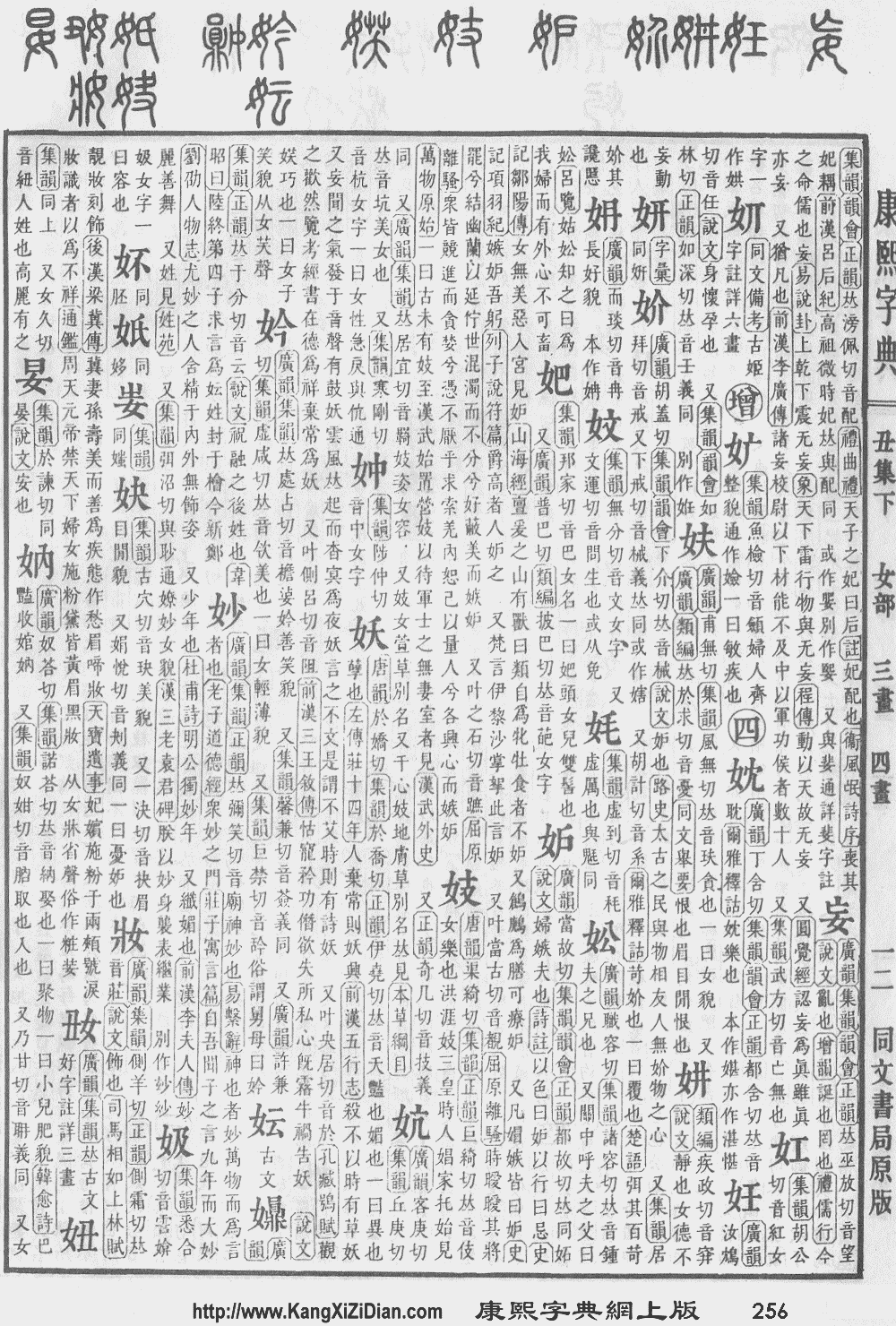
- Kangxi Dictionary: page 256, character 1
- Dai Kanwa Jiten: character 6063
- Hanyu Da Zidian (first edition): volume 2, page 1027, character 9
- Unihan data for U+5984
Chinese
| trad. | 妄 | |
|---|---|---|
| simp. # | 妄 | |
| alternative forms | 𡚶 𡔞 | |
Glyph origin
| Historical forms of the character 妄 | ||
|---|---|---|
| Western Zhou | Shuowen Jiezi (compiled in Han) | Liushutong (compiled in Ming) |
| Bronze inscriptions | Small seal script | Transcribed ancient scripts |
 |
 |
 |
Characters in the same phonetic series (亡) (Zhengzhang, 2003)
| Old Chinese | |
|---|---|
| 忙 | *maːŋ |
| 芒 | *maːŋ, *maŋ |
| 茫 | *maːŋ |
| 恾 | *maːŋ |
| 吂 | *maːŋ, *maːŋs |
| 汒 | *maːŋ, *maŋs |
| 朚 | *maːŋ, *hmaːŋ, *maŋ, *mraːŋ, *mraːŋs |
| 邙 | *maːŋ, *maŋ |
| 杗 | *maːŋ, *maŋ |
| 荒 | *hmaːŋ, *hmaːŋs |
| 肓 | *hmaːŋ |
| 衁 | *hmaːŋ |
| 巟 | *hmaːŋ |
| 詤 | *hmaːŋ, *hmaːŋʔ, *hmaŋʔ |
| 慌 | *hmaːŋ, *hmaːŋʔ |
| 謊 | *hmaːŋʔ |
| 喪 | *smaːŋs, *smaːŋ |
| 亡 | *maŋ |
| 望 | *maŋ, *maŋs |
| 莣 | *maŋ |
| 朢 | *maŋ, *maŋs |
| 鋩 | *maŋ |
| 硭 | *maŋ |
| 忘 | *maŋ, *maŋs |
| 网 | *mlaŋʔ |
| 罔 | *mlaŋʔ |
| 蛧 | *maŋʔ |
| 網 | *mlaŋʔ |
| 輞 | *maŋʔ |
| 棢 | *maŋʔ |
| 惘 | *maŋʔ |
| 菵 | *maŋʔ |
| 誷 | *maŋʔ |
| 魍 | *maŋʔ |
| 妄 | *maŋs |
| 盲 | *mraːŋ |
| 蝱 | *mraːŋ |
| 虻 | *mraːŋ |
| 氓 | *mraːŋ |
| 甿 | *mraːŋ |
Phono-semantic compound (形聲/形声, OC *maŋs) and ideogrammic compound (會意/会意) : phonetic 亡 (OC *maŋ) + semantic 女 (“woman”).
With 亡 also including meanings of “loss” or “destruction”, this character can be interpreted as the loss (亡) of one's proper reason after being seduced by a woman (女).
Pronunciation
Definitions
妄
Compounds
- 不敢妄言
- 任性妄為/任性妄为
- 僭妄 (jiànwàng)
- 塵妄/尘妄
- 大膽妄為/大胆妄为
- 妄下雌黃/妄下雌黄
- 妄人 (wàngrén)
- 妄作 (wàngzuò)
- 妄動/妄动 (wàngdòng)
- 妄圖/妄图 (wàngtú)
- 妄念
- 妄想 (wàngxiǎng)
- 妄想症 (wàngxiǎngzhèng)
- 妄求 (wàngqiú)
- 妄為/妄为 (wàngwéi)
- 妄生穿鑿/妄生穿凿
- 妄稱/妄称 (wàngchēng)
- 妄自尊大 (wàngzìzūndà)
- 妄自菲薄 (wàngzìfěibó)
- 妄言 (wàngyán)
- 妄言妄聽/妄言妄听
- 妄言輕動/妄言轻动
- 妄說/妄说
- 妄語/妄语 (wàngyǔ)
- 妄誕/妄诞 (wàngdàn)
- 妖妄
- 姑妄聽之/姑妄听之
- 姑妄言之
- 恣意妄為/恣意妄为
- 恣意妄行
- 愚妄 (yúwàng)
- 無妄/无妄 (wúwàng)
- 無妄之災/无妄之灾 (wúwàngzhīzāi)
- 無妄之禍/无妄之祸
- 無妄之福/无妄之福
- 狂妄 (kuángwàng)
- 狂妄自大 (kuángwàngzìdà)
- 痴心妄想 (chīxīnwàngxiǎng)
- 目不妄視/目不妄视
- 真妄
- 瞽言妄舉/瞽言妄举
- 禍不妄至/祸不妄至
- 肆意妄為/肆意妄为
- 膽大妄為/胆大妄为
- 虛妄/虚妄 (xūwàng)
- 言十妄九
- 言狂意妄
- 誕妄/诞妄 (dànwàng)
- 謀虛逐妄/谋虚逐妄
- 謬妄/谬妄 (miùwàng)
- 譫妄/谵妄 (zhānwàng)
- 貪心妄想/贪心妄想
- 輕舉妄動/轻举妄动 (qīngjǔ-wàngdòng)
- 逞意妄為/逞意妄为
- 驕矜狂妄/骄矜狂妄
References
- “妄”, in 漢語多功能字庫 (Multi-function Chinese Character Database), 香港中文大學 (the Chinese University of Hong Kong), 2014–
Japanese
Korean
Etymology
(This etymology is missing or incomplete. Please add to it, or discuss it at the Etymology scriptorium. Particularly: “Middle Korean Readings, if any”)
Pronunciation
- (SK Standard/Seoul) IPA(key): [ma̠ŋ]
- Phonetic hangul: [망]
Compounds
Compounds
- 망념 (妄念, mangnyeom)
Vietnamese
This article is issued from Wiktionary. The text is licensed under Creative Commons - Attribution - Sharealike. Additional terms may apply for the media files.