遇
| ||||||||
Translingual
| Stroke order | |||
Mainland China and Japan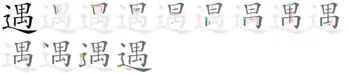 | |||
Han character
遇 (Kangxi radical 162, 辵+9, 13 strokes in traditional Chinese and Korean, 12 strokes in mainland China and Japanese, cangjie input 卜田中月 (YWLB), four-corner 36302, composition ⿺辶禺)
Derived characters
- 𢡎, 𣜛, 𬩔, 𥴪
References
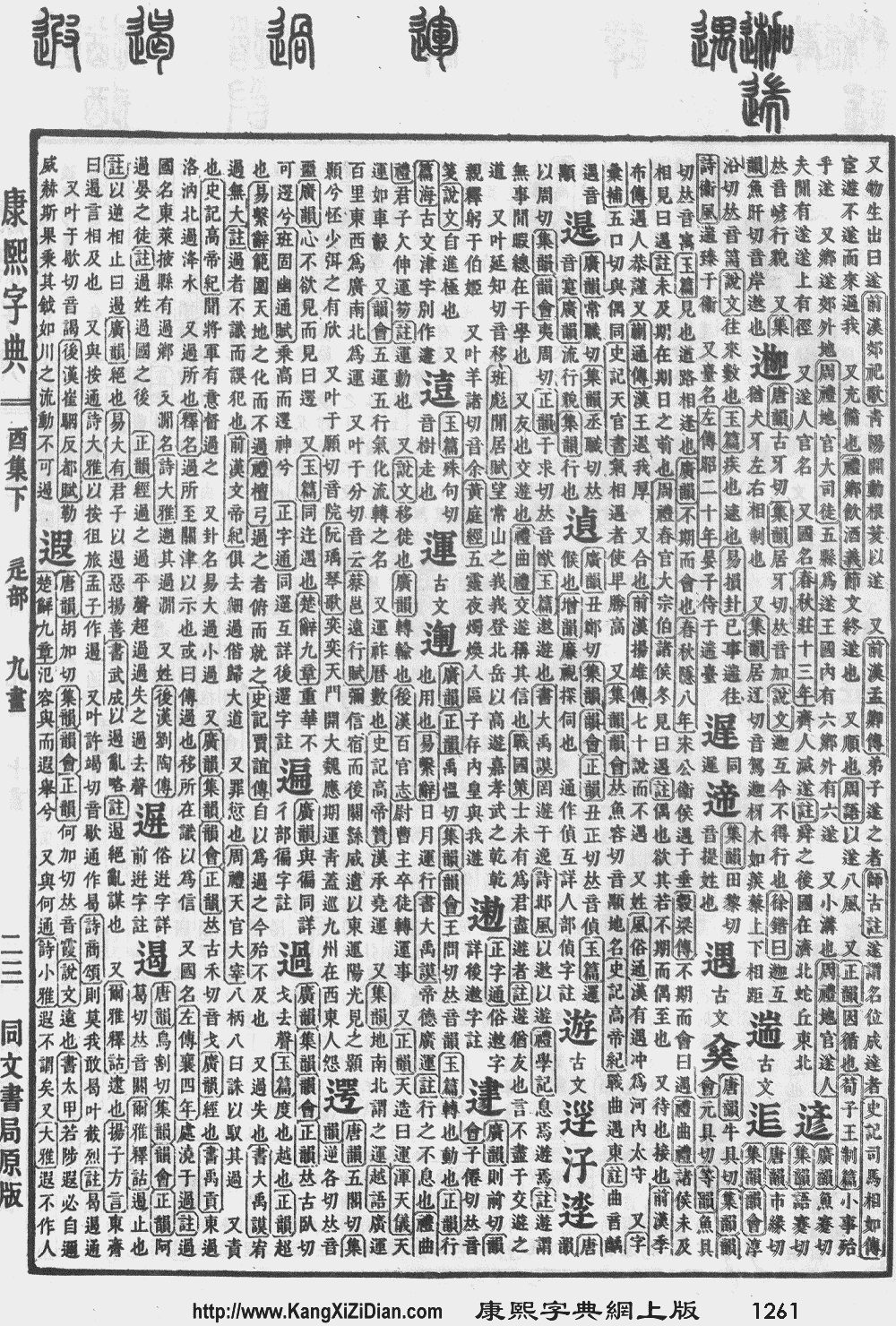
- Kangxi Dictionary: page 1261, character 7
- Dai Kanwa Jiten: character 38991
- Dae Jaweon: page 1751, character 10
- Hanyu Da Zidian (first edition): volume 6, page 3857, character 16
- Unihan data for U+9047
Chinese
| trad. | 遇 | |
|---|---|---|
| simp. # | 遇 | |
| 2nd round simp. | 迂 | |
Glyph origin
Characters in the same phonetic series (禺) (Zhengzhang, 2003)
Phono-semantic compound (形聲/形声, OC *ŋos) : semantic 辶 + phonetic 禺 (OC *ŋo, *ŋos).
Pronunciation
Definitions
遇
- to meet; to come across; to encounter; to run into
- (literary, or in compounds) to treat; to handle; to receive; to entertain
- (literary, or in compounds) chance; fortune; opportunity
- 43rd tetragram of the Taixuanjing; "encounters" (𝌰)
- a surname
Synonyms
- (to meet):
Dialectal synonyms of 遇 (“to encounter”) [map]
| Variety | Location | Words |
|---|---|---|
| Formal (Written Standard Chinese) | 遇, 碰, 遭 | |
| Mandarin | Taiwan | 遇, 碰 |
| Malaysia | 遇, 碰 | |
| Singapore | 遇, 碰 | |
| Cantonese | Guangzhou | 遇, 撞 |
| Hong Kong | 遇, 撞 | |
| Zhongshan (Shiqi) | 遇, 撞 | |
| Singapore (Guangfu) | 遇 | |
| Hakka | Meixian | 遇, 撞 |
| Southern Min | Xiamen | 拄, 撞, 衝, 磅 |
| Quanzhou | 拄, 撞, 衝 | |
| Zhangzhou | 拄, 衝 | |
| Tainan | 拄, 撞, 磅 | |
| Penang (Hokkien) | 拄 | |
| Singapore (Hokkien) | 拄 | |
| Manila (Hokkien) | 拄, 遇 | |
| Chaozhou | 遇, 堵 | |
| Shantou | 遇 | |
| Jieyang | 遇, 堵 | |
| Singapore (Teochew) | 堵 | |
| Wu | Shanghai | 碰 |
- (to treat):
- (opportunity):
- 商機/商机 (shāngjī) (business opportunity)
- 因緣/因缘 (yīnyuán)
- 契機/契机 (qìjī)
- 戰機/战机 (zhànjī) (opportunity for victory in battle)
- 時機/时机 (shíjī)
- 機會/机会 (jīhuì)
- 機遇/机遇 (jīyù)
- 火候 (huǒhòu) (figurative)
- 空子 (kòngzi) (opportunity to take advantage of)
- 空隙 (kòngxì)
- 節裉兒/节裉儿 (Xinzhou)
- 縫縫/缝缝 (fong4 fong4-1) (Sichuanese, Wu)
- 縫縫兒/缝缝儿 (fong4 fongr4-1) (Sichuanese)
- 茬口 (chákǒu) (regional)
- 際遇/际遇 (jìyù) (literary)
Compounds
- 不期而遇 (bùqī'éryù)
- 不遇
- 值遇 (zhíyù)
- 備受禮遇/备受礼遇
- 優惠待遇/优惠待遇
- 優遇/优遇 (yōuyù)
- 冷遇 (lěngyù)
- 千載一遇/千载一遇 (qiānzǎiyīyù)
- 厚遇 (hòuyù)
- 境遇 (jìngyù)
- 外遇 (wàiyù)
- 天緣奇遇/天缘奇遇
- 奇遇 (qíyù)
- 宿遇
- 寵遇/宠遇
- 將遇良才/将遇良才
- 巧遇 (qiǎoyù)
- 差別待遇/差别待遇
- 待遇 (dàiyù)
- 恩遇
- 感遇
- 意遇
- 懷才不遇/怀才不遇 (huái cái bù yù)
- 時遇/时遇
- 景遇
- 機遇/机遇 (jīyù)
- 殊遇
- 特惠待遇
- 生不遇時/生不遇时
- 百不一遇
- 百年不遇 (bǎiniánbùyù)
- 相遇 (xiāngyù)
- 眷遇
- 知遇 (zhīyù)
- 知遇之恩
- 神遇
- 視遇/视遇
- 禮遇/礼遇 (lǐyù)
- 精神外遇
- 累進處遇/累进处遇
- 良遇
- 萍水相遇
- 詭遇/诡遇
- 豔遇/艳遇 (yànyù)
- 身不遇時/身不遇时
- 輳遇/辏遇
- 逢時遇節/逢时遇节
- 遇上 (yùshàng)
- 遇事生風/遇事生风
- 遇人不淑 (yùrénbùshū)
- 遇便
- 遇刺 (yùcì)
- 遇到 (yùdào)
- 遇合
- 遇害 (yùhài)
- 遇救
- 遇物持平
- 遇缺不補/遇缺不补
- 遇見/遇见 (yùjiàn)
- 遇險/遇险 (yùxiǎn)
- 遇難/遇难 (yùnàn)
- 遇難成祥/遇难成祥
- 遭時不遇/遭时不遇
- 遭遇 (zāoyù)
- 遭遇戰/遭遇战 (zāoyùzhàn)
- 邂逅相遇
- 際遇/际遇 (jìyù)
- 隨遇平衡/随遇平衡 (suíyù pínghéng)
- 隨遇而安/随遇而安 (suíyù'ér'ān)
- 顧遇/顾遇
- 齒遇/齿遇
Japanese
| Shinjitai | 遇 | |
| Kyūjitai [1] |
遇󠄁 遇+ 󠄁?(Adobe-Japan1) |
 |
| 遇󠄄 遇+ 󠄄?(Hanyo-Denshi) (Moji_Joho) | ||
| The displayed kanji may be different from the image due to your environment. See here for details. | ||
Readings
References
- “遇”, in 漢字ぺディア (Kanjipedia) (in Japanese), 日本漢字能力検定協会, 2015–2024
Vietnamese
This article is issued from Wiktionary. The text is licensed under Creative Commons - Attribution - Sharealike. Additional terms may apply for the media files.