拄
| ||||||||
Translingual
Han character
拄 (Kangxi radical 64, 手+5, 8 strokes, cangjie input 手卜土 (QYG), four-corner 50014, composition ⿰扌主)
References
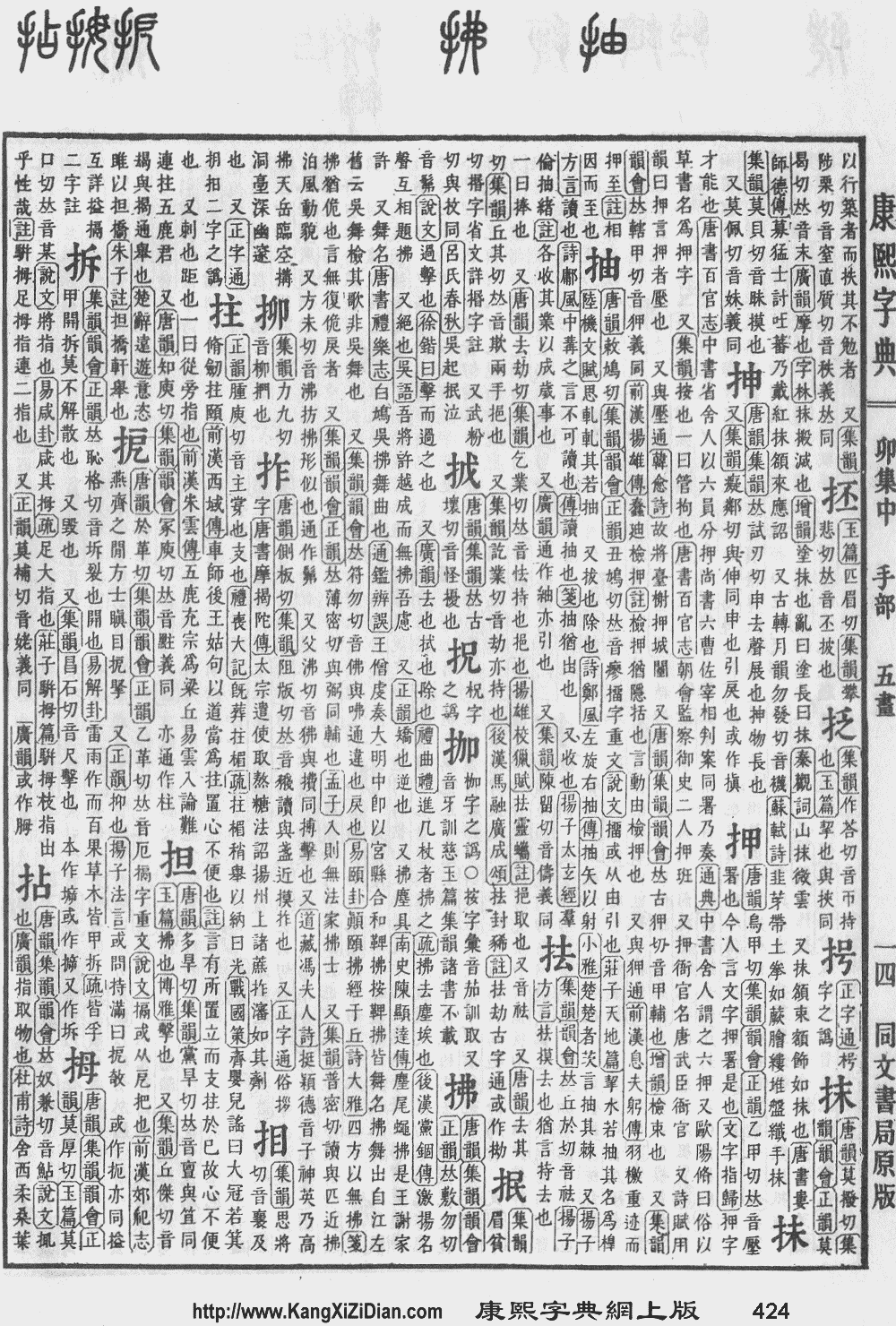
- Kangxi Dictionary: page 424, character 18
- Dai Kanwa Jiten: character 11940
- Dae Jaweon: page 772, character 14
- Hanyu Da Zidian (first edition): volume 3, page 1857, character 1
- Unihan data for U+62C4
Chinese
| simp. and trad. |
拄 | |
|---|---|---|
| alternative forms | 抵 Hokkien 遇 Hokkien “meet” 適/适 Hokkien “just” | |
Glyph origin
Characters in the same phonetic series (主) (Zhengzhang, 2003)
Phono-semantic compound (形聲/形声, OC *toʔ) : semantic 手 (“hand”) + phonetic 主 (OC *tjoʔ).
Etymology
From Proto-Sino-Tibetan *duːŋ (“post; column”). Cognate with 柱 (OC *toʔ, *doʔ, “post; column”); see there for more.
Pronunciation
Definitions
拄
- to prop; to support
- to lean on; to be propped up (with a stick, etc.)
- (archaic) to open (one's eyes)
- (literary or Hokkien, Eastern Min) to ridicule; to retort; to talk back
- (archaic or Eastern Min) to prod; to poke
- (literary) to block; to plug
- (Hokkien) to equal; to be able to exchange one for another
- (Hokkien) to cancel out
- (Hokkien) to meet; to encounter
- (Hokkien) just; just now; a moment ago
- (Quanzhou Hokkien) to give change
Synonyms
Dialectal synonyms of 遇 (“to encounter”) [map]
| Variety | Location | Words |
|---|---|---|
| Formal (Written Standard Chinese) | 遇, 碰, 遭 | |
| Mandarin | Taiwan | 遇, 碰 |
| Malaysia | 遇, 碰 | |
| Singapore | 遇, 碰 | |
| Cantonese | Guangzhou | 遇, 撞 |
| Hong Kong | 遇, 撞 | |
| Zhongshan (Shiqi) | 遇, 撞 | |
| Singapore (Guangfu) | 遇 | |
| Hakka | Meixian | 遇, 撞 |
| Southern Min | Xiamen | 拄, 撞, 衝, 磅 |
| Quanzhou | 拄, 撞, 衝 | |
| Zhangzhou | 拄, 衝 | |
| Tainan | 拄, 撞, 磅 | |
| Penang (Hokkien) | 拄 | |
| Singapore (Hokkien) | 拄 | |
| Manila (Hokkien) | 拄, 遇 | |
| Chaozhou | 遇, 堵 | |
| Shantou | 遇 | |
| Jieyang | 遇, 堵 | |
| Singapore (Teochew) | 堵 | |
| Wu | Shanghai | 碰 |
- (just now):
- (to give change): 找 (zhǎo)
Compounds
References
- “Entry #3963”, in 臺灣閩南語常用詞辭典 [Dictionary of Frequently-Used Taiwan Minnan] (overall work in Mandarin and Hokkien), Ministry of Education, R.O.C., 2023.
Japanese
Kanji
拄
- This term needs a translation to English. Please help out and add a translation, then remove the text
{{rfdef}}.
Korean
Hanja
拄 • (ju) (hangeul 주, revised ju, McCune–Reischauer chu, Yale cwu)
- This term needs a translation to English. Please help out and add a translation, then remove the text
{{rfdef}}.
Vietnamese
This article is issued from Wiktionary. The text is licensed under Creative Commons - Attribution - Sharealike. Additional terms may apply for the media files.