隨
| ||||||||
Translingual
| Japanese | 随 |
|---|---|
| Simplified | 随 |
| Traditional | 隨 |
Han character
隨 (Kangxi radical 170, 阜+13, 16 strokes, cangjie input 弓中卜大月 (NLYKB), four-corner 74232, composition ⿰阝遀)
References
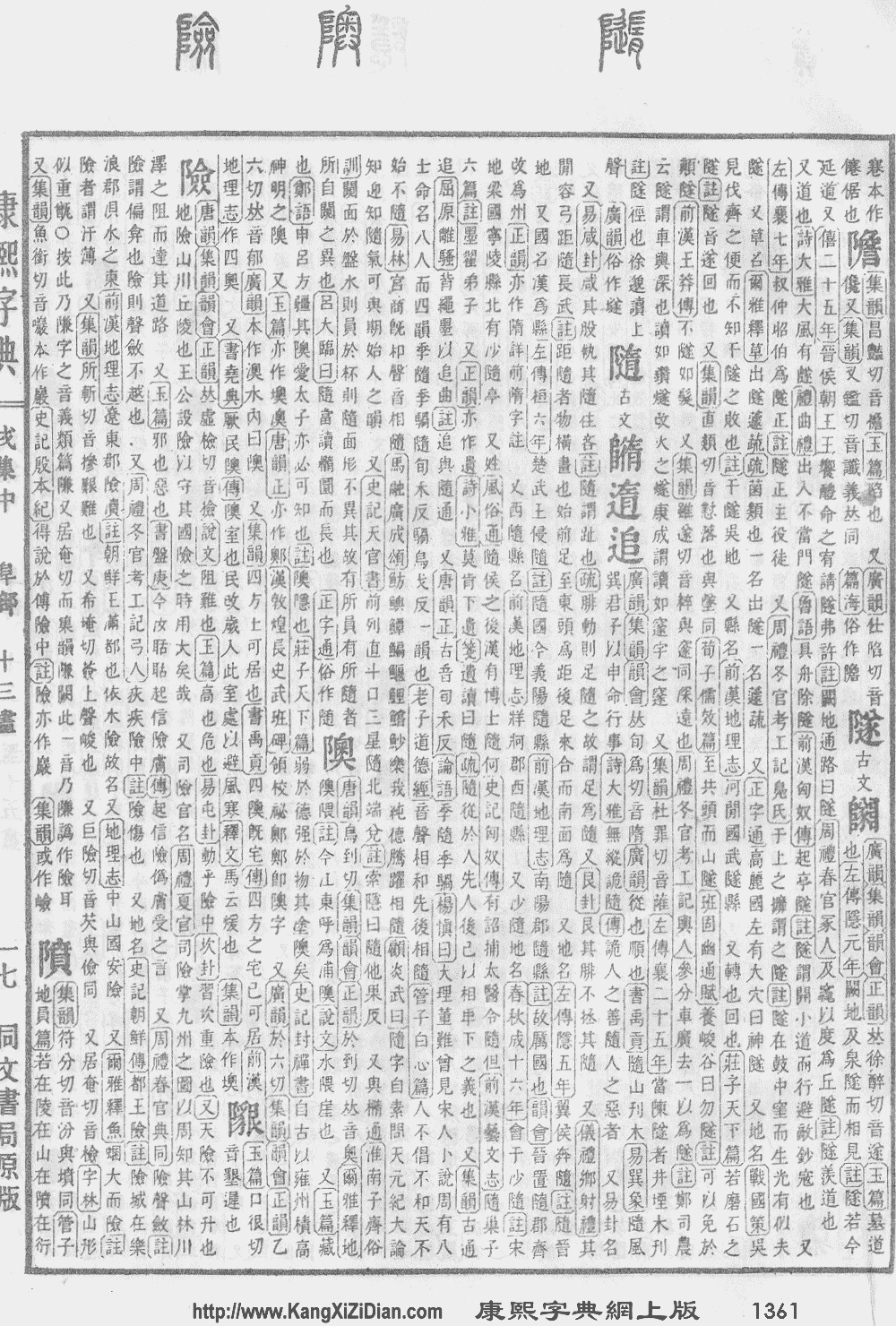
- Kangxi Dictionary: page 1361, character 4
- Dai Kanwa Jiten: character 41871
- Dae Jaweon: page 1864, character 26
- Hanyu Da Zidian (first edition): volume 6, page 4156, character 17
- Unihan data for U+96A8
Chinese
| trad. | 隨 | |
|---|---|---|
| simp. | 随 | |
| 2nd round simp. | 陏 | |
| alternative forms | 遀 ancient form 䢫 historical form 𨼕 historical form 𨔳 | |
Glyph origin
| Historical forms of the character 隨 | |
|---|---|
| Warring States | Shuowen Jiezi (compiled in Han) |
| Qin slip script | Small seal script |
 |
 |
Characters in the same phonetic series (隓) (Zhengzhang, 2003)
Phono-semantic compound (形聲/形声, OC *ljol) : semantic 辵 (“walking”) + abbreviated phonetic 𡐦
Pronunciation
Definitions
隨
- to follow
- to listen to; to submit
- to accompany
- (Northern Mandarin, of a person) to resemble (a parent in appearance or disposition)
- (colloquial) to chip in by giving one's portion of gift money, payment, red packet, etc. (e.g. when others get married)
- incidentally; conveniently; in passing
- to allow; to let somebody do as he or she pleases
- 17th hexagram of the I Ching; "following"
- (~縣) Sui (a county of Suizhou, Hubei, China)
- a surname: Sui
Synonyms
- (to follow):
- (to listen to):
- (to resemble):
- (incidentally):
- (to allow):
Descendants
- → English: Sui
Compounds
- 伴隨/伴随 (bànsuí)
- 依隨/依随 (yīsuí)
- 倡隨/倡随
- 偎隨/偎随
- 尾隨/尾随 (wěisuí)
- 相隨/相随 (xiāngsuí)
- 肩隨/肩随
- 親隨/亲随 (qīnsuí)
- 詭隨/诡随
- 跟隨/跟随 (gēnsuí)
- 追隨/追随 (zhuīsuí)
- 逶隨/逶随
- 長隨/长随
- 隨之而後/随之而后
- 隨事/随事
- 隨侍/随侍
- 隨俗/随俗
- 隨信/随信
- 隨便/随便 (suíbiàn)
- 隨信附上/随信附上
- 隨兕/随兕
- 隨分/随分
- 隨即/随即 (suíjí)
- 隨口/随口 (suíkǒu)
- 隨口胡謅/随口胡诌
- 隨同/随同 (suítóng)
- 隨和/随和
- 隨員/随员 (suíyuán)
- 隨喜/随喜 (suíxǐ)
- 隨園/随园
- 隨地/随地 (suídì)
- 隨坐/随坐
- 隨大流/随大流 (suídàliú)
- 隨宜/随宜
- 隨封/随封
- 隨州/随州 (Suízhōu)
- 隨帶/随带
- 隨常/随常 (suícháng)
- 隨後/随后 (suíhòu)
- 隨從/随从
- 隨心/随心 (suíxīn)
- 隨心所欲/随心所欲 (suíxīnsuǒyù)
- 隨意/随意 (suíyì)
- 隨手/随手 (suíshǒu)
- 隨時/随时 (suíshí)
- 隨時待命/随时待命
- 隨時隨地/随时随地 (suíshísuídì)
- 隨機/随机 (suíjī)
- 隨機存取/随机存取
- 隨機存取存儲器/随机存取存储器
- 隨機存取記憶體/随机存取记忆体
- 隨機性/随机性 (suíjīxìng)
- 隨機應變/随机应变 (suíjīyìngbiàn)
- 隨機效應/随机效应
- 隨機數/随机数 (suíjīshù)
- 隨機時間/随机时间
- 隨次/随次
- 隨波/随波
- 隨波逐流/随波逐流 (suíbōzhúliú)
- 隨波遜流/随波逊流
- 隨直/随直
- 隨筆/随笔 (suíbǐ)
- 隨緣/随缘 (suíyuán)
- 隨縣/随县
- 隨群/随群
- 隨聲附和/随声附和 (suíshēngfùhè)
- 隨興/随兴 (suíxìng)
- 隨著/随着 (suízhe)
- 隨葬/随葬 (suízàng)
- 隨葬品/随葬品 (suízàngpǐn)
- 隨處/随处 (suíchù)
- 隨行/随行 (suíxíng)
- 隨行人員/随行人员
- 隨趁/随趁
- 隨身/随身 (suíshēn)
- 隨身碟/随身碟 (suíshēndié)
- 隨身聽/随身听 (suíshēntīng)
- 隨軒/随轩
- 隨輩/随辈
- 隨逮/随逮
- 隨遇而安/随遇而安 (suíyù'ér'ān)
- 隨邪/随邪
- 隨鑾/随銮
- 隨順/随顺
- 隨類/随类
- 隨風/随风
- 隨風倒/随风倒
- 隨風倒柳/随风倒柳
- 隨風倒舵/随风倒舵
Japanese
| 随 | |
| 隨 |
Kanji
隨
(uncommon “Hyōgai” kanji, kyūjitai kanji, shinjitai form 随)
- This term needs a translation to English. Please help out and add a translation, then remove the text
{{rfdef}}.
Korean
Hanja
隨 • (su) (hangeul 수, revised su, McCune–Reischauer su, Yale swu)
- This term needs a translation to English. Please help out and add a translation, then remove the text
{{rfdef}}.
Vietnamese
This article is issued from Wiktionary. The text is licensed under Creative Commons - Attribution - Sharealike. Additional terms may apply for the media files.