縣

See also: 县 and 県
縣 U+7E23, 縣
CJK UNIFIED IDEOGRAPH-7E23
← 縢
[U+7E22]
CJK Unified Ideographs 縤 →
[U+7E24]

Translingual

Traditional 縣
Shinjitai 県
Simplified 县

Han character

縣 (Kangxi radical 120, 糸+10, 16 strokes, cangjie input 月火竹女火 (BFHVF), four-corner 62993, composition ⿰⿱⿴𠀃三小系(GTV) or ⿰県系(HJK))

Derived characters

Descendants

  • 县 (simplification)
    • also simplified within the compound character 悬 from 懸
  • 県 (simplification)

References

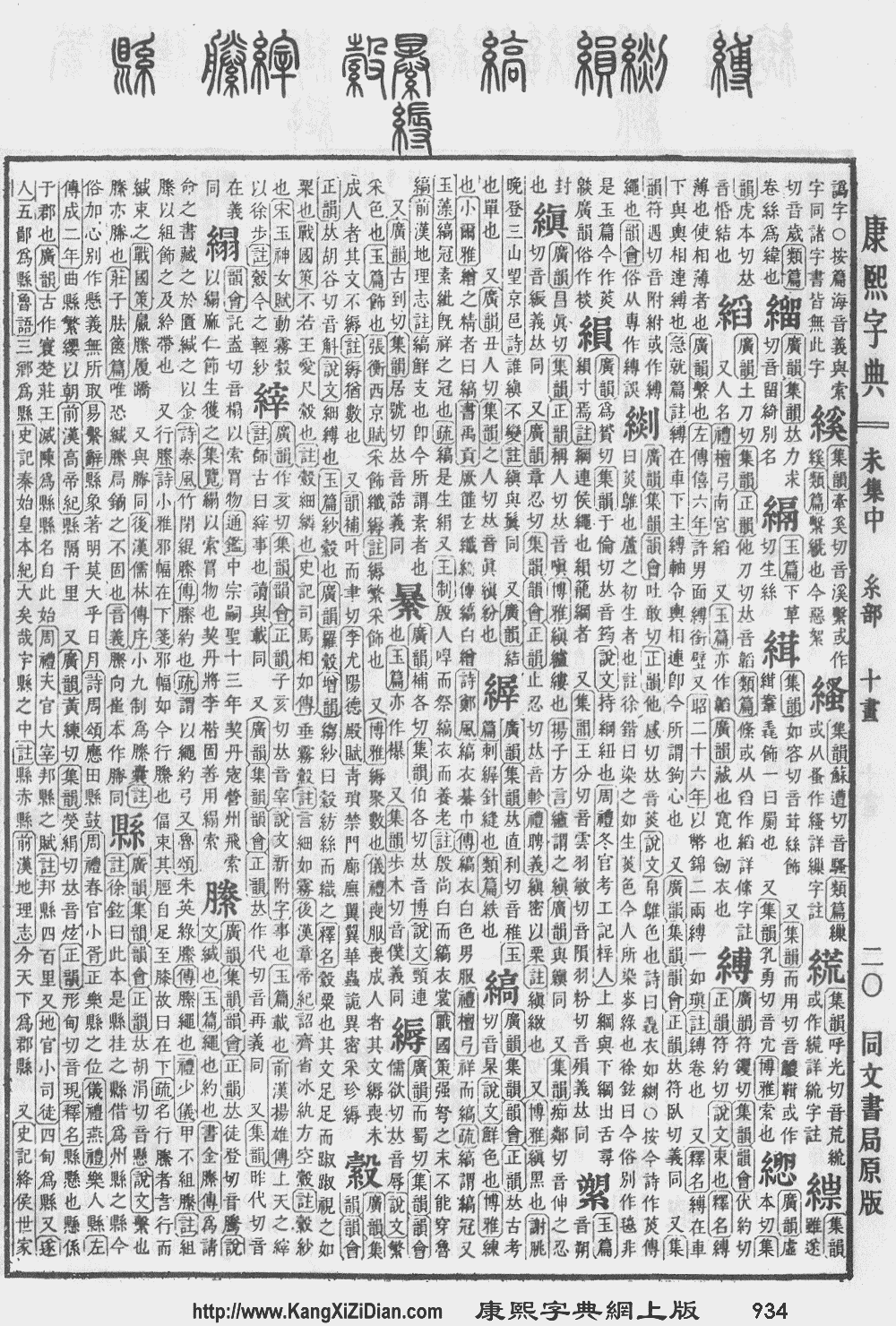
  • Kangxi Dictionary: page 934, character 23
  • Dai Kanwa Jiten: character 27784
  • Dae Jaweon: page 1373, character 8
  • Hanyu Da Zidian (first edition): volume 5, page 3435, character 11
  • Unihan data for U+7E23

Chinese

trad. 縣
simp. 县
alternative forms 県
Map including Fang County (labeled as 房縣 FANG-HSIEN (walled)) and Yun County (labeled as 鄖縣 YÜN-HSIEN (YÜN-YANG) (walled)) in Shiyan, western Hubei Province, China (AMS, 1954)

Glyph origin

Historical forms of the character 縣
Western Zhou Shuowen Jiezi (compiled in Han) Liushutong (compiled in Ming)
Bronze inscriptions Small seal script Transcribed ancient scripts

Shuowen: Ideogrammic compound (會意/会意) : 𥄉 + 系 – to hang 系 by the head 𥄉 (hair hanging down).

Original form of 懸. Originally in bronze and bamboo slip scripts, Ideogrammic compound (會意/会意) : 目 + 木 + 糸 - to hang with the string 糸 by the head 目 (using an eye to represent a head) on a tree 木. In Qin bamboo slip scripts, some of 目 + 木 were corrupted to 県 (with one straight horizontal line rather than 𠃊) which interpreted to a reversed 首 head by Shuowen, and 糸 was corrupted to 系.

Etymology 1

(This etymology is missing or incomplete. Please add to it, or discuss it at the Etymology scriptorium.)

Pronunciation


Note:
  • koāiⁿ/kūiⁿ/koān - vernacular;
  • hiān - literary.
    Note: guain7 - Chaoyang.
    • Wu
      • (Shanghai):
        • Wugniu: 6yoe
        • MiniDict: yoe去
        • Wiktionary Romanisation (Shanghai): 3hhyoe
        • Sinological IPA (Shanghai): /ɦyø²³/
    • Xiang
      • (Changsha)
        • Wiktionary: xienn5 / xienn4
        • Sinological IPA (key): /ɕi̯ẽ²¹/, /ɕi̯ẽ⁴⁵/
    Note:
    • xienn5 - vernacular;
    • xienn4 - literary.

    • Dialectal data
    Variety Location 縣
    Mandarin Beijing /ɕian⁵¹/
    Harbin /ɕian⁵³/
    Tianjin /ɕian⁵³/
    Jinan /ɕiã²¹/
    Qingdao /ɕiã⁴²/
    Zhengzhou /ɕian³¹²/
    Xi'an /ɕiã⁴⁴/
    Xining /ɕiã²¹³/
    Yinchuan /ɕian¹³/
    Lanzhou /ɕiɛ̃n¹³/
    Ürümqi /ɕian²¹³/
    Wuhan /ɕiɛn³⁵/
    Chengdu /ɕian¹³/
    Guiyang /ɕian²¹³/
    Kunming /ɕiɛ̃²¹²/
    Nanjing /ɕien⁴⁴/
    Hefei /ɕiĩ⁵³/
    Jin Taiyuan /ɕie⁴⁵/
    Pingyao /ɕie̞³⁵/
    Hohhot /ɕie⁵⁵/
    Wu Shanghai /ɦyø²³/
    Suzhou /ɦiø³¹/
    Hangzhou /ɦiẽ̞¹³/
    Wenzhou /jy²²/
    Hui Shexian /ɕie²²/
    Tunxi /yɛ¹¹/
    Xiang Changsha /ɕiẽ⁵⁵/
    /ɕiẽ¹¹/
    Xiangtan /ɕiẽ²¹/
    Gan Nanchang /ɕiɛn²¹/
    Hakka Meixian /ian⁵³/
    Taoyuan /ʒen⁵⁵/
    Cantonese Guangzhou /jyn²²/
    Nanning /jin²²/
    /yn²²/
    Hong Kong /jyn²²/
    Min Xiamen (Hokkien) /hian²²/
    /kuãi²²/
    Fuzhou (Eastern Min) /kaiŋ²⁴²/
    Jian'ou (Northern Min) /kyiŋ⁴⁴/
    Shantou (Teochew) /kũi³¹/
    Haikou (Hainanese) /sin³⁵/
    /kɔi²³/

    Rime
    Character 縣
    Reading # 2/2
    Initial (聲) 匣 (33)
    Final (韻) 先 (86)
    Tone (調) Departing (H)
    Openness (開合) Closed
    Division (等) IV
    Fanqie 黃練切
    Baxter hwenH
    Reconstructions
    Zhengzhang
    Shangfang
    /ɦwenH/
    Pan
    Wuyun
    /ɦʷenH/
    Shao
    Rongfen
    /ɣuɛnH/
    Edwin
    Pulleyblank
    /ɦwɛnH/
    Li
    Rong
    /ɣuenH/
    Wang
    Li
    /ɣiwenH/
    Bernard
    Karlgren
    /ɣiwenH/
    Expected
    Mandarin
    Reflex
    xuàn
    Expected
    Cantonese
    Reflex
    jyun6
    Baxter–Sagart system 1.1 (2014)
    Character 縣
    Reading # 1/2
    Modern
    Beijing
    (Pinyin)
    xiàn
    Middle
    Chinese
    ‹ hwenH ›
    Old
    Chinese
    /*Cə.[ɡ]ʷˁe[n]-s/
    English district

    Notes for Old Chinese notations in the Baxter–Sagart system:

    * Parentheses "()" indicate uncertain presence;
    * Square brackets "[]" indicate uncertain identity, e.g. *[t] as coda may in fact be *-t or *-p;
    * Angle brackets "<>" indicate infix;
    * Hyphen "-" indicates morpheme boundary;

    * Period "." indicates syllable boundary.
    Zhengzhang system (2003)
    Character 縣
    Reading # 2/2
    No. 13578
    Phonetic
    component
    縣
    Rime
    group
    元
    Rime
    subdivision
    2
    Corresponding
    MC rime
    Old
    Chinese
    /*ɡʷeːns/

    Definitions

    縣

    1. A type of administrative division:
      1. (historical, in ancient China) district; prefecture
      2. (in Mainland China) county (third level division that is now generally restricted to rural areas, contrasted with urban districts (區/区 (qū)))
      3. (in Taiwan) county (first level division that used to be under the jurisdiction of a province but are now directly administered by the central government)
      4. (in Japan) prefecture
      5. (in the United States) county (second level division under the jurisdiction of a state, excluding Alaska and Louisiana)
        洛杉磯縣/洛杉矶县  ―  luòshānjī xiàn  ―  Los Angeles County
    2. (in many cases but not always) county seat (the town which serves as the seat of government of such divisions)
    3. a surname
    See also
    • (first-level divisions): 省 (shěng), 市 (shì); 道 (dào) (historical)
    • (second-level divisions): 區/区 (qū); 州 (zhōu), 市 (shì), 府 (fǔ), 郡 (jùn), 道 (dào) (historical)

    Compounds

    Descendants

    Sino-Xenic (縣):
    • → Japanese: 県(けん) (ken); 県(げん) (gen)
    • → Korean: 현(縣) (hyeon)
    • → Vietnamese: huyện (縣)

    Others:

    Pronunciation


    Rime
    Character 縣
    Reading # 1/2
    Initial (聲) 匣 (33)
    Final (韻) 先 (86)
    Tone (調) Level (Ø)
    Openness (開合) Closed
    Division (等) IV
    Fanqie 胡涓切
    Baxter hwen
    Reconstructions
    Zhengzhang
    Shangfang
    /ɦwen/
    Pan
    Wuyun
    /ɦʷen/
    Shao
    Rongfen
    /ɣuɛn/
    Edwin
    Pulleyblank
    /ɦwɛn/
    Li
    Rong
    /ɣuen/
    Wang
    Li
    /ɣiwen/
    Bernard
    Karlgren
    /ɣiwen/
    Expected
    Mandarin
    Reflex
    xuán
    Expected
    Cantonese
    Reflex
    jyun4
    Baxter–Sagart system 1.1 (2014)
    Character 縣
    Reading # 2/2
    Modern
    Beijing
    (Pinyin)
    xuán
    Middle
    Chinese
    ‹ hwen ›
    Old
    Chinese
    /*[ɡ]ʷˁe[n]/
    English suspend

    Notes for Old Chinese notations in the Baxter–Sagart system:

    * Parentheses "()" indicate uncertain presence;
    * Square brackets "[]" indicate uncertain identity, e.g. *[t] as coda may in fact be *-t or *-p;
    * Angle brackets "<>" indicate infix;
    * Hyphen "-" indicates morpheme boundary;

    * Period "." indicates syllable boundary.
    Zhengzhang system (2003)
    Character 縣
    Reading # 1/2
    No. 13576
    Phonetic
    component
    縣
    Rime
    group
    元
    Rime
    subdivision
    2
    Corresponding
    MC rime
    玄
    Old
    Chinese
    /*ɡʷeːn/

    Definitions

    縣

    1. † Alternative form of 懸/悬 (xuán, “to hang; to suspend”)

    Japanese

    Shinjitai

    県

    Kyūjitai

    縣

    Kanji

    縣

    (“Jinmeiyō” kanji used for names, kyūjitai kanji, shinjitai form 県)

    1. This term needs a translation to English. Please help out and add a translation, then remove the text {{rfdef}}.

    Readings

    Korean

    Hanja

    縣 (eumhun 고을 현 (go'eul hyeon))

    1. This term needs a translation to English. Please help out and add a translation, then remove the text {{rfdef}}.

    縣 (eumhun 매달 현 (maedal hyeon))

    1. This term needs a translation to English. Please help out and add a translation, then remove the text {{rfdef}}.

    Vietnamese

    Han character

    縣: Hán Nôm readings: huyện

    1. chữ Hán form of huyện (“district”).
    This article is issued from Wiktionary. The text is licensed under Creative Commons - Attribution - Sharealike. Additional terms may apply for the media files.