就
| ||||||||
Translingual
| Stroke order | |||
|---|---|---|---|
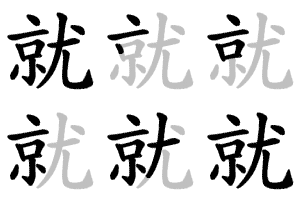 | |||
| Stroke order | |||
|---|---|---|---|
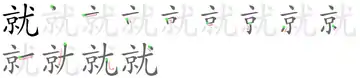 | |||
Han character
就 (Kangxi radical 43, 尢+9, 12 strokes, cangjie input 卜火戈大山 (YFIKU), four-corner 03914, composition ⿰京尤)
References
- Kangxi Dictionary: page 299, character 5
- Dai Kanwa Jiten: character 7599
- Dae Jaweon: page 594, character 20
- Hanyu Da Zidian (first edition): volume 1, page 555, character 11
- Unihan data for U+5C31
Chinese
| simp. and trad. |
就 | |
|---|---|---|
Glyph origin
| Historical forms of the character 就 | |||||||||||||
|---|---|---|---|---|---|---|---|---|---|---|---|---|---|
| Shang | Western Zhou | Warring States | Shuowen Jiezi (compiled in Han) | Liushutong (compiled in Ming) | |||||||||
| Oracle bone script | Bronze inscriptions | Chu slip and silk script | Small seal script | Transcribed ancient scripts | |||||||||
 |
 |
 |
 |
 | |||||||||
||||
|
References: Mostly from Richard Sears' Chinese Etymology site (authorisation),
| |||||||||||||


Characters in the same phonetic series (就) (Zhengzhang, 2003)
Originally 𫢁, ideogrammic compound (會意/会意) : 享 + 京, a temple and a tower – meaning "to sacrifice at a high place". During the Warring States period, 享 was omitted. In seal script, 尤 (“especially; even more”) is added to the right, signifying "high; to go to a higher place".
Etymology 1
Cognate with 造 (OC *skʰuːɡs, “to proceed to”) (Wang, 1982).
Pronunciation
Definitions
就
- to approach; to move towards
- to reach; to arrive at
- to undertake; to engage in
- to succeed; to complete
- to comply; to follow; to accept
- to suffer; to be subjected to
- (of food) to go with
- with regard to; concerning
- even if; even though
- at once; right away
- (Cantonese) almost; soon
- (used for emphasis) exactly; precisely; just
- only; merely; just
- 我工資就五千塊,他買件衣服就一萬塊。人和人的差距真是太大了。 [MSC, trad.]
- Wǒ gōngzī jiù wǔ qiān kuài, tā mǎi jiàn yīfú jiù yī wàn kuài. Rén hé rén de chājù zhēn shì tài dà le. [Pinyin]
- My salary is only five thousand yuan, and he buys clothes that are as much as ten thousand yuan. The disparity between people truly is too large.
我工资就五千块,他买件衣服就一万块。人和人的差距真是太大了。 [MSC, simp.]- Synonym: 只
- then
- (used to express earliness) as early as; as soon as
- as many as; as much as
- Used between two identical words to express indifference or resignation.
- Alternative form of 鷲/鹫 (jiù)
Synonyms
- (to approach):
- (to reach):
- (to go with): 搭配 (dāpèi)
- (with regard to):
- (even if):
- even (Hong Kong Cantonese)
- 不怕 (bùpà)
- 任憑/任凭 (rènpíng)
- 作哩 (Zhangzhou Hokkien)
- 作算 (zo6 sonn4) (Xiang)
- 儘管/尽管
- 即令 (jílìng)
- 即使 (jíshǐ)
- 即便 (jíbiàn)
- 哪怕 (nǎpà) (informal)
- 就使 (Hokkien)
- 就算 (jiùsuàn) (colloquial)
- 就若 (Hokkien)
- 就若是 (Hokkien)
- 怕不 (pàbù) (literary or dialectal)
- 縱/纵 (formal)
- 縱使/纵使 (zòngshǐ)
- 縱然/纵然 (zòngrán)
- 設令/设令 (shèlìng)
- 饒/饶 (ráo) (colloquial)
- (to complete):
Compounds
- 一就
- 一就手兒/一就手儿
- 一揮而就/一挥而就 (yīhuī'érjiù)
- 一蹴而就 (yīcù'érjiù)
- 不堪造就
- 不就 (bùjiù)
- 不明就裡/不明就里 (bùmíngjiùlǐ)
- 不知就裡/不知就里 (bùzhījiùlǐ)
- 便就
- 俯就 (fǔjiù)
- 倒頭就睡/倒头就睡
- 俯首就縛/俯首就缚
- 偎乾就濕/偎干就湿
- 充分就業/充分就业
- 刪繁就簡/删繁就简
- 刪蕪就簡/删芜就简
- 削足就履
- 功就名成
- 功成名就 (gōngchéngmíngjiù)
- 半推半就 (bàntuībànjiù)
- 去危就安
- 去就
- 去就之分
- 去本就末
- 可就
- 因陋就簡/因陋就简
- 圓就/圆就
- 完全就業/完全就业 (wánquán jiùyè)
- 家成業就/家成业就 (jiāchéngyèjiù)
- 將就/将就 (jiāngjiù)
- 將機就機/将机就机
- 將機就計/将机就计
- 將計就計/将计就计 (jiāng jì jiù jì)
- 將錯就錯/将错就错 (jiāngcuòjiùcuò)
- 就世
- 就中 (jiùzhōng)
- 就事 (jiùshì)
- 就事論事/就事论事 (jiùshìlùnshì)
- 就令
- 就任 (jiùrèn)
- 就位 (jiùwèi)
- 就使
- 就便
- 就勢/就势 (jiùshì)
- 就和
- 就地 (jiùdì)
- 就地取材
- 就地正法
- 就坐 (jiùzuò)
- 就學/就学 (jiùxué)
- 就寢/就寝 (jiùqǐn)
- 就就的
- 就座 (jiùzuò)
- 就得
- 就戮
- 就手 (jiùshǒu)
- 就擒 (jiùqín)
- 就教
- 就日瞻雲/就日瞻云
- 就是 (jiùshì)
- 就木 (jiùmù)
- 就枕
- 就棍打腿
- 就業/就业 (jiùyè)
- 就業市場/就业市场
- 就業服務/就业服务
- 就業輔導/就业辅导
- 就正 (jiùzhèng)
- 就此 (jiùcǐ)
- 就此打住
- 就此罷手/就此罢手
- 就湯下麵/就汤下面
- 就禮/就礼
- 就算 (jiùsuàn)
- 就範/就范 (jiùfàn)
- 就緒/就绪 (jiùxù)
- 就義/就义 (jiùyì)
- 就職/就职 (jiùzhí)
- 就虛避實/就虚避实
- 就衰 (jiùshuāi)
- 就裡/就里 (jiùlǐ)
- 就裡人/就里人
- 就要
- 就親/就亲
- 就診/就诊 (jiùzhěn)
- 就讀/就读 (jiùdú)
- 就近 (jiùjìn)
- 就逮
- 就道
- 就醫/就医 (jiùyī)
- 就食 (jiùshí)
- 就養/就养
- 就餐 (jiùcān)
- 就館/就馆
- 屈就 (qūjiù)
- 引頸就戮/引颈就戮
- 從俗就簡/从俗就简
- 從容就義/从容就义
- 急就 (jíjiù)
- 急就篇
- 急就章 (jíjiùzhāng)
- 成就 (chéngjiù)
- 成就感 (chéngjiùgǎn)
- 成就測驗/成就测验
- 打就
- 拔腿就跑
- 按部就班 (ànbùjiùbān)
- 捨安就危/舍安就危
- 推就
- 捨己就人/舍己就人
- 援筆立就/援笔立就
- 援筆而就/援笔而就
- 撋就/𰓷就
- 擬就/拟就
- 日就月將/日就月将
- 早就 (zǎojiù)
- 明知就裡/明知就里 (míngzhījiùlǐ)
- 晚就
- 未就
- 束手就擒 (shùshǒujiùqín)
- 束手就縛/束手就缚
- 束身就縛/束身就缚
- 棄大就小/弃大就小
- 棄文就武/弃文就武
- 欲就還推/欲就还推
- 歸就/归就
- 死就
- 沒去就/没去就
- 煨乾就濕/煨干就湿
- 牽就/牵就 (qiānjiù)
- 甄煩就簡/甄烦就简
- 生就 (shēngjiù)
- 移東就西/移东就西
- 移樽就教
- 管就
- 練就/练就 (liànjiù)
- 羽翮已就
- 脫網就淵/脱网就渊
- 芟繁就簡/芟繁就简
- 行將就木/行将就木 (xíngjiāngjiùmù)
- 見好就收/见好就收 (jiàn hǎo jiù shōu)
- 見縫就鑽/见缝就钻
- 說做就做/说做就做
- 造就 (zàojiù)
- 透風就過/透风就过
- 違害就利/违害就利
- 遷就/迁就 (qiānjiù)
- 避凶就吉
- 避實就虛/避实就虚
- 避就
- 避禍就福/避祸就福
- 避重就輕/避重就轻 (bìzhòngjiùqīng)
- 避難就易/避难就易
- 那就
- 鑽頭就鎖/钻头就锁
- 陳力就列/陈力就列
- 隨方就圓/随方就圆
- 隨行就市/随行就市
- 隨高就低/随高就低
- 非理就終/非理就终
- 駕輕就熟/驾轻就熟 (jiàqīngjiùshú)
- 高就 (gāojiù)
Pronunciation
Japanese
Readings
Korean
Hanja
就 • (chwi) (hangeul 취)
- This term needs a translation to English. Please help out and add a translation, then remove the text
{{rfdef}}.
Vietnamese
Han character
就: Hán Nôm readings: tựu
- This term needs a translation to English. Please help out and add a translation, then remove the text
{{rfdef}}.
This article is issued from Wiktionary. The text is licensed under Creative Commons - Attribution - Sharealike. Additional terms may apply for the media files.