只
| ||||||||
Translingual
| Stroke order | |||
|---|---|---|---|
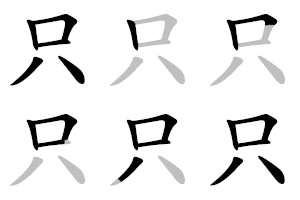 | |||
Han character
只 (Kangxi radical 30, 口+2, 5 strokes, cangjie input 口金 (RC), four-corner 60800, composition ⿱口八)
- Shuowen Jiezi radical №49
Derived characters
References
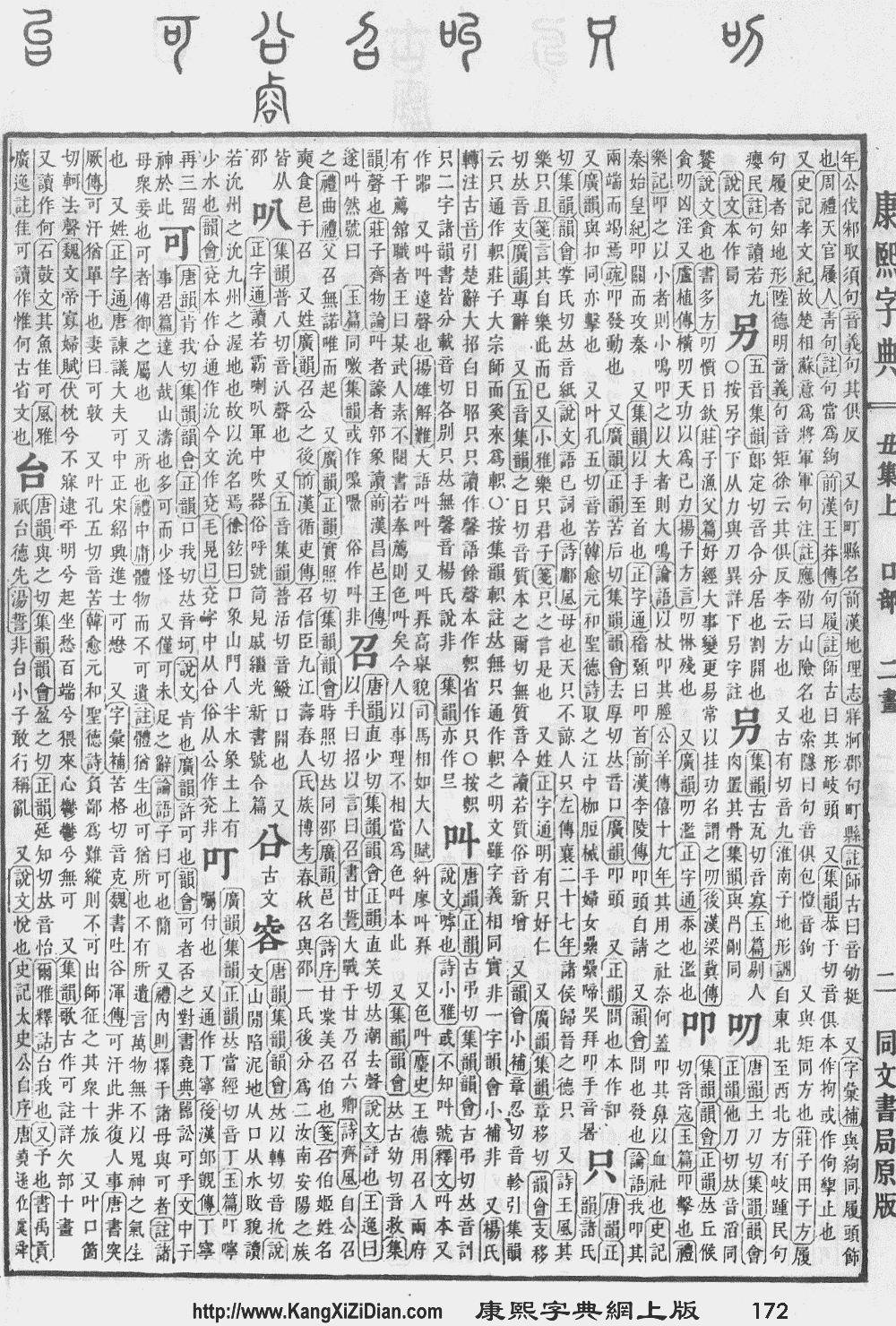
- Kangxi Dictionary: page 172, character 5
- Dai Kanwa Jiten: character 3239
- Dae Jaweon: page 383, character 1
- Hanyu Da Zidian (first edition): volume 1, page 570, character 3
- Unihan data for U+53EA
Chinese
Glyph origin
| Historical forms of the character 只 | |
|---|---|
| Shuowen Jiezi (compiled in Han) | Liushutong (compiled in Ming) |
| Small seal script | Transcribed ancient scripts |
 |
 |
Pictogram (象形) : airflow coming out of a mouth (口) – a modal particle.
Etymology 1
| trad. | 只/衹*/祇*/祗* | |
|---|---|---|
| simp. | 只 | |
| alternative forms | 秖 | |
Schuessler (2007) suggests that it is possibly Sino-Tibetan, relating it to Kamarupan ke, kʰe (“one”), which are perhaps related to Proto-Sino-Tibetan *r-kjaŋ (“single”), whence Tibetan རྐྱང (rkyang, “single”), Burmese ချင်း (hkyang:, “single”) and Burmese ချည်း (hkyany:, “alone,only, just”).
Pronunciation
Definitions
只
Synonyms
- (only):
Compounds
- 不只 (bùzhǐ)
- 不圖打點,只圖混水/不图打点,只图混水
- 不怕官,只怕管 (bùpà guān, zhǐ pà guǎn)
- 不怕縣官,只怕現管/不怕县官,只怕现管
- 不管生癬生瘡,我只生癩/不管生癣生疮,我只生癞
- 不管講雞講鴨,我只講鵝/不管讲鸡讲鸭,我只讲鹅
- 世上無難事,只怕有心人/世上无难事,只怕有心人
- 僅只/仅只
- 只今 (zhǐjīn)
- 只可
- 只可意會,不可言傳/只可意会,不可言传 (zhǐ kě yìhuì, bù kě yánchuán)
- 只合
- 只在 (zhǐzài)
- 只好 (zhǐhǎo)
- 只待 (zhǐdài)
- 只得 (zhǐdé)
- 只怕 (zhǐpà)
- 只教 (zhǐjiào)
- 只是 (zhǐshì)
- 只會/只会
- 只有 (zhǐyǒu)
- 只有出的氣,沒有進的氣/只有出的气,没有进的气
- 只欠東風/只欠东风
- 只此一家,別無分店/只此一家,别无分店 (zhǐ cǐ yī jiā, bié wú fēndiàn)
- 只消 (zhǐxiāo)
- 只爭旦夕/只争旦夕
- 只甚
- 只當/只当
- 只知其一,不知其二
- 只知有己,不知有人
- 只管 (zhǐguǎn)
- 只索
- 只能 (zhǐnéng)
- 只要 (zhǐyào)
- 只要功夫深,鐵杵磨成針/只要功夫深,铁杵磨成针 (zhǐyào gōngfu shēn, tiěchǔ mó chéng zhēn)
- 只見/只见 (zhǐjiàn)
- 只見樹木,不見森林/只见树木,不见森林 (zhǐjiànshùmù, bùjiànsēnlín)
- 只許州官放火,不許百姓點燈/只许州官放火,不许百姓点灯 (zhǐ xǔ zhōuguān fànghuǒ, bùxǔ bǎixìng diǎndēng)
- 只認錢不認人/只认钱不认人
- 只道
- 只重衣衫不重人
- 只須/只须
- 只顧/只顾 (zhǐgù)
- 天下無難事,只怕有心人/天下无难事,只怕有心人 (tiānxià wú nánshì, zhǐpà yǒuxīnrén)
- 好漢只怕病來磨/好汉只怕病来磨
- 弱水三千,只取一瓢飲/弱水三千,只取一瓢饮 (ruòshuǐsānqiān, zhǐ qǔ yīpiáo yǐn)
- 敢只是
- 是非只為多開口/是非只为多开口
- 破蒸籠,只會撒氣/破蒸笼,只会撒气
- 萬事俱備,只欠東風/万事俱备,只欠东风 (wànshì jùbèi, zhǐ qiàn dōngfēng)
- 肐膊只折在袖子裡/肐膊只折在袖子里
- 英雄只怕病來磨/英雄只怕病来磨
- 蚊子遭扇打,只為嘴傷人/蚊子遭扇打,只为嘴伤人
- 豈只/岂只 (qǐzhǐ)
- 賊沒種,只怕哄/贼没种,只怕哄
- 逢人只說三分話/逢人只说三分话
Pronunciation
Synonyms
Etymology 3
| simp. and trad. |
只 | |
|---|---|---|
(This etymology is missing or incomplete. Please add to it, or discuss it at the Etymology scriptorium.)
Pronunciation
Definitions
只
- † A modal particle.
Etymology 4
| simp. and trad. |
只 | |
|---|---|---|
(This etymology is missing or incomplete. Please add to it, or discuss it at the Etymology scriptorium.)
Pronunciation
Pronunciation
Etymology 6
| simp. and trad. |
只 | |
|---|---|---|
(This etymology is missing or incomplete. Please add to it, or discuss it at the Etymology scriptorium.)
Pronunciation
Etymology 7
| For pronunciation and definitions of 只 – see 隻 (“one bird; single; etc.”). (This character is the simplified and variant traditional form of 隻). |
Notes:
|
In traditional script, 只 (zhī) is a variant of 隻/只 (zhī) for a subset of its senses such as classifier for hands (highest affinity), one of a pair, etc, but most notably not for animals.
Pronunciation
Definitions
只
Etymology 8
| For pronunciation and definitions of 只 – see 咫 (“unit of measurement during the Zhou dynasty, equal to eight cun/tsun; etc.”). (This character is a variant form of 咫). |
Japanese
Korean
Hanja
只 (eum 지 (ji))
- This term needs a translation to English. Please help out and add a translation, then remove the text
{{rfdef}}.
Old Korean
Pronunciation
Conventionally reconstructed as *-k, after the Middle Korean reflexes.
Descendants
- Middle Korean: ㄱ (-k)
Verb
只 (*ki-)
References
- 남풍현 [nampunghyeon] (2004) “시상의 조동사 '在/𠂇/겨'의 발달' [sisang'ui jodongsa 在/𠂇/gyeo- ui baldal, The development of the aspectual auxiliary kye-]”, in Gugeo gukmunhak, volume 138, pages 5—34
- 황선엽 (Hwang Seon-yeop) et al. (2009) 석독구결사전/釋讀口訣辭典 [Dictionary of interpretive gugyeol], Bakmunsa, →ISBN, pages 411—549