殺
| ||||||||
 | ||||||||
| ||||||||
 | ||||||||
Translingual
| Traditional | 殺 |
|---|---|
| Simplified | 杀 |
| Japanese | 殺 |
| Korean | 殺 |
Alternative forms
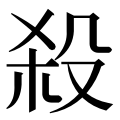
- In traditional Chinese (based on the modern character forms used in Taiwan and Hong Kong), the bottom left component is 朮 (𣎳 with an additional dot at its top right corner).
- In mainland China (based on the Xin Zixing (新字形) standardized character forms), the bottom left component is 朩 instead which is one stroke less.
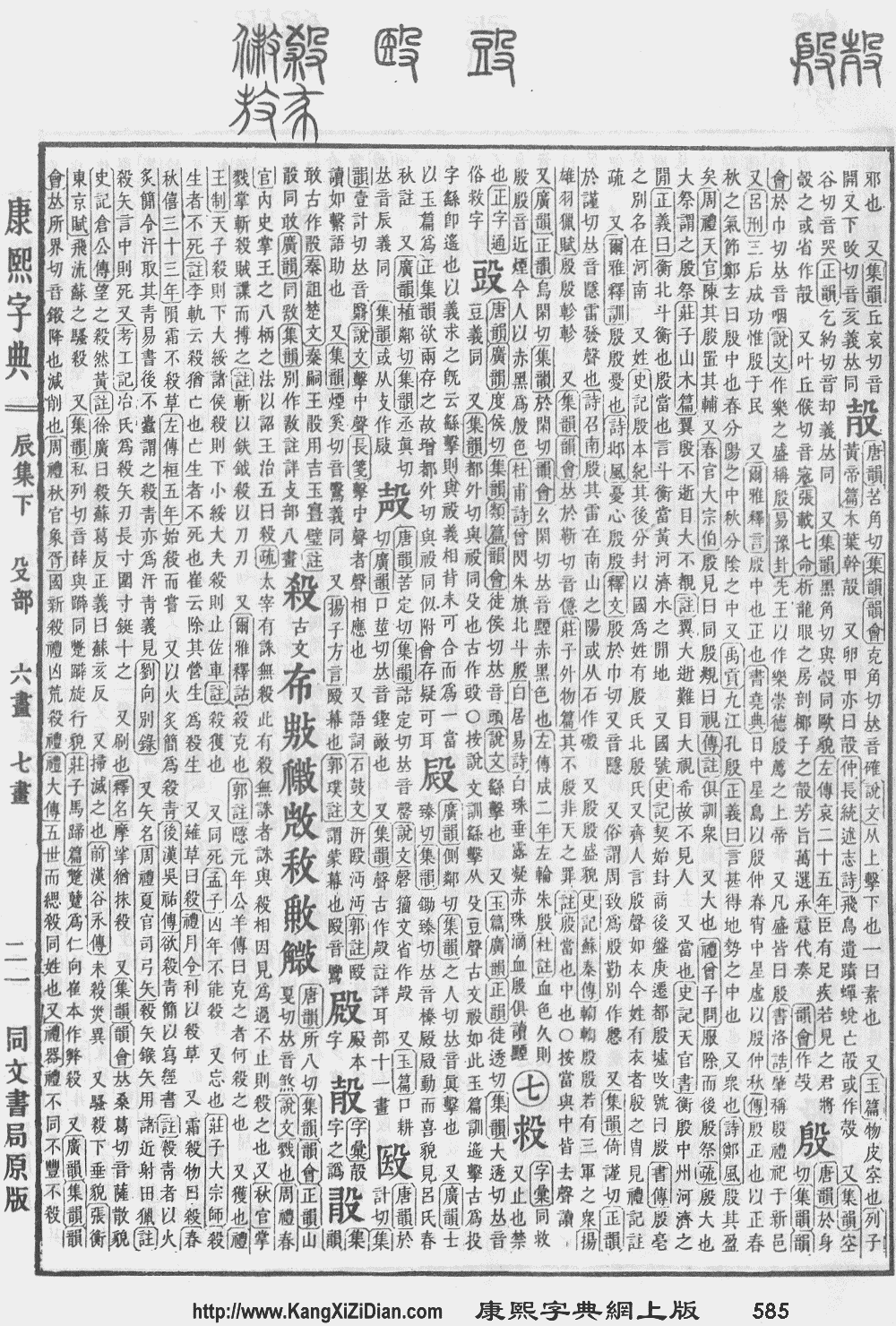
- In Korean hanja, the bottom left component is 术, which is also the historical form found in the Kangxi dictionary.
- In Japanese shinjitai and Vietnamese Nôm, the bottom left component is 木 which is one stroke less.
- Three CJK Compatibility Ideographs exist for this character:
U+F970corresponds to the Japanese kyūjitai form containing 术 which is similar to the historical Kangxi form.U+FA96corresponds to the alternative Korean form which is similar to the Japanese shinjitai form containing 木.U+2F8F5is similar to the traditional form in Taiwan but has 𣎳 (without dot at top right corner) instead of 朮 as its bottom left component.
Han character
殺 (Kangxi radical 79, 殳+7 in traditional Chinese and Korean, 殳+6 in mainland China and Japanese, 11 strokes in traditional Chinese and Korean, 10 strokes in mainland China and Japanese, cangjie input 大金竹弓水 (KCHNE) or 大木竹弓水 (KDHNE), four-corner 47947, composition ⿰⿱㐅朩殳(G) or ⿰⿱㐅朮殳(HT) or ⿰⿱㐅木殳(JV or U+FA96) or ⿰⿱㐅术殳(K or U+F970) or ⿰⿱㐅𣎳殳(U+2F8F5))
Related characters
References
- Kangxi Dictionary: page 585, character 11
- Dai Kanwa Jiten: character 16638
- Dae Jaweon: page 978, character 5
- Hanyu Da Zidian (first edition): volume 3, page 2157, character 1
- Unihan data for U+6BBA
- Unihan data for U+F970
- Unihan data for U+FA96
- Unihan data for U+2F8F5
Chinese
| trad. | 殺 | |
|---|---|---|
| simp. | 杀* | |
| alternative forms | ||
Glyph origin
In the oracle bone script, it was an ideogrammic compound (會意/会意) of a boar that had been impaled in the head.
In the seal script, the original compound was corrupted into 𣏂 (sometimes written as 杀). It was also in the seal script that the pictogram (象形) : 人 (“person”) + 又 (“right hand”), which was later corrupted into 殳 (“spear”) or 攴, was added under the head of the boar to specify the killing was done by a person.
The modern-day character inherits this and can be thought of as a phono-semantic compound (形聲/形声, OC *sreːds, *sreːd) : phonetic 𣏂 () + semantic 殳 (“spear”).
Etymology 1
From Proto-Sino-Tibetan *g/b-sat (“to kill”); compare Tibetan བསད (bsad), perfect of Tibetan གསོད (gsod, “to kill”), Proto-Lolo-Burmese *C-sat (“to kill”), Japhug sat (“to kill”) (STEDT; Schuessler, 2007; Zhang, Jacques and Lai, 2019).
Pronunciation
Definitions
殺
- (transitive) to kill; to murder
- to ruin; to harm
- to fight
- (dialectal, transitive) to cut; to slice (fruit, food)
- (transitive) to abate; to reduce
- (regional, colloquial) to sting
- (chess) to mate; short for 將殺/将杀 (jiāngshā) ("to checkmate")
- (Hokkien) ruthless; ferocious; fierce
- (Hokkien) to butcher, especially by using a blade to drain its blood to death (of animals)
- 殺雞/杀鸡 [Hokkien] ― soah koe [Pe̍h-ōe-jī] ― to butcher a chicken by draining its blood with a knife
- (Taiwanese Hokkien) willing to part with something
Usage notes
- Normally, the subject of 殺 should be animate. The sentence "A tiger killed many people." can be validly translated as 老虎殺死數人, while the sentence "This accident killed many people." is seldom translated as *這次事故殺死數人. For death caused by non-living things, split forms of 致死 (zhìsǐ) are often used instead:
Synonyms
- (to kill):
- 刑 (xíng) (literary)
- 剿戮 (jiǎolù) (archaic)
- 屠宰 (túzǎi) (an animal for food)
- 屠戮 (túlù) (literary)
- 屠殺/屠杀 (túshā) (in large numbers)
- 慘殺/惨杀 (cǎnshā) (to kill in cold blood)
- 故意殺人/故意杀人 (gùyì shārén) (law, mainland China)
- 殘殺/残杀 (cánshā)
- 殛斃/殛毙 (jíbì) (literary)
- 殺人/杀人 (shārén) (to kill someone)
- 殺害/杀害 (shāhài)
- 殺戮/杀戮 (shālù) (literary)
- 殺死/杀死 (shāsǐ)
- 解決/解决 (jiějué) (euphemism)
- 誅殺/诛杀 (zhūshā) (literary)
- 謀殺/谋杀 (móushā)
- 辦/办 (bàn) (euphemism)
| Variety | Location | Words |
|---|---|---|
| Classical Chinese | 殺 | |
| Formal (Written Standard Chinese) | 殺 | |
| Mandarin | Beijing | 殺 |
| Taiwan | 殺 | |
| Yantai (Muping) | 殺 | |
| Jinan | 殺 | |
| Luoyang | 殺 | |
| Wanrong | 殺 | |
| Xi'an | 殺 | |
| Yinchuan | 殺 | |
| Wuhan | 殺 | |
| Chengdu | 殺 | |
| Guilin | 殺 | |
| Yangzhou | 殺 | |
| Nanjing | 殺 | |
| Hefei | 殺 | |
| Malaysia | 殺 | |
| Singapore | 殺 | |
| Cantonese | Guangzhou | 殺 |
| Hong Kong | 殺 | |
| Yangjiang | 殺 | |
| Kuala Lumpur (Guangfu) | 殺 | |
| Singapore (Guangfu) | 殺 | |
| Gan | Nanchang | 殺 |
| Lichuan | 殺 | |
| Hakka | Meixian | 殺 |
| Yudu | 殺 | |
| Huizhou | Jixi | 殺 |
| Jin | Taiyuan | 殺 |
| Northern Min | Jian'ou | 殺 |
| Eastern Min | Fuzhou | 刣 |
| Fuqing | 殺 | |
| Southern Min | Xiamen | 刣 |
| Quanzhou | 刣 | |
| Jinjiang | 刣 | |
| Yongchun | 刣 | |
| Zhangzhou | 刣 | |
| Tainan | 刣 | |
| Penang (Hokkien) | 刣 | |
| Singapore (Hokkien) | 刣 | |
| Manila (Hokkien) | 刣 | |
| Chaozhou | 刣 | |
| Shantou | 刣 | |
| Shantou (Chenghai) | 刣 | |
| Jieyang | 刣 | |
| Lufeng | 刣 | |
| Haifeng | 刣 | |
| Singapore (Teochew) | 刣 | |
| Leizhou | 殺 | |
| Wenchang | 殺 | |
| Haikou | 殺 | |
| Wu | Shanghai | 殺 |
| Shanghai (Chongming) | 殺 | |
| Suzhou | 殺 | |
| Hangzhou | 殺 | |
| Wenzhou | 殺 | |
| Jinhua | 殺 | |
| Xiang | Changsha | 殺 |
| Loudi | 殺 | |
| Shuangfeng | 殺 | |
Compounds
- 一概抹殺/一概抹杀
- 一筆抹殺/一笔抹杀 (yībǐmǒshā)
- 不教而殺/不教而杀
- 仇殺/仇杀 (chóushā)
- 他殺/他杀 (tāshā)
- 以殺去殺/以杀去杀
- 以殺止殺/以杀止杀
- 低溫殺菌/低温杀菌
- 借刀殺人/借刀杀人 (jièdāoshārén)
- 借劍殺人/借剑杀人
- 六殺/六杀
- 凶殺 (xiōngshā)
- 凶殺案
- 切腹自殺/切腹自杀
- 刺殺/刺杀 (cìshā)
- 剿殺 (jiǎoshā)
- 劇本殺/剧本杀 (jùběnshā)
- 劫殺/劫杀
- 勝殘去殺/胜残去杀 (shèngcánqùshā)
- 卸磨殺驢/卸磨杀驴 (xièmòshālǘ)
- 去殺勝殘/去杀胜残
- 合殺/合杀
- 喊殺/喊杀 (hǎnshā)
- 喊殺連天/喊杀连天
- 嗜殺成性/嗜杀成性
- 嚇殺/吓杀 (xiàshā)
- 嚇殺人/吓杀人
- 嚇殺人香/吓杀人香 (xiàshārénxiāng)
- 嚴殺/严杀
- 坑殺/坑杀
- 大屠殺/大屠杀 (dàtúshā)
- 大殺/大杀 (dàshā)
- 大殺風景/大杀风景
- 天殺的/天杀的
- 天生天殺/天生天杀
- 夾殺/夹杀
- 好生惡殺/好生恶杀
- 妨殺/妨杀
- 姦殺/奸杀 (jiānshā)
- 宰殺/宰杀 (zǎishā)
- 封殺/封杀 (fēngshā)
- 射殺/射杀 (shèshā)
- 屠殺/屠杀 (túshā)
- 廝殺/厮杀 (sīshā)
- 忒殺/忒杀
- 惡支殺/恶支杀
- 情殺/情杀 (qíngshā)
- 慈悲殺人/慈悲杀人
- 慢性自殺/慢性自杀
- 打打殺殺/打打杀杀 (dǎdashāshā)
- 打殺/打杀
- 打魚殺家/打鱼杀家
- 扼殺/扼杀 (èshā)
- 抄殺/抄杀 (chāoshā)
- 抹殺/抹杀 (mǒshā)
- 拉殺/拉杀
- 拋閃殺人/抛闪杀人
- 按殺/按杀
- 捐殘去殺/捐残去杀
- 捕殺/捕杀 (bǔshā)
- 掩殺/掩杀 (yǎnshā)
- 接殺/接杀
- 掠殺/掠杀
- 捧殺/捧杀 (pěngshā)
- 搏殺/搏杀 (bóshā)
- 撲殺/扑杀 (pūshā)
- 收殺/收杀
- 故殺/故杀 (gùshā)
- 斫殺/斫杀
- 斬刈殺伐/斩刈杀伐
- 斬盡殺絕/斩尽杀绝
- 春生秋殺/春生秋杀
- 暗殺/暗杀 (ànshā)
- 曾參殺人/曾参杀人 (Zēng Shēn shārén)
- 曾子殺彘/曾子杀彘
- 格殺/格杀 (géshā)
- 格殺勿論/格杀勿论 (géshāwùlùn)
- 槍殺/枪杀 (qiāngshā)
- 止殺/止杀
- 殘殺/残杀 (cánshā)
- 殺一儆百/杀一儆百 (shāyījǐngbǎi)
- 殺一利百/杀一利百
- 殺人償命/杀人偿命
- 殺人如芥/杀人如芥
- 殺人如草/杀人如草
- 殺人如蓺/杀人如蓺
- 殺人如麻/杀人如麻 (shārénrúmá)
- 殺人放火/杀人放火 (shārénfànghuǒ)
- 殺人滅口/杀人灭口 (shārénmièkǒu)
- 殺人滅跡/杀人灭迹
- 殺人犯/杀人犯 (shārénfàn)
- 殺人盈野/杀人盈野
- 殺人罪/杀人罪
- 殺人越貨/杀人越货 (shārényuèhuò)
- 殺伐/杀伐 (shāfá)
- 殺伐決斷/杀伐决断
- 殺傷/杀伤 (shāshāng)
- 殺傷力/杀伤力 (shāshānglì)
- 殺價/杀价 (shājià)
- 殺出重圍/杀出重围
- 殺剁/杀剁
- 殺千刀/杀千刀
- 殺口甜/杀口甜 (shākǒutián)
- 殺坯/杀坯
- 殺妻求將/杀妻求将
- 殺威棒/杀威棒
- 殺威風/杀威风
- 殺害/杀害 (shāhài)
- 殺家達子/杀家达子
- 殺彘教子/杀彘教子
- 殺性子/杀性子
- 殺戒/杀戒 (shājiè)
- 殺戮/杀戮 (shālù)
- 殺手/杀手 (shāshǒu)
- 殺才/杀才
- 殺手鐧/杀手锏
- 殺掠/杀掠 (shālüè)
- 殺敵致果/杀敌致果
- 殺校/杀校
- 殺機/杀机 (shājī)
- 殺死/杀死 (shāsǐ)
- 殺氣/杀气 (shāqì)
- 殺氣騰騰/杀气腾腾
- 殺狗勸夫/杀狗劝夫
- 殺狗記/杀狗记
- 殺生/杀生 (shāshēng)
- 殺生之柄/杀生之柄
- 殺生之權/杀生之权
- 殺生與奪/杀生与夺
- 殺聲震天/杀声震天
- 殺菌/杀菌 (shājūn)
- 殺菌劑/杀菌剂
- 殺蟲劑/杀虫剂 (shāchóngjì)
- 殺蟲器/杀虫器
- 殺身/杀身 (shāshēn)
- 殺身之禍/杀身之祸 (shāshēnzhīhuò)
- 殺身出生/杀身出生
- 殺身報國/杀身报国
- 殺身成仁/杀身成仁 (shāshēnchéngrén)
- 殺身成名/杀身成名
- 殺身成義/杀身成义
- 殺身救國/杀身救国
- 殺身為報/杀身为报
- 殺雞儆猴/杀鸡儆猴 (shājījǐnghóu)
- 殺雞取卵/杀鸡取卵 (shājīqǔluǎn)
- 殺雞扯脖/杀鸡扯脖
- 殺雞炊黍/杀鸡炊黍
- 殺雞為黍/杀鸡为黍
- 殺雞駭猴/杀鸡骇猴 (shājīhàihóu)
- 殺青/杀青 (shāqīng)
- 殺頭/杀头 (shātóu)
- 殺風景/杀风景 (shā fēngjǐng)
- 殺馬毀車/杀马毁车
- 毀車殺馬/毁车杀马
- 毒殺/毒杀 (dúshā)
- 氣殺鍾馗/气杀钟馗
- 沒亂殺/没乱杀
- 淹殺/淹杀
- 溷殺/溷杀
- 濫殺無辜/滥杀无辜 (lànshā wúgū)
- 爛殺/烂杀
- 牲殺/牲杀
- 狙殺/狙杀 (jūshā)
- 獵殺/猎杀 (lièshā)
- 生殺之權/生杀之权
- 生殺予奪/生杀予夺 (shēngshāyǔduó)
- 生殺大權/生杀大权 (shēngshādàquán)
- 生殺與奪/生杀与夺 (shēngshāyǔduó)
- 畏罪自殺/畏罪自杀
- 砍殺/砍杀 (kǎnshā)
- 破殺殺/破杀杀
- 絞殺/绞杀 (jiǎoshā)
- 義刑義殺/义刑义杀
- 肅殺/肃杀 (sùshā)
- 自殺/自杀 (zìshā)
- 自相殘殺/自相残杀 (zìxiāngcánshā)
- 苦殺/苦杀
- 荊劉拜殺/荆刘拜杀
- 藥殺/药杀
- 虐殺/虐杀 (nüèshā)
- 虧殺/亏杀
- 衝殺/冲杀 (chōngshā)
- 覆軍殺將/覆军杀将
- 觸殺/触杀
- 誅殺/诛杀 (zhūshā)
- 誅盡殺絕/诛尽杀绝
- 誤殺/误杀 (wùshā)
- 誘殺/诱杀 (yòushā)
- 謀殺/谋杀 (móushā)
- 趕盡殺絕/赶尽杀绝 (gǎnjìnshājué)
- 躁殺/躁杀
- 追殺/追杀 (zhuīshā)
- 通殺/通杀 (tōngshā)
- 過失殺人/过失杀人 (guòshī shārén)
- 逼殺/逼杀 (bīshā)
- 雙殺/双杀
- 馬殺雞/马杀鸡 (mǎshājī)
- 鴆殺/鸩杀 (zhènshā)
Etymology 2
From 衰 (OC *sʰrol, *srul, “to diminish; to decay”) + final *-t (Schuessler, 2007).
Pronunciation
Definitions
殺
Compounds
- 不殺/不杀
- 不豐不殺/不丰不杀
- 噍殺/噍杀
- 幽殺/幽杀
- 殺衣縮食/杀衣缩食
- 豐殺/丰杀
Pronunciation
Pronunciation
Definitions
殺
- Only used in 蹩殺/蹩杀.
Pronunciation
Definitions
殺
- Only used in 降殺/降杀.
Etymology 6
| For pronunciation and definitions of 殺 – see 弒 (“to assassinate; to kill a superior”). (This character is a variant form of 弒). |
References
- “殺”, in 漢語多功能字庫 (Multi-function Chinese Character Database), 香港中文大學 (the Chinese University of Hong Kong), 2014–
Japanese
| Shinjitai | 殺 | |
| Kyūjitai [1][2] |
殺 殺or 殺+ ︀? |
|
| 殺󠄀 殺+ 󠄀?(Adobe-Japan1) | ||
| 殺󠄃 殺+ 󠄃?(Hanyo-Denshi) (Moji_Joho) | ||
| The displayed kanji may be different from the image due to your environment. See here for details. | ||
Readings
From Middle Chinese 殺 (MC sreat):
From Middle Chinese 殺 (MC sreajH):
From native Japanese roots:
Compounds
- 暗殺 (ansatsu, “assassination”)
- 縊殺 (isatsu, “strangling to death”)
- 虐殺 (gyakusatsu, “massacre”)
- 殺害 (satsugai, “murder”)
- 殺人 (satsujin, “murder, homicide”)
- 殺伐 (satsubatsu)
- 殺戮 (satsuriku)
- 殺気 (sakki, “bloodlust”, literally “killing spirit”)
- 殺菌 (sakkin, “sterilization”)
- 殺傷 (sasshō, “violence, bloodshed”)
- 殺虫剤 (satchūzai, “insecticide”)
- 殺到 (sattō, “rush, flood (of people, letters, phone calls etc.)”)
- 殺風景 (sappūkei, “bleak, barren”, literally “killing the scenery”)
- 刺殺 (shisatsu)
- 自殺 (jisatsu, “suicide”)
- 殺生 (sesshō)
- 相殺 (sōsai, “cancelling out, offsetting”)
- 他殺 (tasatsu, “murder”)
- 殺陣 (tate, “stage combat”)
- 人殺し (hitogoroshi, “murderer”)
- 必殺 (hissatsu)
- 併殺 (heisatsu, “double play”)
- 抹殺 (massatsu, “erasure; denial”)
- 黙殺 (mokusatsu, “ignoring”, literally “killing with silence”)
References
- “殺”, in 漢字ぺディア (Kanjipedia) (in Japanese), 日本漢字能力検定協会, 2015–2024
- Haga, Gōtarō (1914) 漢和大辞書 [The Great Kanji-Japanese Dictionary] (in Japanese), Fourth edition, Tōkyō: Kōbunsha, , page 1220 (paper), page 661 (digital)
Korean
Etymology 1
From Middle Chinese 殺 (MC sreat).
| Historical readings |
|---|
|
Pronunciation
- (SK Standard/Seoul) IPA(key): [sʰa̠ɭ]
- Phonetic hangul: [살]
Compounds
- 교살 (絞殺, gyosal)
- 말살 (抹殺, malsal)
- 몰살 (沒殺, molsal)
- 박살 (搏殺, baksal)
- 사살 (射殺, sasal)
- 살상 (殺傷, salsang)
- 살충 (殺蟲, salchung)
- 살해 (殺害, salhae)
- 자살 (自殺, jasal)
- 총살 (銃殺, chongsal)
- 척살 (刺殺, cheoksal)
- 타살 (他殺, tasal)
- 피살 (被殺, pisal)
- 살의 (殺意, sarui)
- 묵살 (默殺, muksal)
- 독살 (毒殺, doksal)
- 살생 (殺生, salsaeng)
- 학살 (虐殺, haksal, “massacre; slaughter”)
- 도살 (屠殺, dosal, “slaughter (of animals)”)
- 살균 (殺菌, salgyun, “sterilization”)
- 살인 (殺人, sarin, “murder; killing; homicide”)
- 암살 (暗殺, amsal, “assassination”)
- 피살 (被殺, pisal, “being killed”)
Etymology 2
From Middle Chinese 殺 (MC sreajH).
| Historical readings |
|---|
|
Pronunciation
- (SK Standard/Seoul) IPA(key): [sʰwɛ(ː)] ~ [sʰwe̞(ː)]
- Phonetic hangul: [쇄(ː)/쉐(ː)]
- Though still prescribed in Standard Korean, most speakers in both Koreas no longer distinguish vowel length.
Hanja
Compounds
- 뇌쇄 (惱殺, noeswae)
- 감쇄 (減殺, gamswae)
- 쇄도 (殺到, swaedo, “a rush”)
- 상쇄 (相殺, sangswae, “counteraction; neutralization; offsetting”)