鰹
See also: 鲣
| ||||||||
Translingual
Han character
鰹 (Kangxi radical 195, 魚+11, 22 strokes, cangjie input 弓火尸水土 (NFSEG), four-corner 27314, composition ⿰魚堅)
- a skipjack tuna, a bonito, Katsuwonus pelamis (Japanese)
- a great eel (Classical Chinese)
- a kind of shark
References
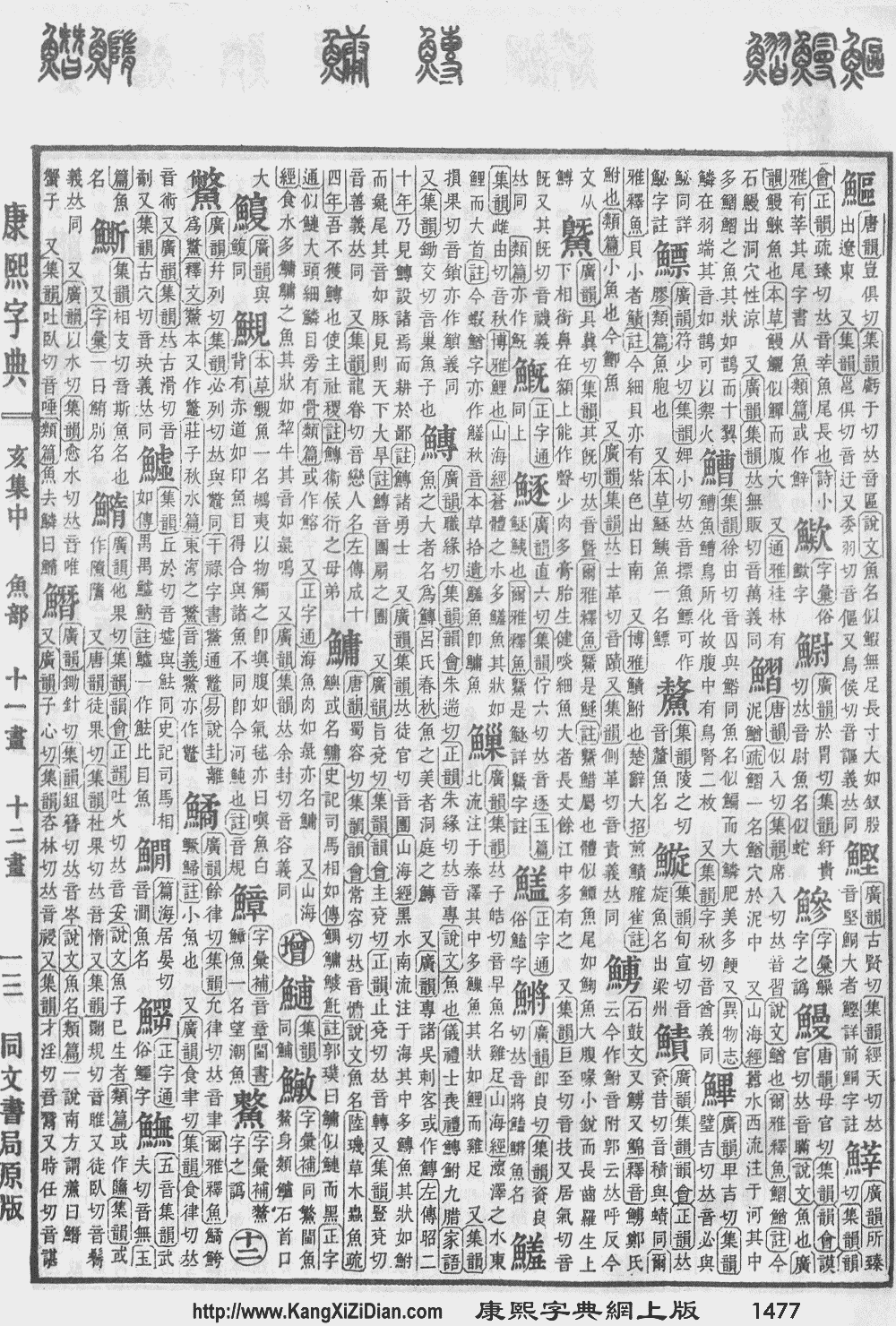
- Kangxi Dictionary: page 1477, character 2
- Dai Kanwa Jiten: character 46437
- Dae Jaweon: page 2008, character 28
- Hanyu Da Zidian (first edition): volume 7, page 4709, character 14
- Unihan data for U+9C39
Chinese
| trad. | 鰹 | |
|---|---|---|
| simp. | 鲣 | |
Glyph origin
Characters in the same phonetic series (臣) (Zhengzhang, 2003)
Phono-semantic compound (形聲/形声, OC *kiːn) : semantic 魚 + phonetic 堅 (OC *kiːn).
Pronunciation
Definitions
鰹
- This term needs a translation to English. Please help out and add a translation, then remove the text
{{rfdef}}.
Japanese
Etymology
| Kanji in this term |
|---|
| 鰹 |
| かつお Hyōgaiji |
| kun’yomi |
| Alternative spellings |
|---|
| 堅魚 松魚 |
From Old Japanese katuwo. Found in the Man'yōshū of 759.[1]
/katuwo/ → /kat͡suwo/ → /kat͡suo/
Two possible derivations:
- A shift from a compound of 堅 (kata-, stem meaning "firm, hard") + 魚 (uo, “fish”), from the long-standing practice of drying lower-grade tuna into hard blocks, in part due to the common presence of parasites. A folk etymology also derives this kanji character, compare 木工 → 杢 (moku, “woodworker”, archaic) and 麻呂 → 麿 (maro, first-person pronoun, archaic).
- A shift from a compound of 勝つ (katsu, “to win”) + 魚 (uo, “fish”).
Considering the rules of Old Japanese phonology, specifically that two vowels are not allowed in sequence, resulting in elision or fusion, the kata + uo → katuo shift seems likely.
Noun
鰹 or 鰹 • (katsuo) ←かつを (katwo) or カツヲ (katwo)?
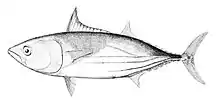
- a skipjack tuna, Katsuwonus pelamis
- Short for 鰹木 (katsuogi): a log on the roof of a shrine set perpendicular to the ridgepole
- Short for 鰹節 (katsuobushi): smoked and dried skipjack tuna
- (obsolete) Short for 鰹虫 (katsuomushi): a biting midge; a water strider
Derived terms
Derived terms
- 秋鰹 (akigatsuo, “bonito caught in autumn”, obscure)
- 鰹木 (katsuogi, “shrine log”)
- 鰹鯨 (katsuokujira, “Eden's whale, Bryde's whale”, Balaenoptera edeni)
- 鰹だし, 鰹出汁, 鰹出し (katsuodashi, “(dried) bonito stock”)
- 鰹鳥 (katsuodori, “brown booby”, Sula leucogaster)
- 鰹の烏帽子 (katsuo no eboshi, “Portuguese man-of-war”, Physalia physalis)
- 鰹節 (katsubushi), 鰹節 (katsuobushi, “katsuobushi”)
- 鰹味噌 (katsuomiso, “miso mixed with bonito”)
- 縞鰹 (shimagatsuo, “Pacific pomfret”, Brama japonica)
- 宗太鰹 (sōdagatsuo, “frigate tuna”, genus Auxis spp.)
- 歯鰹 (hagatsuo, “striped bonito”, Sarda orientalis)
- 初松魚, 初鰹 (hatsugatsuo, “first bonito of the season”)
- 花鰹 (hanakatsuo), 花鰹 (hanagatsuo, “dried bonito shavings”)
- 真魚鰹 (managatsuo, a species of butterfish, Pampus punctatissimus)
Descendants
References
- , available online here. Katuwo appears spelled as 堅魚. While this does not phonetically spell katuwo itself, given the meter of the poetry, this word must have three morae, and given Old Japanese phonology, we know that this cannot have been kata uwo due to the restriction on successive vowels.
- Matsumura, Akira, editor (2006), 大辞林 [Daijirin] (in Japanese), Third edition, Tōkyō: Sanseidō, →ISBN
- NHK Broadcasting Culture Research Institute, editor (1998), NHK日本語発音アクセント辞典 [NHK Japanese Pronunciation Accent Dictionary] (in Japanese), Tōkyō: NHK Publishing, →ISBN
Further reading
- Entry at Nihon Jiten (in Japanese)
- Entry at Gogen Yurai Jiten ("Etymology Derivation Dictionary", in Japanese)
Korean
Hanja
鰹 • (gyeon) (hangeul 견, revised gyeon, McCune–Reischauer kyŏn, Yale kyen)
- This term needs a translation to English. Please help out and add a translation, then remove the text
{{rfdef}}.
Vietnamese
This article is issued from Wiktionary. The text is licensed under Creative Commons - Attribution - Sharealike. Additional terms may apply for the media files.