腎
See also: 肾
| ||||||||
Translingual
Han character
腎 (Kangxi radical 130, 肉+8 in Chinese, 肉+9 in Japanese, 12 strokes in Chinese, 13 strokes in Japanese, cangjie input 尸水月 (SEB), four-corner 77227, composition ⿱臤肉)
Descendants
References
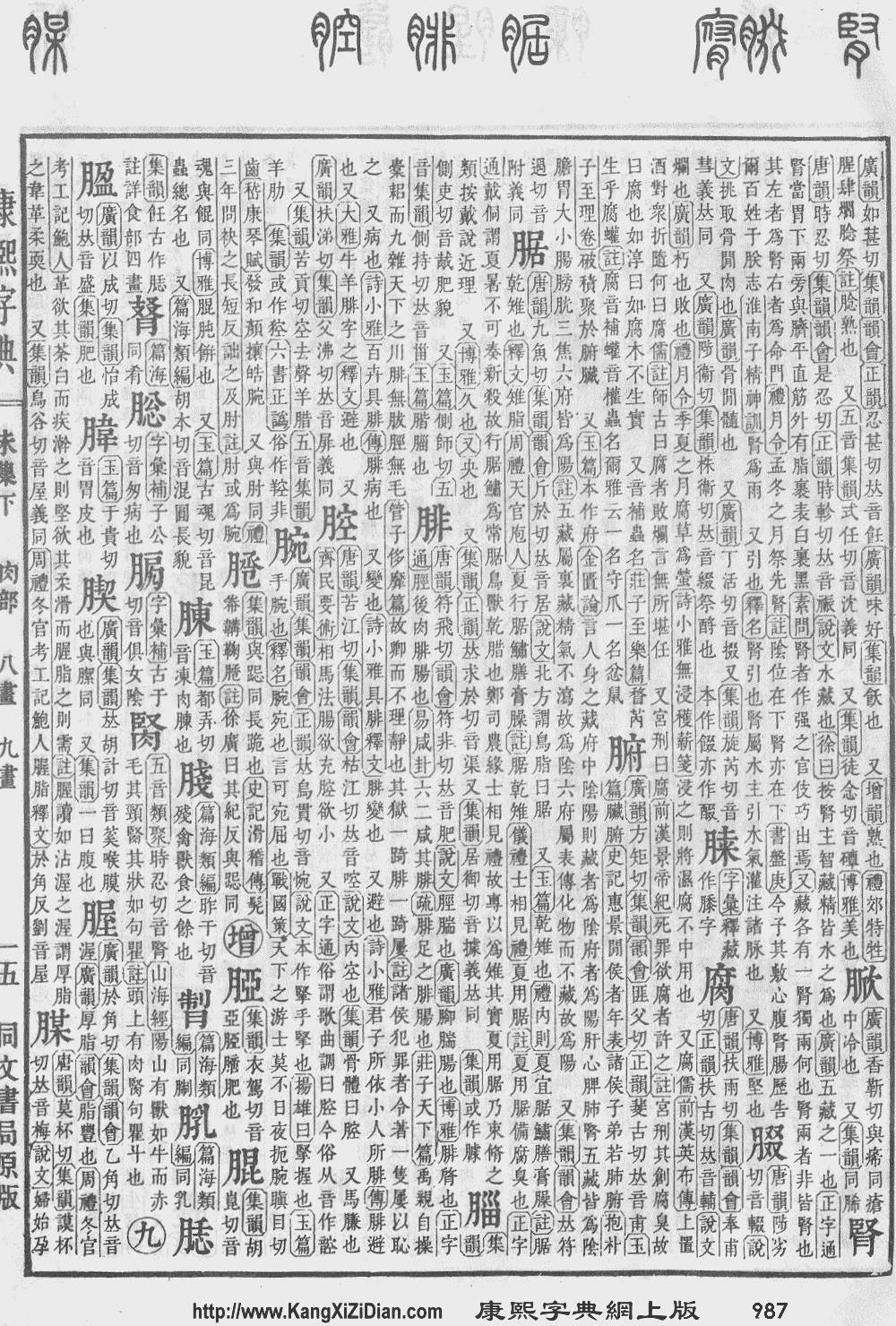
- Kangxi Dictionary: page 987, character 2
- Dai Kanwa Jiten: character 29621
- Dae Jaweon: page 1439, character 13
- Hanyu Da Zidian (first edition): volume 3, page 2086, character 4
- Unihan data for U+814E
Chinese
| trad. | 腎 | |
|---|---|---|
| simp. | 肾 | |
Glyph origin
Characters in the same phonetic series (臣) (Zhengzhang, 2003)
Phono-semantic compound (形聲/形声, OC *ɡjinʔ) : phonetic 臤 (OC *kʰaːn, *kʰriːn, *ɡiːn, *kʰins) + semantic ⺼ (“meat; flesh”) – a body part, the kidneys.
Etymology
From Proto-Sino-Tibetan *m-k(j)un (“kidney”). Cognate with Burmese ကုန်း (kun:, “back”).
Pronunciation
Definitions
腎
Synonyms
Dialectal synonyms of 腎 (“kidney”) [map]
Dialectal synonyms of 睪丸 (“testicle”) [map]
Compounds
- 敗腎/败肾
- 洗腎/洗肾 (xǐshèn)
- 腎上腺/肾上腺 (shènshàngxiàn)
- 腎上腺素/肾上腺素 (shènshàngxiànsù)
- 腎元/肾元 (shènyuán)
- 腎動脈/肾动脉 (shèndòngmài)
- 腎囊/肾囊 (shènnáng)
- 腎子/肾子 (shènzi)
- 腎炎/肾炎 (shènyán)
- 腎病症候群/肾病症候群 (shènbìngzhènghòuqún)
- 腎病綜合症/肾病综合症 (shènbìngzōnghézhèng)
- 腎癌/肾癌 (shèn'ái)
- 腎盂/肾盂 (shènyú)
- 腎盂炎/肾盂炎
- 腎素/肾素 (shènsù)
- 腎結核/肾结核
- 腎結石/肾结石 (shènjiéshí)
- 腎臟/肾脏 (shènzàng)
- 腎臟癌/肾脏癌 (shènzàng'ái)
- 腎虧/肾亏 (shènkuī)
- 腎錐體/肾锥体 (shènzhuītǐ)
- 腎靜脈/肾静脉 (shènjìngmài)
- 補腎/补肾 (bǔshèn)
- 賣腎/卖肾
- 雕肝琢腎/雕肝琢肾
- 雕肝鏤腎/雕肝镂肾
- 雞腎/鸡肾 (jīshèn)
- 鴨腎/鸭肾
Japanese
Kanji
腎
- This term needs a translation to English. Please help out and add a translation, then remove the text
{{rfdef}}.
Etymology 1
/murato1/ → /murato/.
Pronunciation
- IPA(key): [murato]
Noun
腎 • (murato)
- (obsolete) kidney
- 794, Shin'yaku Kegonkyō Ongi Shiki:
- 心腎肝脯 心人情也 腎音神 訓牟良斗 肝音干 訓岐毛
- (please add an English translation of this quotation)
Etymology 2
From earlier /murato/. Voicing suggests that it was originally a compound of mura and to.
Pronunciation
- IPA(key): [murado]
Noun
腎 • (murado)
- (obsolete) kidney
- 938, Minamoto no Shitagō, Wamyō Ruijushō, volume 2, pages 35-36:
- 腎 白虎通云 時忍反 上聲之重 无良度 [...] 水之精也 色黑 [...] 水藏也 [...]
- 腎 白虎通云 時忍反 上聲之重 无良度 [...] 水之精也 色黑 [...] 水藏也 [...]
- (please add an English translation of this quotation)
References
- Takeuchi, Rizō (1962) Nara Ibun: Volume 3 (in Japanese), Tōkyō: Tōkyōdō Shuppan, →ISBN.
- Minamoto, Shitagō with Kyōto Daigaku Bungakubu Kokugogaku Kokubungaku Kenkyūshitu (931–938) Shohon Shūsei Wamyō Ruijushō: Honbunhen (in Japanese), Kyōto: Rinsen, published 1968, →ISBN.
Korean
Etymology
From Middle Chinese 腎 (MC dzyinX). Recorded as Middle Korean 신〮 (sín) (Yale: sin) in Hunmong Jahoe (訓蒙字會 / 훈몽자회), 1527.
This article is issued from Wiktionary. The text is licensed under Creative Commons - Attribution - Sharealike. Additional terms may apply for the media files.