亙

See also: 𠄣 and 亘
亙 U+4E99, 亙
CJK UNIFIED IDEOGRAPH-4E99
← 亘
[U+4E98]
CJK Unified Ideographs 亚 →
[U+4E9A]

Translingual

Stroke order

Han character

亙 (Kangxi radical 7, 二+4, 6 strokes, cangjie input 一月一 (MBM), four-corner 10106, composition ⿻𠄠⿴𠂊⺀)

Derived characters

References

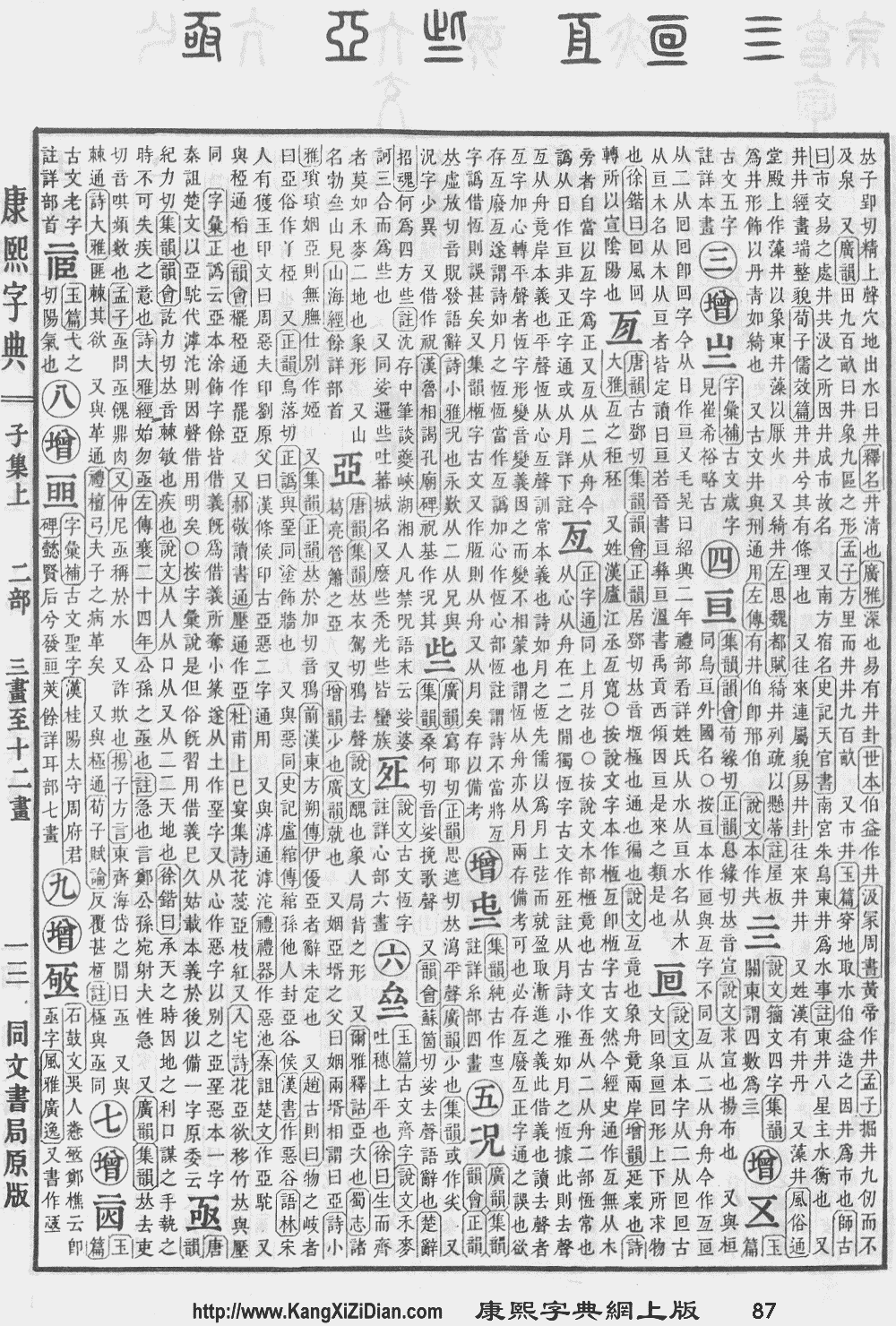
  • Kangxi Dictionary: page 87, character 7
  • Dai Kanwa Jiten: character 265
  • Dae Jaweon: page 183, character 12
  • Hanyu Da Zidian (first edition): volume 1, page 19, character 5
  • Unihan data for U+4E99

Chinese

trad. 亙/亘*
simp. 亘*
alternative forms 𠀕
𠄣
𠄭

Glyph origin

Historical forms of the character 亙


References:

Mostly from Richard Sears' Chinese Etymology site (authorisation),
which in turn draws data from various collections of ancient forms of Chinese characters, including:

  • Shuowen Jiezi (small seal),
  • Jinwen Bian (bronze inscriptions),
  • Liushutong (Liushutong characters) and
  • Yinxu Jiaguwen Bian (oracle bone script).

Ideogrammic compound (會意/会意) : 二 + 月 (“moon”).

Possibly also the original form of 恆.

Pronunciation


Rime
Character 亙
Reading # 1/1
Initial (聲) 見 (28)
Final (韻) 登 (129)
Tone (調) Departing (H)
Openness (開合) Open
Division (等) I
Fanqie 古鄧切
Baxter kongH
Reconstructions
Zhengzhang
Shangfang
/kəŋH/
Pan
Wuyun
/kəŋH/
Shao
Rongfen
/kəŋH/
Edwin
Pulleyblank
/kəŋH/
Li
Rong
/kəŋH/
Wang
Li
/kəŋH/
Bernard
Karlgren
/kəŋH/
Expected
Mandarin
Reflex
gèng
Expected
Cantonese
Reflex
gang3
Baxter–Sagart system 1.1 (2014)
Character 亙
Reading # 1/1
Modern
Beijing
(Pinyin)
gèn
Middle
Chinese
‹ kongH ›
Old
Chinese
/*[k]ˁəŋ-s/
English continuous; constant

Notes for Old Chinese notations in the Baxter–Sagart system:

* Parentheses "()" indicate uncertain presence;
* Square brackets "[]" indicate uncertain identity, e.g. *[t] as coda may in fact be *-t or *-p;
* Angle brackets "<>" indicate infix;
* Hyphen "-" indicates morpheme boundary;

* Period "." indicates syllable boundary.
Zhengzhang system (2003)
Character 亙
Reading # 1/1
No. 5122
Phonetic
component
亙
Rime
group
蒸
Rime
subdivision
0
Corresponding
MC rime
亘
Old
Chinese
/*kɯːŋs/
Notes 原作亙雲出方言,
方言作緪
。通行作此字,見漢賦,近甲文與說文㮓古文,
中本象上弦月

Definitions

亙

  1. (of space or time) to extend all the way; to stretch
  2. † continuous; complete
  3. † completely; thoroughly
  4. a surname

Compounds

  • 亙久/亘久
  • 亙代/亘代
  • 亙古/亘古 (gèngǔ)
  • 亙古亙今/亘古亘今
  • 亙古未有/亘古未有 (gèngǔwèiyǒu)
  • 亙地/亘地 (gèndì)
  • 亙天/亘天
  • 亙屏/亘屏
  • 亙帶/亘带
  • 亙年/亘年
  • 亙歷/亘历
  • 亙絕/亘绝
  • 亙舒/亘舒
  • 亙連/亘连
  • 亙隔/亘隔
  • 修亙/修亘
  • 包亙/包亘
  • 周亙/周亘
  • 層亙/层亘
  • 崇亙/崇亘
  • 延亙/延亘
  • 彌亙/弥亘
  • 彌天亙地/弥天亘地 (mítiāngèndì)
  • 彌山亙野/弥山亘野
  • 懸亙/悬亘
  • 橫亙/横亘 (hénggèn)
  • 沈亙
  • 盤亙/盘亘
  • 經亙/经亘
  • 綿亙/绵亘 (miángèn)
  • 聯亙/联亘
  • 蟠亙/蟠亘
  • 追亙/追亘
  • 連亙/连亘 (liángèn)
  • 遐亙/遐亘
  • 邪亙/邪亘
  • 雲亙/云亘

Japanese

Kanji

亙

(“Jinmeiyō” kanji used for names)

  1. request

Readings

  • Go-on: こう (kō)
  • Kan-on: こう (kō)
  • Kun: わたる (wataru, 亙る); わたり (watari, 亙り)

Korean

Hanja

亙 (eum 긍 (geung))

  1. This term needs a translation to English. Please help out and add a translation, then remove the text {{rfdef}}.

Vietnamese

Han character

亙: Hán Nôm readings: cẳng, cắng, cứng, gắng, hẵng

  1. This term needs a translation to English. Please help out and add a translation, then remove the text {{rfdef}}.

References

This article is issued from Wiktionary. The text is licensed under Creative Commons - Attribution - Sharealike. Additional terms may apply for the media files.