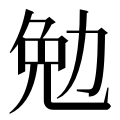
勉

勉 U+52C9, 勉
CJK UNIFIED IDEOGRAPH-52C9
← 勈
[U+52C8]
CJK Unified Ideographs 勊 →
[U+52CA]

勉 U+FA33, 勉
CJK COMPATIBILITY IDEOGRAPH-FA33
← 免
[U+FA32]
CJK Compatibility Ideographs 勤 →
[U+FA34]

勉 U+2F826, 勉
CJK COMPATIBILITY IDEOGRAPH-2F826
← 勇
[U+2F825]
CJK Compatibility Ideographs Supplement 勤 →
[U+2F827]

Translingual

Japanese 勉
Simplified 勉
Traditional 勉

Alternative forms

Note that in Japanese shinjitai, the bottom left handed stroke ㇓ of 免 is written as two separate components (𫩏+儿).

Han character

勉 (Kangxi radical 19, 力+7 in Chinese, 力+8 in Japanese, 9 strokes in Chinese, 10 strokes in Japanese, cangjie input 弓山大尸 (NUKS), four-corner 24212, composition ⿺免力)

References

Chinese

simp. and trad.
勉

Glyph origin

Phono-semantic compound (形聲/形声, OC *mronʔ) : phonetic 免 (OC *mronʔ) + semantic 力 (“strong”) – make a strong effort.

Pronunciation


Note:
  • miang2 - Shantou;
  • miêng2 - Chaozhou.

    Rime
    Character 勉
    Reading # 1/1
    Initial (聲) 明 (4)
    Final (韻) 仙 (79)
    Tone (調) Rising (X)
    Openness (開合) Open
    Division (等) III
    Fanqie 亡辨切
    Baxter mjenX
    Reconstructions
    Zhengzhang
    Shangfang
    /mˠiᴇnX/
    Pan
    Wuyun
    /mᵚiɛnX/
    Shao
    Rongfen
    /miænX/
    Edwin
    Pulleyblank
    /mianX/
    Li
    Rong
    /mjɛnX/
    Wang
    Li
    /mĭɛnX/
    Bernard
    Karlgren
    /mi̯ɛnX/
    Expected
    Mandarin
    Reflex
    miǎn
    Expected
    Cantonese
    Reflex
    min5
    Baxter–Sagart system 1.1 (2014)
    Character 勉
    Reading # 1/1
    Modern
    Beijing
    (Pinyin)
    miǎn
    Middle
    Chinese
    ‹ mjenX ›
    Old
    Chinese
    /*mr[o][r]ʔ/
    English make an effort

    Notes for Old Chinese notations in the Baxter–Sagart system:

    * Parentheses "()" indicate uncertain presence;
    * Square brackets "[]" indicate uncertain identity, e.g. *[t] as coda may in fact be *-t or *-p;
    * Angle brackets "<>" indicate infix;
    * Hyphen "-" indicates morpheme boundary;

    * Period "." indicates syllable boundary.
    Zhengzhang system (2003)
    Character 勉
    Reading # 1/1
    No. 9068
    Phonetic
    component
    免
    Rime
    group
    元
    Rime
    subdivision
    3
    Corresponding
    MC rime
    免
    Old
    Chinese
    /*mronʔ/

    Definitions

    勉

    1. to endeavor; to make an effort; to strive
    2. to encourage; to urge
    3. to force; to do something reluctantly
    4. † to hurry; quickly
    5. † Alternative form of 娩 (“to give birth to a child”)
    6. a surname

    Compounds

    Japanese

    Shinjitai 勉
    Kyūjitai
    [1]

    勉
    &#xFA33;
    or
    勉+&#xFE00;?
    勉󠄀
    勉+&#xE0100;?
    (Adobe-Japan1)
    勉󠄃
    勉+&#xE0103;?
    (Hanyo-Denshi)
    (Moji_Joho)
    The displayed kanji may be different from the image due to your environment.
    See here for details.

    Kanji

    勉

    (grade 3 “Kyōiku” kanji, shinjitai kanji, kyūjitai form 勉)

    1. effort
    2. to study

    Readings

    Compounds

    Proper noun

    勉(つとむ) • (Tsutomu) 

    1. a male given name

    References

    1. “勉”, in 漢字ぺディア (Kanjipedia)‎ (in Japanese), 日本漢字能力検定協会, 2015–2024

    Korean

    Etymology

    From Middle Chinese 勉 (MC mjenX).

    Hanja

    Wikisource 勉 (eumhun 힘쓸 면 (himsseul myeon))

    1. Hanja form? of 면 (“strive; make an effort”).

    Compounds

    References

    • 국제퇴계학회 대구경북지부 (國際退溪學會 大邱慶北支部) (2007). Digital Hanja Dictionary, 전자사전/電子字典.

    Vietnamese

    Han character

    勉: Hán Nôm readings: miễn, mến, mễn, mịn

    1. This term needs a translation to English. Please help out and add a translation, then remove the text {{rfdef}}.
    This article is issued from Wiktionary. The text is licensed under Creative Commons - Attribution - Sharealike. Additional terms may apply for the media files.