晚
 | ||||||||
Translingual
| Stroke order | |||
|---|---|---|---|
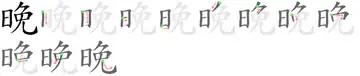 | |||
| Japanese | 晩 |
|---|---|
| Simplified | 晚 |
| Traditional | 晚 |
Alternative forms
Note that in Japanese shinjitai, the bottom left handed stroke ㇓ of 免 is written as two separate components (𫩏+儿). This is encoded as a separate character 晩 (U+6669).
Han character
晚 (Kangxi radical 72, 日+7, 11 strokes, cangjie input 日弓日山 (ANAU), four-corner 67016, composition ⿰日免)
References
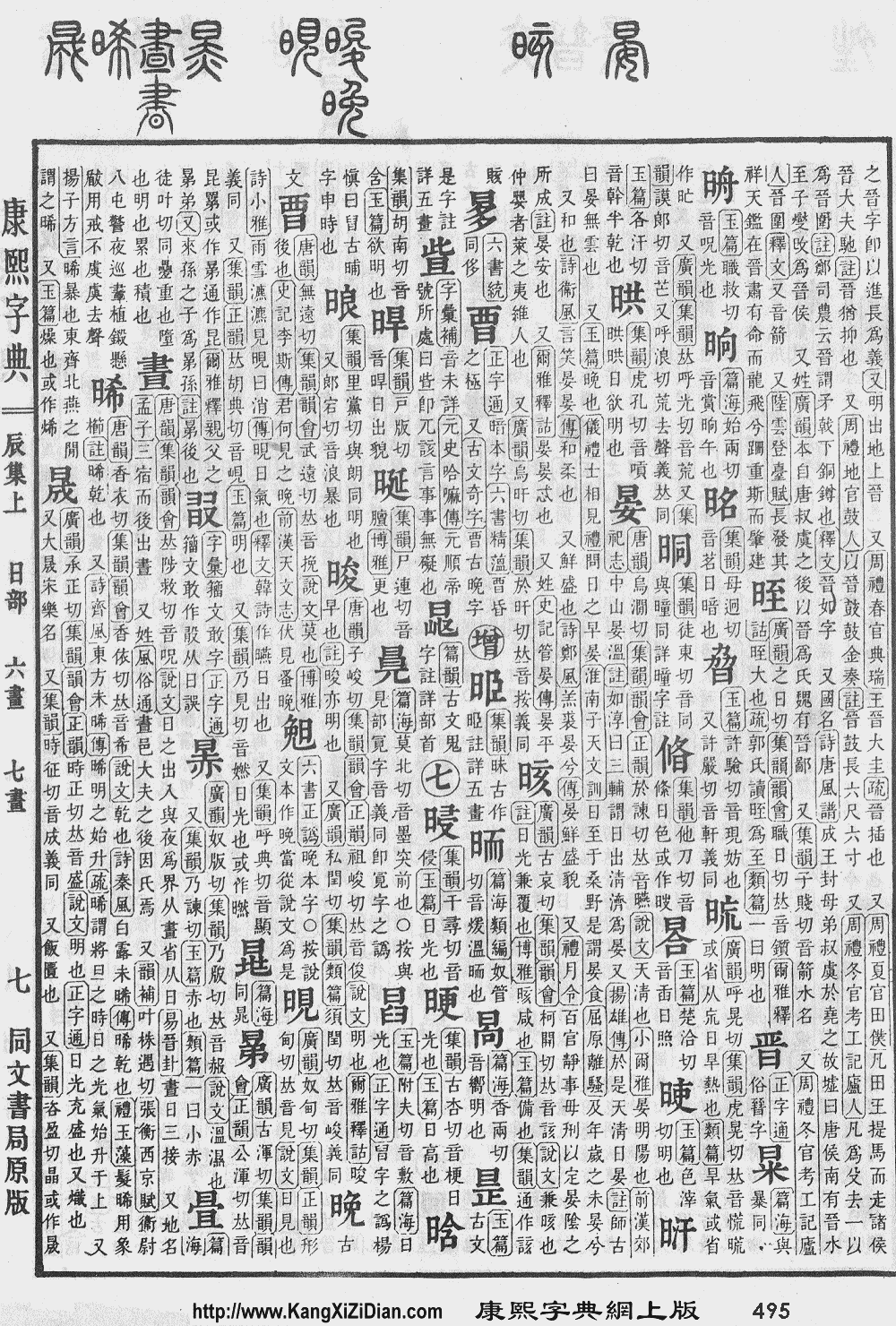
- Kangxi Dictionary: page 495, character 34
- Dai Kanwa Jiten: character 13940
- Dae Jaweon: page 861, character 21
- Hanyu Da Zidian (first edition): volume 2, page 1514, character 4
- Unihan data for U+665A
- Standard Form by Ministry of Education of the Republic of China
Chinese
| simp. and trad. |
晚 | |
|---|---|---|
Glyph origin
Characters in the same phonetic series (免) (Zhengzhang, 2003)
Phono-semantic compound (形聲/形声, OC *monʔ) : semantic 日 + phonetic 免 (OC *mronʔ).
Etymology
(This etymology is missing or incomplete. Please add to it, or discuss it at the Etymology scriptorium.)
Pronunciation
Definitions
晚
Synonyms
Dialectal synonyms of 夜 (“night (counting)”) [map]
| Variety | Location | Words |
|---|---|---|
| Classical Chinese | 夜, 夕 | |
| Formal (Written Standard Chinese) | 夜 | |
| Mandarin | Singapore | 晚 |
| Cantonese | Guangzhou | 晚 |
| Hong Kong | 晚 | |
| Singapore (Guangfu) | 晚 | |
| Southern Min | Xiamen | 暝, 暗 |
| Quanzhou | 暝, 暗 | |
| Shishi | 暗暝 | |
| Zhangzhou | 暝, 暗 | |
| Zhangzhou (Changtai) | 暝 | |
| Taipei | 暝 GT, 暗 GT | |
| Singapore (Hokkien) | 暝 | |
| Manila (Hokkien) | 暗 | |
| Shantou | 暝 | |
| Singapore (Teochew) | 暝 | |
| Wenchang | 暝 | |
| Note | GT - General Taiwanese (no specific region identified) | |
Dialectal synonyms of 晚 (“late (in time)”) [map]
Compounds
- 一天到晚 (yītiāndàowǎn)
- 下晚
- 不早不晚
- 今晚 (jīnwǎn)
- 何見之晚/何见之晚
- 傍晚 (bàngwǎn)
- 前晚 (qiánwǎn)
- 前親晚後/前亲晚后
- 向晚 (xiàngwǎn)
- 多早晚
- 夜晚 (yèwǎn)
- 大器晚成 (dàqìwǎnchéng)
- 如今晚兒/如今晚儿
- 好早晚
- 寒花晚節/寒花晚节
- 將晚/将晚
- 年晚
- 後生晚學/后生晚学
- 恨相知晚
- 恨相見晚/恨相见晚
- 投晚
- 拉晚兒/拉晚儿
- 拜晚年
- 旦晚
- 早出晚歸/早出晚归 (zǎochūwǎnguī)
- 早晚 (zǎowǎn)
- 早迷晚寤
- 昨晚 (zuówǎn)
- 晚上 (wǎnshang)
- 晚世
- 晚半天兒/晚半天儿
- 晚參/晚参
- 晚唐
- 晚場/晚场
- 晚報/晚报 (wǎnbào)
- 晚境
- 晚娘 (wǎnniáng)
- 晚娘面孔
- 晚婚 (wǎnhūn)
- 晚學/晚学
- 晚學生/晚学生
- 晚安 (wǎn'ān)
- 晚宴 (wǎnyàn)
- 晚就
- 晚年 (wǎnnián)
- 晚戀/晚恋
- 晚成
- 晚明小品 (Wǎn Míng Xiǎopǐn)
- 晚春 (wǎnchūn)
- 晚晌
- 晚景 (wǎnjǐng)
- 晚暮
- 晚會/晚会 (wǎnhuì)
- 晚期 (wǎnqī)
- 晚歲/晚岁
- 晚歸/晚归
- 晚照
- 晚熟 (wǎnshú)
- 晚班 (wǎnbān)
- 晚生 (wǎnshēng)
- 晚生後學/晚生后学
- 晚田
- 晚疫病
- 晚禮服/晚礼服 (wǎnlǐfú)
- 晚秋 (wǎnqiū)
- 晚秋作物 (wǎnqiū zuòwù)
- 晚稻 (wǎndào)
- 晚節/晚节 (wǎnjié)
- 晚節不終/晚节不终
- 晚節末路/晚节末路
- 晚節黃花/晚节黄花
- 晚翠
- 晚育
- 晚膳 (wǎnshàn)
- 晚西
- 晚課/晚课
- 晚豔/晚艳
- 晚起
- 晚車/晚车 (wǎnchē)
- 晚輩/晚辈 (wǎnbèi)
- 晚近
- 晚進/晚进
- 晚運/晚运
- 晚間/晚间 (wǎnjiān)
- 晚霜
- 晚霞 (wǎnxiá)
- 晚風/晚风 (wǎnfēng)
- 晚食當肉/晚食当肉
- 晚飯/晚饭 (wǎnfàn)
- 晚餐 (wǎncān)
- 晚香玉
- 晚點/晚点
- 晼晚
- 未晚 (wèiwǎn)
- 桑榆晚景 (sāngyúwǎnjǐng)
- 為時已晚/为时已晚 (wéishíyǐwǎn)
- 為時未晚/为时未晚 (wéishíwèiwǎn)
- 當晚/当晚 (dāngwǎn)
- 相得恨晚
- 相知恨晚
- 相見恨晚/相见恨晚 (xiāngjiànhènwǎn)
- 相逢恨晚
- 眷晚生
- 薄晚
- 趕晚/赶晚
- 這早晚/这早晚 (zhè zǎowǎn)
- 黃花晚節/黄花晚节
References
- “晚”, in 漢語多功能字庫 (Multi-function Chinese Character Database), 香港中文大學 (the Chinese University of Hong Kong), 2014–
Korean
Etymology
From Middle Chinese 晚 (MC mjonX).
| Historical readings |
|---|
|
Pronunciation
- (SK Standard/Seoul) IPA(key): [ma̠(ː)n]
- Phonetic hangul: [만(ː)]
- Though still prescribed in Standard Korean, most speakers in both Koreas no longer distinguish vowel length.
Usage notes
Note that the educational form of this hanja in South Korea is (U+665A) which has 口 overlapped by 丿 as its middle right component and not 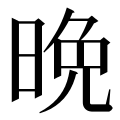 (
U+6669), which consists of 𫩏 and 儿 as its bottom right component.
Compounds
Compounds
- 만각 (晚覺, man'gak)
- 만경 (晚境, man'gyeong)
- 만경 (晚景, man'gyeong)
- 만계 (晚計, man'gye)
- 만교 (晚交, man'gyo)
- 만기 (晚期, man'gi)
- 만년 (晚年, mannyeon)
- 만달 (晚達, mandal)
- 만당 (晚唐, mandang)
- 만도 (晚到, mando)
- 만도 (晚禱, mando)
- 만도 (晚稻, mando)
- 만동 (晚冬, mandong)
- 만득 (晚得, mandeuk)
- 만산 (晚産, mansan)
- 만생 (晚生, mansaeng)
- 만성 (晚成, manseong)
- 만숙 (晚熟, mansuk)
- 만시 (晚時, mansi)
- 만식 (晚食, mansik)
- 만염 (晚炎, manyeom)
- 만운 (晚運, manun)
- 만절 (晚節, manjeol)
- 만종 (晚鐘, manjong)
- 만찬 (晚餐, manchan)
- 만추 (晚秋, manchu)
- 만춘 (晚春, manchun)
- 만파 (晚播, manpa)
- 만하 (晚夏, manha)
- 만하 (晚霞, manha)
- 만학 (晚學, manhak)
- 만혼 (晚婚, manhon)
Vietnamese
This article is issued from Wiktionary. The text is licensed under Creative Commons - Attribution - Sharealike. Additional terms may apply for the media files.