矣
| ||||||||
Translingual
Han character
矣 (Kangxi radical 111, 矢+2, 7 strokes, cangjie input 戈人大 (IOK), four-corner 23430, composition ⿱厶矢)
Derived characters
References
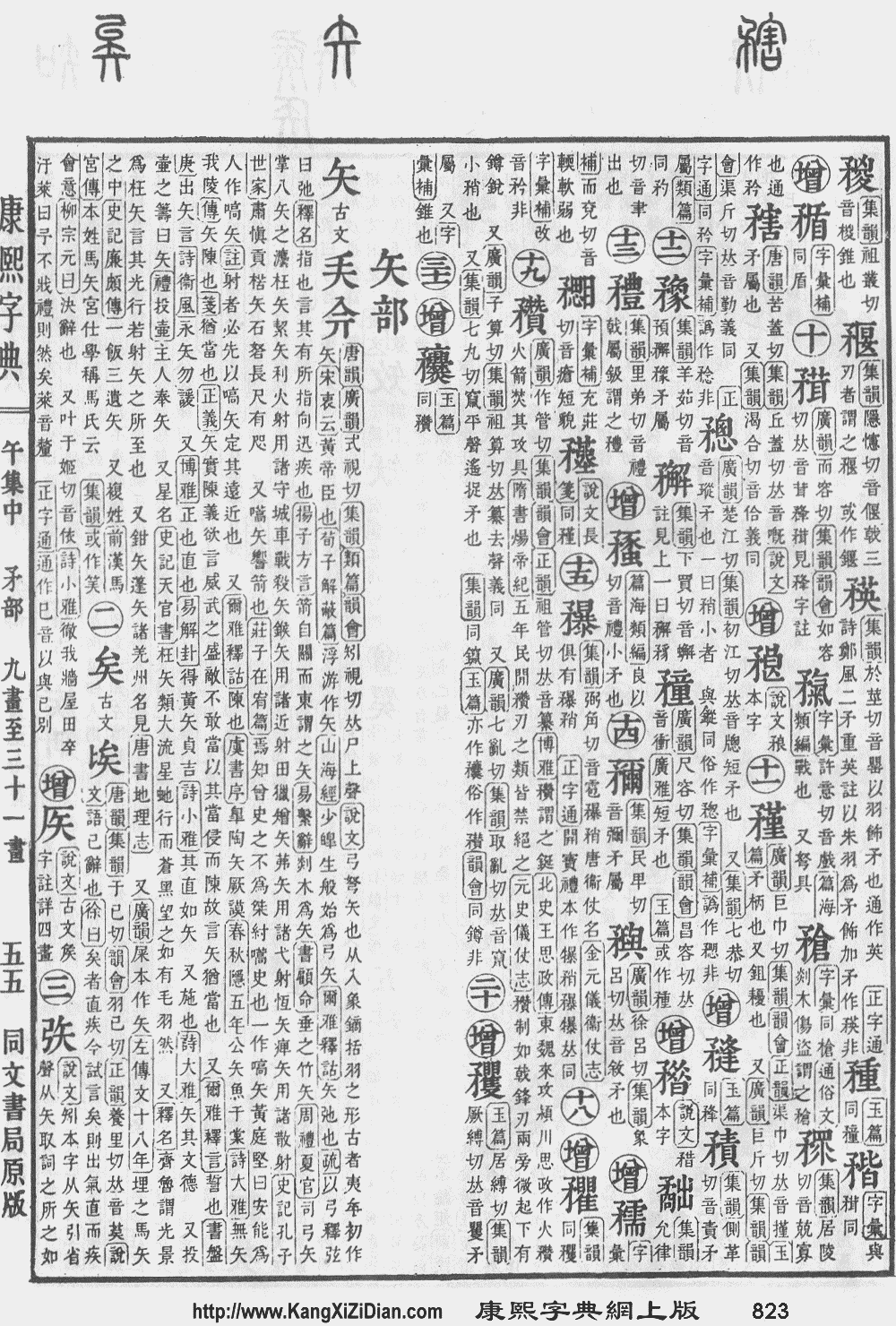
- Kangxi Dictionary: page 823, character 37
- Dai Kanwa Jiten: character 23931
- Dae Jaweon: page 1235, character 23
- Hanyu Da Zidian (first edition): volume 4, page 2580, character 4
- Unihan data for U+77E3
Chinese
Glyph origin
| Historical forms of the character 矣 | ||
|---|---|---|
| Western Zhou | Shuowen Jiezi (compiled in Han) | Liushutong (compiled in Ming) |
| Bronze inscriptions | Small seal script | Transcribed ancient scripts |
 |
 |
 |
Characters in the same phonetic series (矣) (Zhengzhang, 2003)
Phono-semantic compound (形聲/形声, OC *ɢlɯʔ) : phonetic 㠯 (OC *lɯʔ) + semantic 矢 (“arrow”). 矢 (OC *hliʔ) may also act as a phonetic component.
Etymology 1
| trad. | 矣 | |
|---|---|---|
| simp. # | 矣 | |
| alternative forms | 𠤘 𢦕 𡗞 | |
Pulleyblank (1995) tentatively suggests a connection to adverb 已 (OC *lɯʔ, “already, perfective marker”), drawing a parallel with the 了₁ (perfective particle) and 了₂ (change of state modal particle) meanings of 了 (le), but doubts that they are etymologically related, suggesting the connection may be purely semantic and for aspectual functions.
Pronunciation
Definitions
矣
- (literary) Particle expressing completion, similar to 了 (le) in Standard Mandarin.
- (literary) Particle expressing exclamation, similar to 啦 (la) in Standard Mandarin.
Synonyms
Dialectal synonyms of 了 (“(perfective particle)”) [map]
Compounds
Pronunciation
Definitions
矣
- (Hokkien, dialectal Hakka) Sentence-final particle expressing completion, similar to 了 (le) in Standard Mandarin.
- 我食飽矣/我食饱矣 [Taiwanese Hokkien] ― Góa chia̍h-pá--ah [Pe̍h-ōe-jī] ― I've eaten already. / I am now full.
Synonyms
Dialectal synonyms of 了 (“(perfective particle)”) [map]
Etymology 3
| trad. | 矣 | |
|---|---|---|
| simp. # | 矣 | |
(This etymology is missing or incomplete. Please add to it, or discuss it at the Etymology scriptorium.)
Pronunciation
Japanese
Korean
Vietnamese
This article is issued from Wiktionary. The text is licensed under Creative Commons - Attribution - Sharealike. Additional terms may apply for the media files.