吻
| ||||||||
Translingual
Han character
吻 (Kangxi radical 30, 口+4, 7 strokes, cangjie input 口心竹竹 (RPHH), four-corner 67020, composition ⿰口勿)
Derived characters
- 𣵓, 𪷡, 𪡕, 𦮶, 𥁴, 𬠉
References
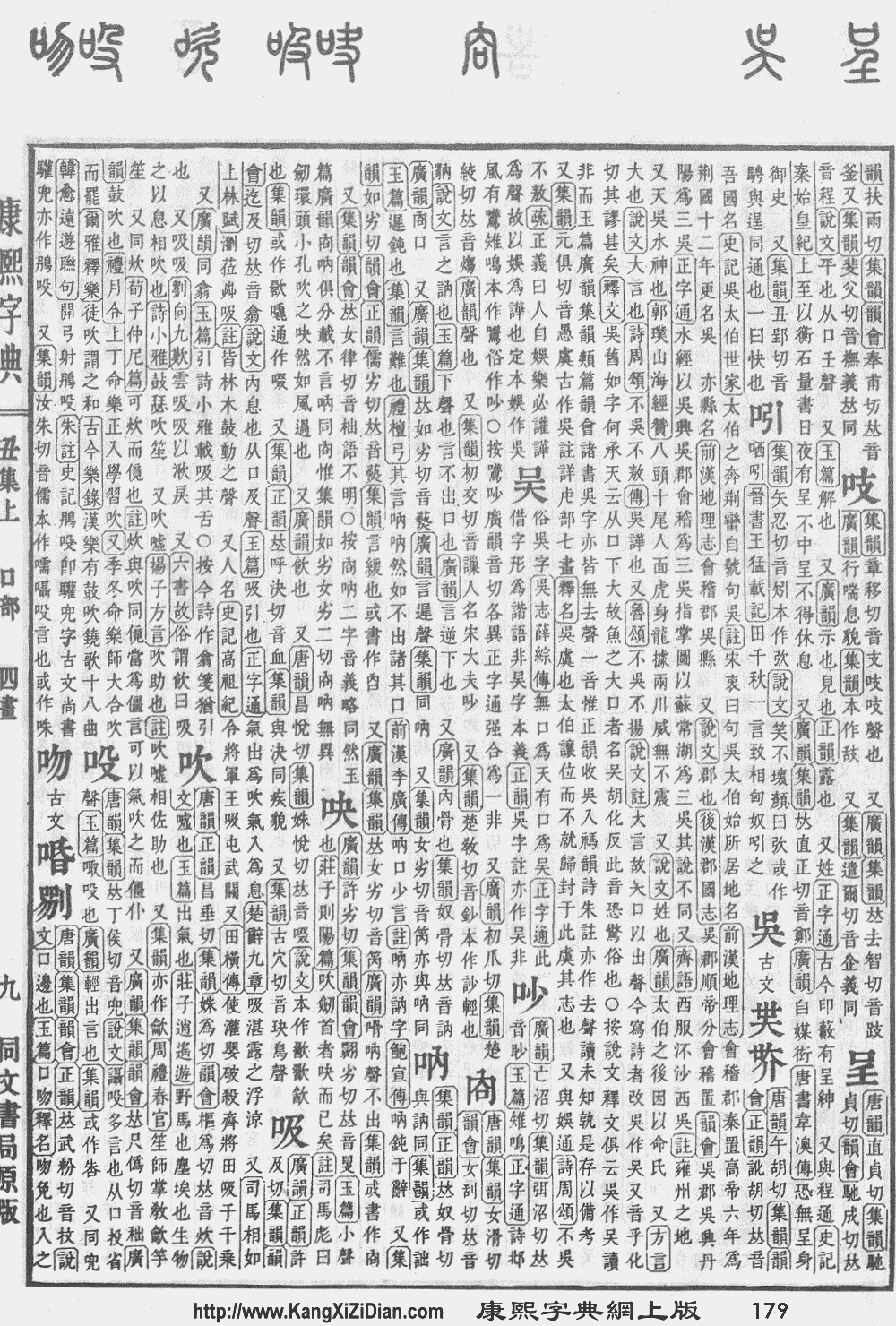
- Kangxi Dictionary: page 179, character 15
- Dai Kanwa Jiten: character 3375
- Dae Jaweon: page 397, character 9
- Hanyu Da Zidian (first edition): volume 1, page 593, character 1
- Unihan data for U+543B
Chinese
| simp. and trad. |
吻 | |
|---|---|---|
| alternative forms | 𦝮 脗/吻 | |
Glyph origin
| Historical forms of the character 吻 | ||
|---|---|---|
| Warring States | Shuowen Jiezi (compiled in Han) | Liushutong (compiled in Ming) |
| Chu slip and silk script | Small seal script | Transcribed ancient scripts |
 |
 |
 |
Characters in the same phonetic series (勿) (Zhengzhang, 2003)
Phono-semantic compound (形聲/形声, OC *mɯnʔ) : semantic 口 + phonetic 勿 (OC *mɯd).
Etymology
Unknown. Various possibilities are (Schuessler, 2007):
- Related to 門 (OC *mɯːn, “door”);
- Related to Mizo hmûi (“lips; upper lip”);
- Related to Proto-Vietic *c-ɓuːj(ʔ) (“lip”) (Vietnamese môi);
- Related to Burmese မုတ် (mut, “mouth”) (in မုတ်ဆိတ် (muthcit, “beard”)) and မှုတ် (hmut, “to blow with mouth”);
- Related to Khmer មាត់ (mŏət, “mouth, lip”).
Pronunciation
Definitions
吻
Synonyms
- (lip):
Dialectal synonyms of 嘴脣 (“lips”) [map]
- (to kiss):
Dialectal synonyms of 吻 (“to kiss”) [map]
| Variety | Location | Words |
|---|---|---|
| Formal (Written Standard Chinese) | 吻, 親, 親吻 | |
| Mandarin | Beijing | 吻, 親 |
| Taiwan | 吻, 親 | |
| Yantai (Muping) | 親 | |
| Wanrong | 親 | |
| Xi'an | 親 | |
| Yangzhou | 親 | |
| Singapore | 吻, 親 | |
| Cantonese | Guangzhou | 惜, 啜, 痛 |
| Hong Kong | 惜, 啜, 嘴 | |
| Taishan | 啜 | |
| Dongguan | 啜 | |
| Singapore (Guangfu) | 惜 | |
| Hakka | Meixian | 唚 |
| Miaoli (N. Sixian) | 唚 | |
| Pingtung (Neipu; S. Sixian) | 唚 | |
| Hsinchu County (Zhudong; Hailu) | 唚 | |
| Taichung (Dongshi; Dabu) | 唚 | |
| Hsinchu County (Qionglin; Raoping) | 唚 | |
| Yunlin (Lunbei; Zhao'an) | 唚 | |
| Jin | Taiyuan | 親 |
| Xinzhou | 親 | |
| Northern Min | Jian'ou | 蜜 |
| Songxi | 鼻 | |
| Zhenghe | 蜜 | |
| Jianyang | 蜜 | |
| Wuyishan | 敕 | |
| Pucheng (Shibei) | 鼻 | |
| Eastern Min | Fuzhou | 唚 |
| Southern Min | Xiamen | 唚 |
| Xiamen (Tong'an) | 唚 | |
| Quanzhou | 唚 | |
| Shishi | 唚 | |
| Zhangzhou | 唚 | |
| Tainan | 唚 | |
| Penang (Hokkien) | 唚 | |
| Singapore (Hokkien) | 唚 | |
| Manila (Hokkien) | 唚 | |
| Chaozhou | 唚 | |
| Shantou | 唚 | |
| Singapore (Teochew) | 唚 | |
| Haikou | 惜 | |
| Wu | Shanghai | 香, 親 |
| Shanghai (Chongming) | 香 | |
| Shanghai (Zhoupu, Pudong) | 香 | |
| Suzhou | 香 | |
| Hangzhou | 香 | |
| Ningbo | 親 | |
Japanese
References
- Matsumura, Akira, editor (2006), 大辞林 [Daijirin] (in Japanese), Third edition, Tōkyō: Sanseidō, →ISBN
Korean
Hanja
吻 • (mun) (hangeul 문, revised mun, McCune–Reischauer mun)
- This term needs a translation to English. Please help out and add a translation, then remove the text
{{rfdef}}.
Vietnamese
This article is issued from Wiktionary. The text is licensed under Creative Commons - Attribution - Sharealike. Additional terms may apply for the media files.