啉
| ||||||||
Translingual
Han character
啉 (Kangxi radical 30, 口+8, 11 strokes, cangjie input 口木木 (RDD), four-corner 6409, composition ⿰口林)
Derived characters
- 𪢇
References
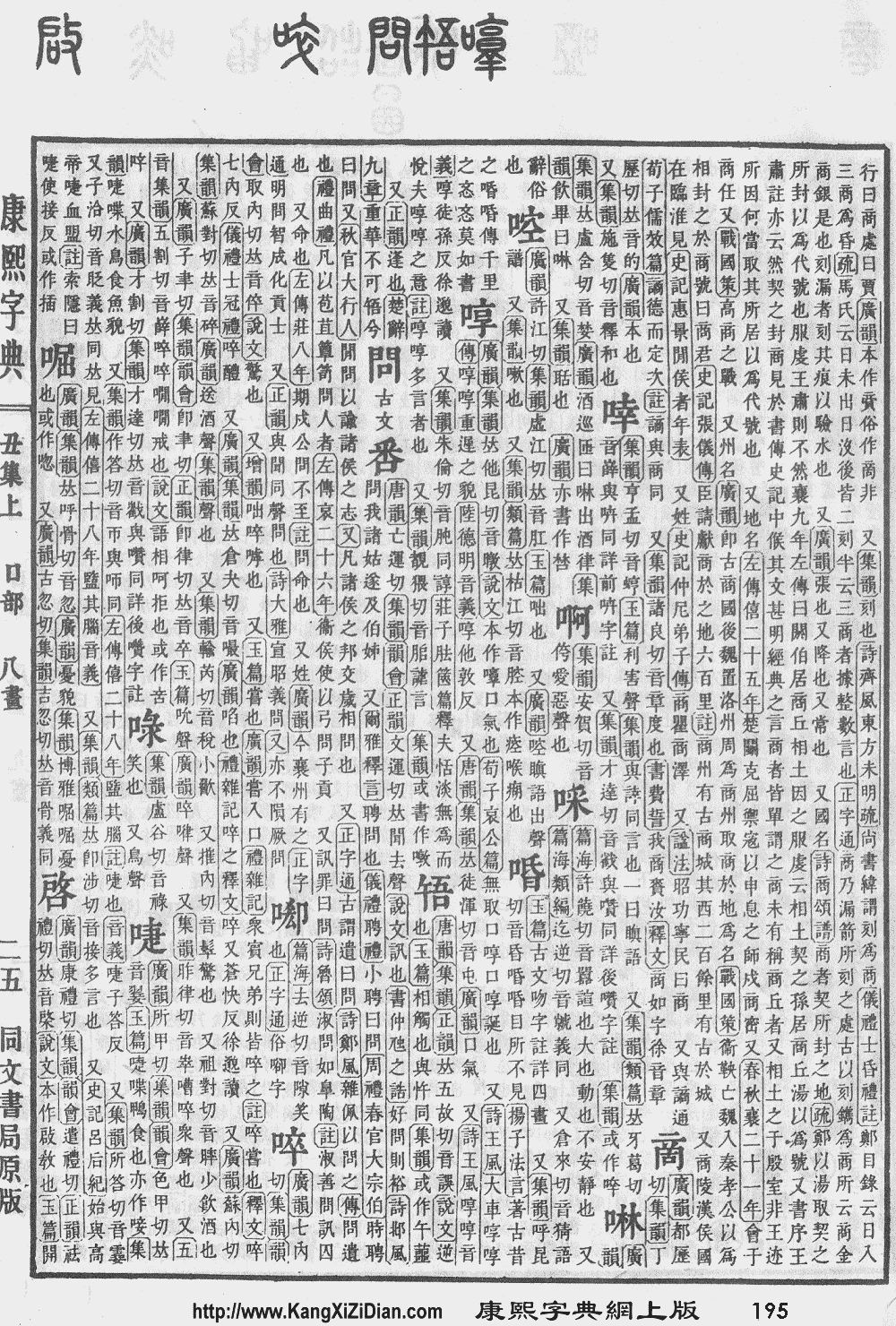
- Kangxi Dictionary: page 195, character 3
- Dai Kanwa Jiten: character 3806
- Dae Jaweon: page 416, character 3
- Hanyu Da Zidian (first edition): volume 1, page 637, character 7
- Unihan data for U+5549
Chinese
Glyph origin
Characters in the same phonetic series (林) (Zhengzhang, 2003)
Phono-semantic compound (形聲/形声, OC *ɡ·ruːm) : semantic 口 (“mouth”) + phonetic 林 (OC *ɡ·rɯm).
Etymology 1
| simp. and trad. |
啉 | |
|---|---|---|
| alternative forms | 𠵂 飲/饮 Hokkien 啿 Teochew | |
Related to Thai ดื่ม (dʉ̀ʉm, “to drink”) (Schuessler, 2007).
This etymology is incomplete. You can help Wiktionary by elaborating on the origins of this term.
Pronunciation
Definitions
啉
Synonyms
Dialectal synonyms of 喝 (“to drink”) [map]
Etymology 2
| For pronunciation and definitions of 啉 – see 婪 (“to covet; to be avaricious; to be greedy”). (This character is recorded in one or more historical dictionaries as a variant form of 婪). |
Pronunciation
Pronunciation
Definitions
啉
- † stupid
- 足下其實啉,休裝㖔。 [Written Vernacular Chinese, trad.]
- From: Wang Shifu, The Story of the Western Wing, 13th – 14th centuries CE
- Zúxià qíshí lìn, xiū zhuāng tǔn. [Pinyin]
- (please add an English translation of this usage example)
足下其实啉,休装㖔。 [Written Vernacular Chinese, simp.]
Pronunciation
Definitions
啉
- Used in transcription, especially of chemical names.
Compounds
References
- “Entry #7042”, in 臺灣閩南語常用詞辭典 [Dictionary of Frequently-Used Taiwan Minnan] (overall work in Mandarin and Hokkien), Ministry of Education, R.O.C., 2023.
Japanese
Kanji
啉
- This term needs a translation to English. Please help out and add a translation, then remove the text
{{rfdef}}.
Korean
Hanja
啉 • (ram) (hangeul 람, revised ram, McCune–Reischauer ram)
- This term needs a translation to English. Please help out and add a translation, then remove the text
{{rfdef}}.
Vietnamese
This article is issued from Wiktionary. The text is licensed under Creative Commons - Attribution - Sharealike. Additional terms may apply for the media files.