啞

See also: 唖 and 哑
啞 U+555E, 啞
CJK UNIFIED IDEOGRAPH-555E
← 啝
[U+555D]
CJK Unified Ideographs 啟 →
[U+555F]

Translingual

Traditional 啞
Shinjitai
(extended)
唖
Simplified 哑

Han character

啞 (Kangxi radical 30, 口+8, 11 strokes, cangjie input 口一中一 (RMLM), four-corner 61017, composition ⿰口亞)

References

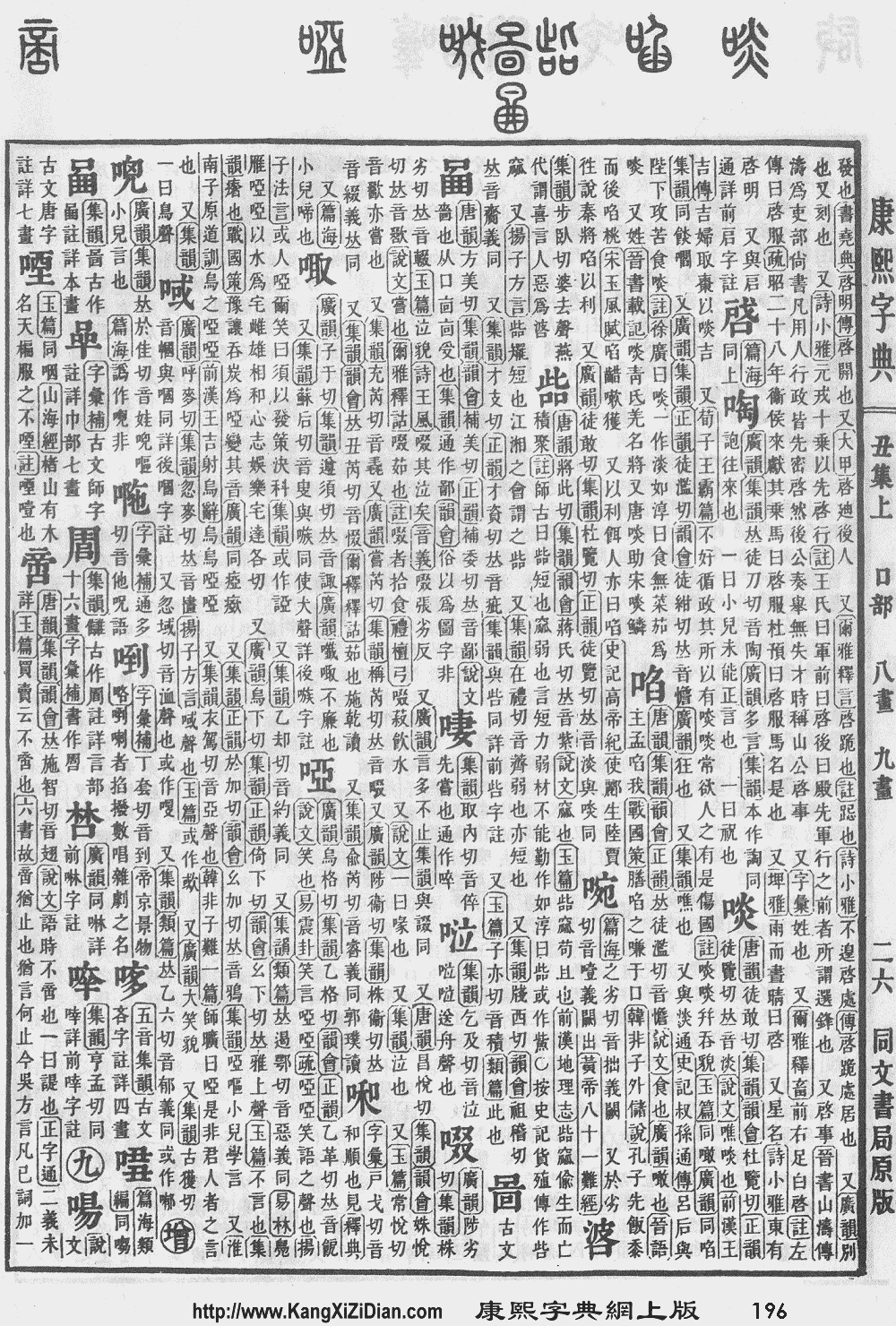
  • Kangxi Dictionary: page 196, character 15
  • Dai Kanwa Jiten: character 3835
  • Dae Jaweon: page 417, character 24
  • Hanyu Da Zidian (first edition): volume 1, page 636, character 7
  • Unihan data for U+555E

Chinese

Glyph origin

Phono-semantic compound (形聲/形声, OC *qraːʔ, *qraːɡs, *qraːɡ, *qraːɡ) : semantic 口 (“mouth”) + phonetic 亞 (OC *qraːɡs).

Etymology

From Proto-Sino-Tibetan *m-ʔa (“mute”).

Pronunciation 1

trad. 啞
simp. 哑
alternative forms 瘂/痖 “mute; hoarse”
𤺘


Note: The zero initial /∅-/ is commonly pronounced with a ng-initial /ŋ-/ in some varieties of Cantonese, including Hong Kong Cantonese.
Note:
  • é/ée - vernacular;
  • á - literary.

Rime
Character 啞
Reading # 1/4
Initial (聲) 影 (34)
Final (韻) 麻 (98)
Tone (調) Rising (X)
Openness (開合) Open
Division (等) II
Fanqie 烏下切
Baxter 'aeX
Reconstructions
Zhengzhang
Shangfang
/ʔˠaX/
Pan
Wuyun
/ʔᵚaX/
Shao
Rongfen
/ʔaX/
Edwin
Pulleyblank
/ʔaɨX/
Li
Rong
/ʔaX/
Wang
Li
/aX/
Bernard
Karlgren
/ʔaX/
Expected
Mandarin
Reflex
yǎ
Expected
Cantonese
Reflex
aa2
Baxter–Sagart system 1.1 (2014)
Character 啞
Reading # 1/1
Modern
Beijing
(Pinyin)
yǎ
Middle
Chinese
‹ ʔaeX ›
Old
Chinese
/*ʔˁraʔ/
English mute

Notes for Old Chinese notations in the Baxter–Sagart system:

* Parentheses "()" indicate uncertain presence;
* Square brackets "[]" indicate uncertain identity, e.g. *[t] as coda may in fact be *-t or *-p;
* Angle brackets "<>" indicate infix;
* Hyphen "-" indicates morpheme boundary;

* Period "." indicates syllable boundary.
Zhengzhang system (2003)
Character 啞
Reading # 1/4
No. 14210
Phonetic
component
亞
Rime
group
魚
Rime
subdivision
0
Corresponding
MC rime
啞
Old
Chinese
/*qraːʔ/
Notes 見史記後亦作瘂

Definitions

啞

  1. mute; dumb (unable to speak)
  2. speechless; without sound
    啞劇/哑剧  ―  yǎjù  ―  mime
    啞鈴/哑铃  ―  yǎlíng  ―  dumbbell
    啞口無言/哑口无言  ―  yǎkǒuwúyán  ―  to be left speechless
  3. hoarse
    喊得我嗓子都啞了 [MSC, trad.]
    喊得我嗓子都哑了 [MSC, simp.]
    hǎn de wǒ sǎngzi dōu yǎ le [Pinyin]
    to have shouted myself hoarse
  4. (of a shell, bomb, etc.) to fail to explode; (of a firearm) to fail to fire
Coordinate terms
  • 聾/聋 (lóng, “deaf”)
  • 盲 (máng, “blind”)

Compounds

Pronunciation 2

trad. 啞
simp. 哑
alternative forms 䛩/𲂉


Note: The zero initial /∅-/ is commonly pronounced with a ng-initial /ŋ-/ in some varieties of Cantonese, including Hong Kong Cantonese.

Rime
Character 啞 啞
Reading # 3/4 4/4
Initial (聲) 影 (34) 影 (34)
Final (韻) 陌 (113) 麥 (119)
Tone (調) Checked (Ø) Checked (Ø)
Openness (開合) Open Open
Division (等) II II
Fanqie 烏格切 於革切
Baxter 'aek 'eak
Reconstructions
Zhengzhang
Shangfang
/ʔˠæk̚/ /ʔˠɛk̚/
Pan
Wuyun
/ʔᵚak̚/ /ʔᵚæk̚/
Shao
Rongfen
/ʔak̚/ /ʔɐk̚/
Edwin
Pulleyblank
/ʔaɨjk̚/ /ʔəɨjk̚/
Li
Rong
/ʔɐk̚/ /ʔɛk̚/
Wang
Li
/ɐk̚/ /æk̚/
Bernard
Karlgren
/ʔɐk̚/ /ʔæk̚/
Expected
Mandarin
Reflex
e e
Expected
Cantonese
Reflex
ak1 ak1
Zhengzhang system (2003)
Character 啞 啞
Reading # 3/4 4/4
No. 14223 14224
Phonetic
component
亞 亞
Rime
group
鐸 鐸
Rime
subdivision
0 0
Corresponding
MC rime
啞 戹
Old
Chinese
/*qraːɡ/ /*qraːɡ/

Definitions

啞

  1. † (onomatopoeia) laughter; sound of laughing

Compounds

  • 啞啞/哑哑
  • 啞然/哑然
  • 啞然失笑/哑然失笑
  • 啞然失色/哑然失色
  • 啞然無言/哑然无言

Pronunciation 3


Note: The zero initial /∅-/ is commonly pronounced with a ng-initial /ŋ-/ in some varieties of Cantonese, including Hong Kong Cantonese.

Rime
Character 啞
Reading # 2/4
Initial (聲) 影 (34)
Final (韻) 麻 (98)
Tone (調) Departing (H)
Openness (開合) Open
Division (等) II
Fanqie 衣嫁切
Baxter 'aeH
Reconstructions
Zhengzhang
Shangfang
/ʔˠaH/
Pan
Wuyun
/ʔᵚaH/
Shao
Rongfen
/ʔaH/
Edwin
Pulleyblank
/ʔaɨH/
Li
Rong
/ʔaH/
Wang
Li
/aH/
Bernard
Karlgren
/ʔaH/
Expected
Mandarin
Reflex
yà
Expected
Cantonese
Reflex
aa3
Zhengzhang system (2003)
Character 啞
Reading # 2/4
No. 14216
Phonetic
component
亞
Rime
group
暮
Rime
subdivision
0
Corresponding
MC rime
亞
Old
Chinese
/*qraːɡs/
Notes 見淮南子後亦作呀

Definitions

啞

  1. Alternative form of 呀
  2. (onomatopoeia) The sound of cawing.
  3. (onomatopoeia) The sound of a child learning to speak.

Compounds

  • 啞吒/哑咤 (yāzhà)
  • 啞咽/哑咽
  • 啞啞學語/哑哑学语
  • 嗚啞/呜哑
  • 嘔啞/呕哑
  • 嘔嘔啞啞/呕呕哑哑

Japanese

Shinjitai
(extended)

唖

Kyūjitai

啞

Kanji

啞

(uncommon “Hyōgai” kanji, kyūjitai kanji, shinjitai form 唖)

  1. Kyūjitai form of 唖

Readings

Definitions

For pronunciation and definitions of 啞 – see the following entry.
【唖】H
[kanji] Hyōgaiji kanji
[kanji] Extended shinjitai form of 啞: mute, dumb
Kanji reading:
おし
(This term, 啞, is the kyūjitai of the above term.)

Korean

Hanja

啞 • (a) (hangeul 아, revised a, McCune–Reischauer a)

  1. This term needs a translation to English. Please help out and add a translation, then remove the text {{rfdef}}.

Vietnamese

Han character

啞: Hán Nôm readings: á, ạ, ớ, dạ

  1. This term needs a translation to English. Please help out and add a translation, then remove the text {{rfdef}}.
This article is issued from Wiktionary. The text is licensed under Creative Commons - Attribution - Sharealike. Additional terms may apply for the media files.