惡
| ||||||||
| ||||||||
Translingual
| Traditional | 惡 |
|---|---|
| Shinjitai | 悪 |
| Simplified | 恶 |
Han character
惡 (Kangxi radical 61, 心+8, 12 strokes, cangjie input 一一心 (MMP), four-corner 10331, composition ⿱亞心)
Descendants
- Japanese: 𛀅
References
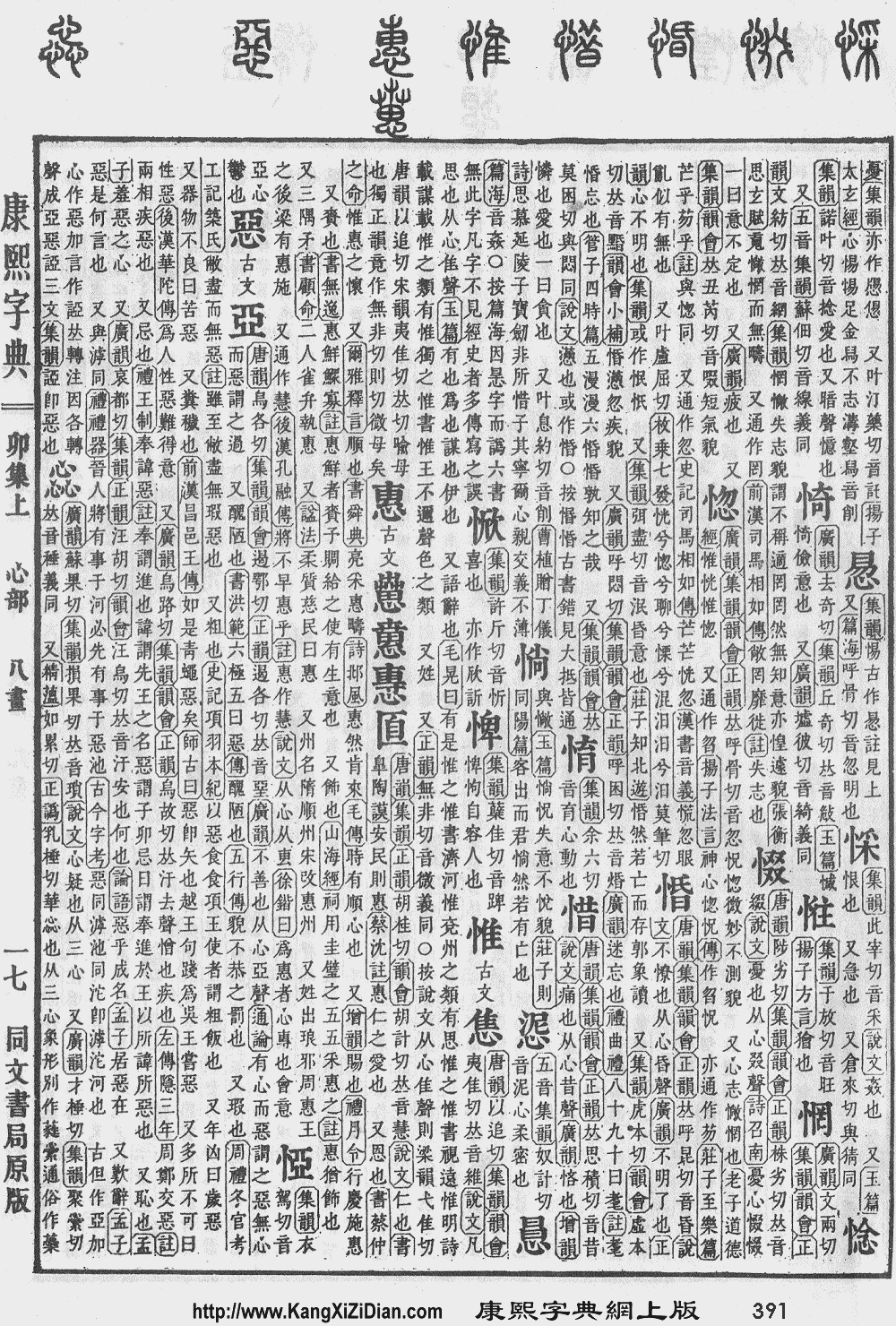
- Kangxi Dictionary: page 391, character 25
- Dai Kanwa Jiten: character 10824
- Dae Jaweon: page 724, character 7
- Hanyu Da Zidian (first edition): volume 4, page 2307, character 12
- Unihan data for U+60E1
- Unihan data for U+F9B9
Chinese
Glyph origin
| Historical forms of the character 惡 | |
|---|---|
| Shuowen Jiezi (compiled in Han) | Liushutong (compiled in Ming) |
| Small seal script | Transcribed ancient scripts |
 |
 |
Phono-semantic compound (形聲/形声, OC *qaː, *qaːɡs, *qaːɡ) : phonetic 亞 (OC *qraːɡs) + semantic 心 (“heart”).
Etymology 1
| trad. | 惡 | |
|---|---|---|
| simp. | 恶* | |
| alternative forms | ||
From Proto-Sino-Tibetan *ʔak (“bad”); cognate with Tibetan ཨག་པོ (ag po, “bad”) (Coblin, 1986; Schuessler, 2007). Also related to Thai ยาก (yâak, “difficult”) (Schuessler, 2007).
Pronunciation
Definitions
惡
- evil; wicked; foul
- fierce; hostile; ferocious
- (Cantonese, transitive) to be hostile against (someone)
- bad; poor
- 士志於道,而恥惡衣惡食者,未足與議也。 [Classical Chinese, trad.]
- From: The Analects of Confucius, c. 475 – 221 BCE, translated based on James Legge's version
- Shì zhì yú dào, ér chǐ è yī è shí zhě, wèi zú yǔ yì yě. [Pinyin]
- A scholar, whose mind is set on truth, and who is ashamed of bad clothes and bad food, is not fit to be discoursed with.
士志于道,而耻恶衣恶食者,未足与议也。 [Classical Chinese, simp.]
- (Cantonese, Southern Min) difficult
- (Quanzhou, Xiamen and Philippine Hokkien) to verbally abuse; to reprimand; to curse; to rebuke
- (Taiwanese Hokkien) slow
Synonyms
| Variety | Location | Words |
|---|---|---|
| Formal (Written Standard Chinese) | 慢, 緩慢 | |
| Mandarin | Beijing | 慢 |
| Taiwan | 慢 | |
| Jinan | 慢 | |
| Xi'an | 慢 | |
| Wuhan | 慢 | |
| Chengdu | 慢 | |
| Yangzhou | 慢 | |
| Hefei | 慢 | |
| Malaysia | 慢 | |
| Singapore | 慢 | |
| Cantonese | Guangzhou | 慢, 嚤 |
| Hong Kong | 慢, 嚤 | |
| Yangjiang | 慢 | |
| Kuala Lumpur (Guangfu) | 慢 | |
| Singapore (Guangfu) | 慢 | |
| Gan | Nanchang | 慢 |
| Hakka | Meixian | 慢 |
| Miaoli (N. Sixian) | 慢 | |
| Pingtung (Neipu; S. Sixian) | 慢 | |
| Hsinchu County (Zhudong; Hailu) | 慢 | |
| Taichung (Dongshi; Dabu) | 慢 | |
| Hsinchu County (Qionglin; Raoping) | 慢 | |
| Yunlin (Lunbei; Zhao'an) | 慢 | |
| Kuching (Hepo) | 慢 | |
| Jin | Taiyuan | 慢 |
| Northern Min | Jian'ou | 慢 |
| Eastern Min | Fuzhou | 慢 |
| Southern Min | Xiamen | 慢 |
| Quanzhou | 慢 | |
| Zhangzhou | 慢 | |
| Taipei | 慢, 惡 | |
| New Taipei (Sanxia) | 慢, 惡 | |
| Kaohsiung | 慢, 惡 | |
| Yilan | 慢, 惡 | |
| Changhua (Lukang) | 慢, 惡 | |
| Taichung | 慢, 惡 | |
| Tainan | 慢, 惡 | |
| Hsinchu | 慢, 惡 | |
| Kinmen | 慢, 惡 | |
| Penghu (Magong) | 慢, 惡 | |
| Penang (Hokkien) | 慢, 惡 | |
| Singapore (Hokkien) | 慢 | |
| Manila (Hokkien) | 慢 | |
| Chaozhou | 慢 | |
| Shantou | 慢 | |
| Singapore (Teochew) | 慢 | |
| Wenchang | 慢 | |
| Singapore (Hainanese) | 慢 | |
| Zhongshan Min | Shaxi (Longdu) | 慢 |
| Wu | Shanghai | 慢 |
| Suzhou | 慢 | |
| Ningbo | 慢, 緩 | |
| Wenzhou | 慢 | |
| Xiang | Changsha | 慢 |
| Shuangfeng | 慢 | |
Compounds
- 三惡道/三恶道
- 不念舊惡/不念旧恶 (bùniànjiù'è)
- 不惡而嚴/不恶而严
- 中惡/中恶 (zhòng'è)
- 乞留惡濫/乞留恶滥
- 五濁惡世/五浊恶世
- 作惡/作恶 (zuò'è)
- 作惡多端/作恶多端 (zuò'èduōduān)
- 做好做惡/做好做恶
- 元惡/元恶 (yuán'è)
- 元惡大奸
- 元惡大憝/元恶大憝
- 凶惡 (xiōng'è)
- 凶神惡煞 (xiōngshénèshà)
- 刁惡/刁恶
- 剗惡除奸/刬恶除奸
- 剪惡除奸
- 助惡/助恶 (zhù'è)
- 勸善懲惡/劝善惩恶 (quànshànchéng'è)
- 勸善戒惡/劝善戒恶
- 勸善黜惡/劝善黜恶
- 十惡/十恶 (shí'è)
- 十惡不赦/十恶不赦 (shí'èbùshè)
- 千刁萬惡/千刁万恶
- 同惡相助/同恶相助
- 同惡相救/同恶相救
- 同惡相求/同恶相求
- 同惡相濟/同恶相济
- 善惡/善恶 (shàn'è)
- 嚴惡/严恶
- 大惡/大恶 (dà'è)
- 好善嫉惡/好善嫉恶
- 姑惡/姑恶
- 嫉惡/嫉恶
- 嫉惡如仇/嫉恶如仇
- 嫉惡好善/嫉恶好善
- 嫉惡若仇/嫉恶若仇
- 差惡/差恶
- 彰善癉惡/彰善瘅恶
- 忒惡/忒恶
- 怒惡/怒恶
- 怙惡不悛/怙恶不悛 (hù'èbùquān)
- 怙惡不改/怙恶不改
- 性惡說/性恶说
- 惡人/恶人 (èrén)
- 惡仗/恶仗
- 惡作劇/恶作剧 (èzuòjù)
- 惡例/恶例
- 惡俗/恶俗 (èsú)
- 惡兆/恶兆 (èzhào)
- 惡兇兇/恶凶凶
- 惡劣/恶劣 (èliè)
- 惡勢力/恶势力
- 惡化/恶化 (èhuà)
- 惡叉白賴/恶叉白赖
- 惡口/恶口 (èkǒu)
- 惡名/恶名 (èmíng)
- 惡名昭彰/恶名昭彰 (èmíngzhāozhāng)
- 惡哏哏/恶哏哏
- 惡唸/恶念
- 惡因/恶因
- 惡地/恶地
- 惡報/恶报 (èbào)
- 惡夢/恶梦 (èmèng)
- 惡婦/恶妇
- 惡子/恶子
- 惡孽/恶孽
- 惡客/恶客 (èkè)
- 惡寒/恶寒
- 惡少/恶少 (èshào)
- 惡徒/恶徒 (ètú)
- 惡德/恶德 (èdé)
- 惡心/恶心 (èxīn)
- 惡性/恶性 (èxìng)
- 惡性倒閉/恶性倒闭
- 惡性循環/恶性循环 (èxìng xúnhuán)
- 惡性競爭/恶性竞争
- 惡性腫瘤/恶性肿瘤 (èxìng zhǒngliú)
- 惡性貧血/恶性贫血 (èxìng pínxuè)
- 惡惡實實/恶恶实实
- 惡意/恶意 (èyì)
- 惡感/恶感 (ègǎn)
- 惡憐/恶怜
- 惡戰/恶战 (èzhàn)
- 惡支殺/恶支杀
- 惡曜/恶曜
- 惡月/恶月
- 惡有惡報/恶有恶报 (èyǒu'èbào)
- 惡果/恶果 (èguǒ)
- 惡棍/恶棍 (ègùn)
- 惡業/恶业
- 惡模惡樣/恶模恶样
- 惡歲/恶岁
- 惡毒/恶毒 (èdú)
- 惡氣/恶气
- 惡水/恶水 (èshuǐ)
- 惡法/恶法 (èfǎ)
- 惡浪/恶浪
- 惡漢/恶汉 (èhàn)
- 惡濁/恶浊 (èzhuó)
- 惡煞/恶煞 (èshà)
- 惡犬/恶犬 (èquǎn)
- 惡狗/恶狗 (ègǒu)
- 惡狠狠/恶狠狠 (èhěnhěn)
- 惡疾/恶疾 (èjí)
- 惡病質/恶病质 (èbìngzhì)
- 惡瘡/恶疮
- 惡癖/恶癖 (èpǐ)
- 惡發/恶发
- 惡相/恶相
- 惡眉惡眼/恶眉恶眼
- 惡稔禍盈/恶稔祸盈
- 惡稔罪盈/恶稔罪盈
- 惡稔貫盈/恶稔贯盈
- 惡積禍盈/恶积祸盈
- 惡緣惡業/恶缘恶业
- 惡罵/恶骂 (èmà)
- 惡習/恶习 (èxí)
- 惡耗/恶耗 (èhào)
- 惡聲/恶声
- 惡聲惡氣/恶声恶气
- 惡臭/恶臭 (èchòu)
- 惡行/恶行
- 惡衣惡食/恶衣恶食
- 惡衣糲食/恶衣粝食
- 惡衣菲食/恶衣菲食
- 惡衣蔬食/恶衣蔬食
- 惡補/恶补 (èbǔ)
- 惡言/恶言 (èyán)
- 惡言惡語/恶言恶语
- 惡言潑語/恶言泼语
- 惡言詈辭/恶言詈辞
- 惡訊/恶讯
- 惡評/恶评 (èpíng)
- 惡詫/恶诧
- 惡語/恶语 (èyǔ)
- 惡語中傷/恶语中伤
- 惡識/恶识
- 惡變/恶变 (èbiàn)
- 惡貫滿盈/恶贯满盈 (èguànmǎnyíng)
- 惡貫禍盈/恶贯祸盈
- 惡賴/恶赖
- 惡趣/恶趣
- 惡蹟/恶迹
- 惡躁/恶躁
- 惡辣/恶辣
- 惡逆/恶逆
- 惡道/恶道 (èdào)
- 惡運/恶运 (èyùn)
- 惡運當頭/恶运当头
- 惡阻/恶阻
- 惡限/恶限
- 惡障/恶障
- 惡露/恶露 (èlù)
- 惡霸/恶霸 (èbà)
- 惡風/恶风
- 惡食/恶食
- 惡鬥/恶斗 (èdòu)
- 惡鬼/恶鬼 (èguǐ)
- 惡魔/恶魔 (èmó)
- 惡黨/恶党 (èdǎng)
- 懲惡勸善/惩恶劝善 (chéng'èquànshàn)
- 懲惡獎善/惩恶奖善
- 懷惡不悛/怀恶不悛
- 扶善懲惡/扶善惩恶
- 抑惡揚善/抑恶扬善
- 掩惡揚善/掩恶扬善
- 掩惡溢美/掩恶溢美
- 掩罪藏惡/掩罪藏恶
- 播惡遺臭/播恶遗臭
- 改惡向善/改恶向善
- 改惡從善/改恶从善 (gǎi'ècóngshàn)
- 改惡行善/改恶行善
- 旌善懲惡/旌善惩恶
- 是非善惡/是非善恶
- 欺善怕惡/欺善怕恶 (qīshànpà'è)
- 止惡揚善/止恶扬善 (zhǐ'èyángshàn)
- 溢惡/溢恶
- 濟惡/济恶
- 為惡不悛/为恶不悛
- 無惡不作/无恶不作 (wú'èbùzuò)
- 犯惡/犯恶
- 狠惡/狠恶
- 獰惡/狞恶 (níng'è)
- 疾惡/疾恶
- 疾惡如仇/疾恶如仇
- 疾惡好善/疾恶好善
- 疾惡若仇/疾恶若仇
- 癉惡彰善/瘅恶彰善
- 禍因惡積/祸因恶积
- 禍盈惡稔/祸盈恶稔
- 禍稔惡盈/祸稔恶盈
- 萬惡/万恶 (wàn'è)
- 積惡/积恶 (jī'è)
- 積惡餘殃/积恶余殃
- 窮凶惡極/穷凶恶极
- 窮凶極惡/穷凶极恶 (qióngxiōngjí'è)
- 窮山惡水/穷山恶水 (qióngshān'èshuǐ)
- 粗惡/粗恶
- 粗衣惡食/粗衣恶食
- 罪大惡極/罪大恶极 (zuìdà'èjí)
- 罪惡/罪恶 (zuì'è)
- 罪惡如山/罪恶如山
- 罪惡感/罪恶感 (zuì'ègǎn)
- 罪惡昭著/罪恶昭著 (zuì'èzhāozhù)
- 罪惡深重/罪恶深重
- 罪惡滔天/罪恶滔天
- 罪惡貫盈/罪恶贯盈 (zuì'è guànyíng)
- 美惡/美恶
- 腐惡/腐恶
- 自食惡果/自食恶果
- 舊惡/旧恶 (jiù'è)
- 苦思惡想/苦思恶想
- 菲衣惡食/菲衣恶食
- 薄惡/薄恶
- 褒善貶惡/褒善贬恶
- 褒賢遏惡/褒贤遏恶
- 討惡剪暴/讨恶剪暴
- 諱惡不悛/讳恶不悛
- 貧嘴惡舌/贫嘴恶舌
- 賞善罰惡/赏善罚恶
- 賣惡/卖恶
- 辟惡
- 辟惡除患
- 逢君之惡/逢君之恶
- 遏惡揚善/遏恶扬善
- 遠惡/远恶
- 邪惡/邪恶 (xié'è)
- 醜惡/丑恶 (chǒu'è)
- 醜類惡物/丑类恶物
- 釁惡/衅恶
- 長君之惡/长君之恶
- 長惡不悛/长恶不悛
- 除惡務本/除恶务本
- 除惡務盡/除恶务尽 (chú'èwùjìn)
- 除惡扶善/除恶扶善
- 陰惡/阴恶
- 險惡/险恶 (xiǎn'è)
- 隱惡揚善/隐恶扬善 (yǐn'èyángshàn)
- 面善心惡/面善心恶
- 面惡心善/面恶心善 (miàn è xīn shàn)
- 風塵惡俗/风尘恶俗
- 首惡/首恶 (shǒu'è)
- 鬼怕惡人/鬼怕恶人
Pronunciation
Definitions
惡
- to hate; to loathe; to dislike
- 死亦我所惡,所惡有甚於死者,故患有所不辟也。 [Classical Chinese, trad.]
- From: Mencius, c. 4th century BCE, translated based on James Legge's version
- Sǐ yì wǒ suǒ wù, suǒ wù yǒu shèn yú sǐ zhě, gù huàn yǒu suǒ bù bì yě. [Pinyin]
- I dislike death indeed, but there is that which I dislike more than death, and therefore there are occasions when I will not avoid danger.
死亦我所恶,所恶有甚于死者,故患有所不辟也。 [Classical Chinese, simp.]- 好賢如《緇衣》,惡惡如《巷伯》。 [Classical Chinese, trad.]
- From: The Book of Rites, c. 4th – 2nd century BCE
- Hào xián rú “Zī Yī”, wù è rú “Xiàng Bó”. [Pinyin]
- Love the good (persons) like how the poet of Black Robes loves her lover, and loathe the wicked like the poet who wrote Xiang Bo.
好贤如《缁衣》,恶恶如《巷伯》。 [Classical Chinese, simp.]- 又有可怪者。上帝惡世人罪惡,破天淵之水,以盡滅之,又俯念以色列盡戮埃及長子。此時其「不忍仁愛之性」未知何處去。 [Korean Literary Sinitic, trad.]
- From: 1961, Kim Yeong'ik (金永益), 《西敎辨》
- U yu ga goe ja. Sangje o sein joeak, pa cheon yeon ji su, i jin myeol ji, u bunyeom Isaengnyeol jin ryuk Aegup jangja. Chasi gi "burin inae ji seong" miji hacheo geo. [Sino-Korean]
- There is another strange thing. God hating the sins of the people of the world, he broke open the waters of the heavenly vaults and annihilated them all thereby; and looking down upon Israel, he massacred all of Egypt's eldest sons. I do not know where this "kindhearted nature which cannot bear [to punish]" was to be found at those times.
Compounds
Etymology 3
| trad. | 惡 | |
|---|---|---|
| simp. | 恶* | |
| alternative forms | ||
Cognate with 安 (OC *qaːn, “where; how”), 焉 (OC *qan, “where; how”).
Pronunciation
Definitions
惡
- † An interrogative pronoun: how
- 自我觀之,仁義之端,是非之塗,樊然殽亂,吾惡能知其辯? [Classical Chinese, trad.]
- From: Zhuangzi, circa 3rd – 2nd centuries BCE
- Zì wǒ guān zhī, rényì zhī duān, shìfēi zhī tú, fánrán yáoluàn, wú wū néng zhī qí biàn? [Pinyin]
- As I look at the matter, the first principles of benevolence and righteousness and the paths of approval and disapproval are inextricably mixed and confused together - how is it possible that I should know how to discriminate among them?
自我观之,仁义之端,是非之涂,樊然淆乱,吾恶能知其辩? [Classical Chinese, simp.]
- † Interjection used to express surprise: oh; ah
Etymology 4
| For pronunciation and definitions of 惡 – see 噁. (This character is a variant traditional form of 噁). |
Etymology 5
| trad. | 惡 | |
|---|---|---|
| simp. | 恶* | |
| alternative forms | 污 屙 涴 | |
Probably related to etymologies 1 and 2 (Zhengzhang, 2011b; Xiang, 2019). Alternatively, 涴 (MC 'waH, “to soil; to stain”) has been proposed to be the etymon (Cao, 2008).
Pronunciation
Synonyms
References
- “惡”, in 漢語多功能字庫 (Multi-function Chinese Character Database), 香港中文大學 (the Chinese University of Hong Kong), 2014–
- Dictionary of Chinese Character Variants (教育部異體字字典), A01382
Japanese
| 悪 | |
| 惡 |
Kanji
(“Jinmeiyō” kanji used for names, kyūjitai kanji, shinjitai form 悪)
- This term needs a translation to English. Please help out and add a translation, then remove the text
{{rfdef}}.
Korean
Etymology 1
From Middle Chinese 惡 (MC 'ak).
| Historical Readings | ||
|---|---|---|
| Dongguk Jeongun Reading | ||
| Dongguk Jeongun, 1448 | ᅙᅡᆨ〮 (Yale: qák) | |
| Middle Korean | ||
| Text | Eumhun | |
| Gloss (hun) | Reading | |
| Hunmong Jahoe, 1527 | 모〯딜 (Yale: mwǒtìl) | 악〮 (Yale: ák) |
Pronunciation
- (SK Standard/Seoul) IPA(key): [a̠k̚]
- Phonetic hangul: [악]
Compounds
- 간악 (奸惡, ganak)
- 강악 (強惡, gang'ak)
- 괴악 (怪惡, goeak)
- 극악 (極惡, geugak)
- 선악 (善惡, seonak)
- 악감 (惡感, akgam)
- 악과 (惡果, akgwa)
- 악귀 (惡鬼, akgwi)
- 악기 (惡氣, akgi)
- 악녀 (惡女, angnyeo)
- 악담 (惡談, akdam)
- 악당 (惡黨, akdang)
- 악덕 (惡德, akdeok)
- 악령 (惡靈, angnyeong)
- 악마 (惡魔, angma)
- 악몽 (惡夢, angmong)
- 악법 (惡法, akbeop)
- 악설 (惡舌/惡說, akseol)
- 악성 (惡性, akseong)
- 악성 (惡聲, akseong)
- 악습 (惡習, akseup)
- 악역 (惡役, agyeok)
- 악용 (惡用, agyong)
- 악의 (惡意, agui)
- 악인 (惡人, agin)
- 악질 (惡疾, akjil)
- 악질 (惡質, akjil)
- 악취 (惡臭, akchwi)
- 악투 (惡投, aktu)
- 악폐 (惡弊, akpye)
- 악풍 (惡風, akpung)
- 악화 (惡化, akhwa)
- 열악 (劣惡, yeorak)
- 잔악 (殘惡, janak)
- 조악 (粗惡, joak)
- 죄악 (罪惡, joeak)
- 참악 (慘惡, chamak)
- 최악 (最惡, choeak)
- 추악 (醜惡, chuak)
- 포악 (暴惡, poak)
- 해악 (害惡, haeak)
- 행악 (行惡, haeng'ak)
- 험악 (險惡, heomak)
- 흉악 (凶惡, hyung'ak)
Etymology 2
From Middle Chinese 惡 (MC 'uH).
| Historical Readings | ||
|---|---|---|
| Dongguk Jeongun Reading | ||
| Dongguk Jeongun, 1448 | ᅙᅩᆼ〮 (Yale: qwó) | |
| Middle Korean | ||
| Text | Eumhun | |
| Gloss (hun) | Reading | |
| Sinjeung Yuhap, 1576 | 아쳐 (Yale: achye) | 오 (Yale: wo) |
Pronunciation
- (SK Standard/Seoul) IPA(key): [o̞]
- Phonetic hangul: [오]
Tày
Adjective
惡 (ác)