睡
| ||||||||
Translingual
| Stroke order | |||
|---|---|---|---|
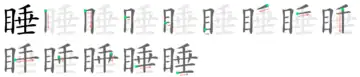 | |||
| Japanese | 睡 |
|---|---|
| Simplified | 睡 |
| Traditional | 睡 |
Alternative forms
Note minor compositional differences.
Han character
睡 (Kangxi radical 109, 目+8, 13 strokes, cangjie input 月山竹十一 (BUHJM), four-corner 62014, composition ⿰目垂)
Derived characters
- 𬑩
References
- Kangxi Dictionary: page 810, character 23
- Dai Kanwa Jiten: character 23448
- Dae Jaweon: page 1225, character 20
- Hanyu Da Zidian (first edition): volume 4, page 2497, character 4
- Unihan data for U+7761

Chinese
| trad. | 睡 | |
|---|---|---|
| simp. # | 睡 | |
Glyph origin
| Historical forms of the character 睡 | |
|---|---|
| Shuowen Jiezi (compiled in Han) | Liushutong (compiled in Ming) |
| Small seal script | Transcribed ancient scripts |
 |
 |
Characters in the same phonetic series (垂) (Zhengzhang, 2003)
Phono-semantic compound (形聲/形声, OC *djols) : semantic 目 (“eye”) + phonetic 垂 (OC *djol) – sleep.
Etymology
May be from Proto-Sino-Tibetan *(d/n)waj (“to hang from; to cling to; creeper”) (STEDT), whence Burmese တွယ် (twai, “to cling”). May be related to 垂 (OC *djol, “to hang down”), 朵 (OC *toːlʔ, “to hang from a tree; classifier for blossoms”), 橢 (OC *l̥ʰoːlʔ, “oblong; oval”), 惰 (OC *l'oːlʔ, *l'oːls, “lazy”) and 蕊 (OC *ŋljolʔ, *ŋljulʔ, “reproductive organ of flower”).
Pronunciation

睡
Definitions
睡
Synonyms
- (to sleep):
Dialectal synonyms of 睡覺 (“to sleep”) [map]
- (to lie):
Dialectal synonyms of 躺 (“to lie; to recline”) [map]
| Variety | Location | Words |
|---|---|---|
| Formal (Written Standard Chinese) | 躺 | |
| Mandarin | Beijing | 躺, 歪 |
| Taiwan | 躺 | |
| Jinan | 躺 | |
| Xi'an | 睡, 躺 | |
| Wuhan | 睡 | |
| Chengdu | 躺, 睡 | |
| Guilin | 躺 | |
| Yangzhou | 躺, 睡 | |
| Hefei | 睡, 躺 | |
| Singapore | 躺 | |
| Cantonese | Guangzhou | 瞓 |
| Hong Kong | 瞓 | |
| Yangjiang | 睡 | |
| Singapore (Guangfu) | 瞓 | |
| Gan | Nanchang | 睏 |
| Hakka | Meixian | 眠, 抗 |
| Miaoli (N. Sixian) | 睡 | |
| Pingtung (Neipu; S. Sixian) | 眠 | |
| Hsinchu County (Zhudong; Hailu) | 睡 | |
| Taichung (Dongshi; Dabu) | 睡 | |
| Hsinchu County (Qionglin; Raoping) | 睡 | |
| Jin | Taiyuan | 躺, 睡 |
| Northern Min | Jian'ou | 倒 |
| Eastern Min | Fuzhou | 倒 |
| Southern Min | Xiamen | 倒 |
| Quanzhou | 倒 | |
| Zhangzhou | 倒 | |
| Penang (Hokkien) | 倒 | |
| Singapore (Hokkien) | 倒 | |
| Chaozhou | 倒 | |
| Shantou | 夗 | |
| Jieyang | 夗 | |
| Wu | Suzhou | 睏 |
| Wenzhou | 翻, 倒 | |
| Xiang | Changsha | 睏 |
| Shuangfeng | 睏 | |
Compounds
- 低睡
- 倒頭就睡/倒头就睡
- 入睡 (rùshuì)
- 午睡 (wǔshuì)
- 半睡半醒
- 卯睡
- 卻睡草/却睡草
- 呼呼大睡
- 嗑睡
- 嗜睡症 (shìshuìzhèng)
- 囫圇睡/囫囵睡
- 安睡 (ānshuì)
- 客睡
- 寢睡/寝睡
- 小睡 (xiǎoshuì)
- 引睡
- 憩睡
- 打睡
- 打瞌睡 (dǎ kēshuì)
- 打磕睡
- 打齁睡
- 放睡
- 昏昏欲睡 (hūnhūnyùshuì)
- 昏睡 (hūnshuì)
- 昏睡病 (hūnshuìbìng)
- 晌睡
- 楊妃春睡/杨妃春睡
- 沉睡 (chénshuì)
- 沈睡
- 淺睡/浅睡
- 清睡
- 渴睡
- 渴睡漢/渴睡汉
- 濃睡/浓睡
- 熟睡 (shúshuì)
- 狗瞌睡魚/狗瞌睡鱼
- 獨睡丸/独睡丸
- 獸睡/兽睡
- 甜睡
- 疲睡
- 癱睡/瘫睡
- 益睡
- 盹睡
- 省睡
- 眠睡
- 睏睡/困睡
- 睡不著/睡不着 (shuìbùzháo)
- 睡中覺/睡中觉
- 睡仙
- 睡伏
- 睡佛
- 睡僊/睡仙
- 睡債/睡债
- 睡兀
- 睡功
- 睡午覺/睡午觉 (shuìwǔjiào)
- 睡卿
- 睡味
- 睡國/睡国
- 睡夢/睡梦 (shuìmèng)
- 睡大覺/睡大觉
- 睡媒
- 睡寐 (shuìmèi)
- 睡帽 (shuìmào)
- 睡性
- 睡思
- 睡息
- 睡意 (shuìyì)
- 睡態/睡态
- 睡懶覺/睡懒觉 (shuì lǎnjiào)
- 睡晌覺/睡晌觉
- 睡椅 (shuìyǐ)
- 睡榻
- 睡獅/睡狮
- 睡王
- 睡理
- 睡生夢死/睡生梦死
- 睡病蟲/睡病虫
- 睡癖
- 睡相
- 睡眠 (shuìmián)
- 睡眠療法/睡眠疗法
- 睡眼
- 睡眼惺忪 (shuìyǎnxīngsōng)
- 睡神
- 睡美人 (Shuìměirén)
- 睡聲/睡声
- 睡臉/睡脸
- 睡臥/睡卧
- 睡臥不寧/睡卧不宁
- 睡興/睡兴
- 睡草
- 睡菜 (shuìcài)
- 睡著/睡着 (shuìzháo)
- 睡蓮/睡莲 (shuìlián)
- 睡虎子
- 睡蛇
- 睡衣 (shuìyī)
- 睡袋 (shuìdài)
- 睡袍 (shuìpáo)
- 睡褲/睡裤 (shuìkù)
- 睡覺/睡觉
- 睡語/睡语
- 睡車/睡车
- 睡鄉/睡乡 (shuìxiāng)
- 睡長夢多/睡长梦多
- 睡長覺/睡长觉
- 睡雨
- 睡鞋
- 睡頓/睡顿
- 睡餘/睡余
- 睡香
- 睡魔
- 睡鴨/睡鸭
- 睡龍/睡龙
- 瞌睡 (kēshuì)
- 瞌睡漢/瞌睡汉
- 瞌睡蟲/瞌睡虫 (kēshuìchóng)
- 瞌睡鬼
- 破睡
- 磕睡
- 磕睡蟲/磕睡虫
- 紅窗睡/红窗睡
- 美睡
- 臥榻鼾睡/卧榻鼾睡
- 臨睡/临睡 (línshuì)
- 袁安睡
- 調睡參軍/调睡参军
- 貉睡
- 貪睡/贪睡 (tānshuì)
- 起早睡晚
- 酣睡 (hānshuì)
- 醒睡 (xǐngshuì)
- 頓瞌睡/顿瞌睡
- 餘睡/余睡
- 驚睡/惊睡
- 鼾睡 (hānshuì)
- 齁睡
- 龍睡/龙睡
References
- “睡”, in 漢語多功能字庫 (Multi-function Chinese Character Database), 香港中文大學 (the Chinese University of Hong Kong), 2014–
Japanese
Vietnamese
This article is issued from Wiktionary. The text is licensed under Creative Commons - Attribution - Sharealike. Additional terms may apply for the media files.