塞
| ||||||||
| ||||||||
Translingual
Han character
塞 (Kangxi radical 32, 土+10, 13 strokes, cangjie input 十廿金土 (JTCG), four-corner 30104, composition ⿱𡨄土)
References
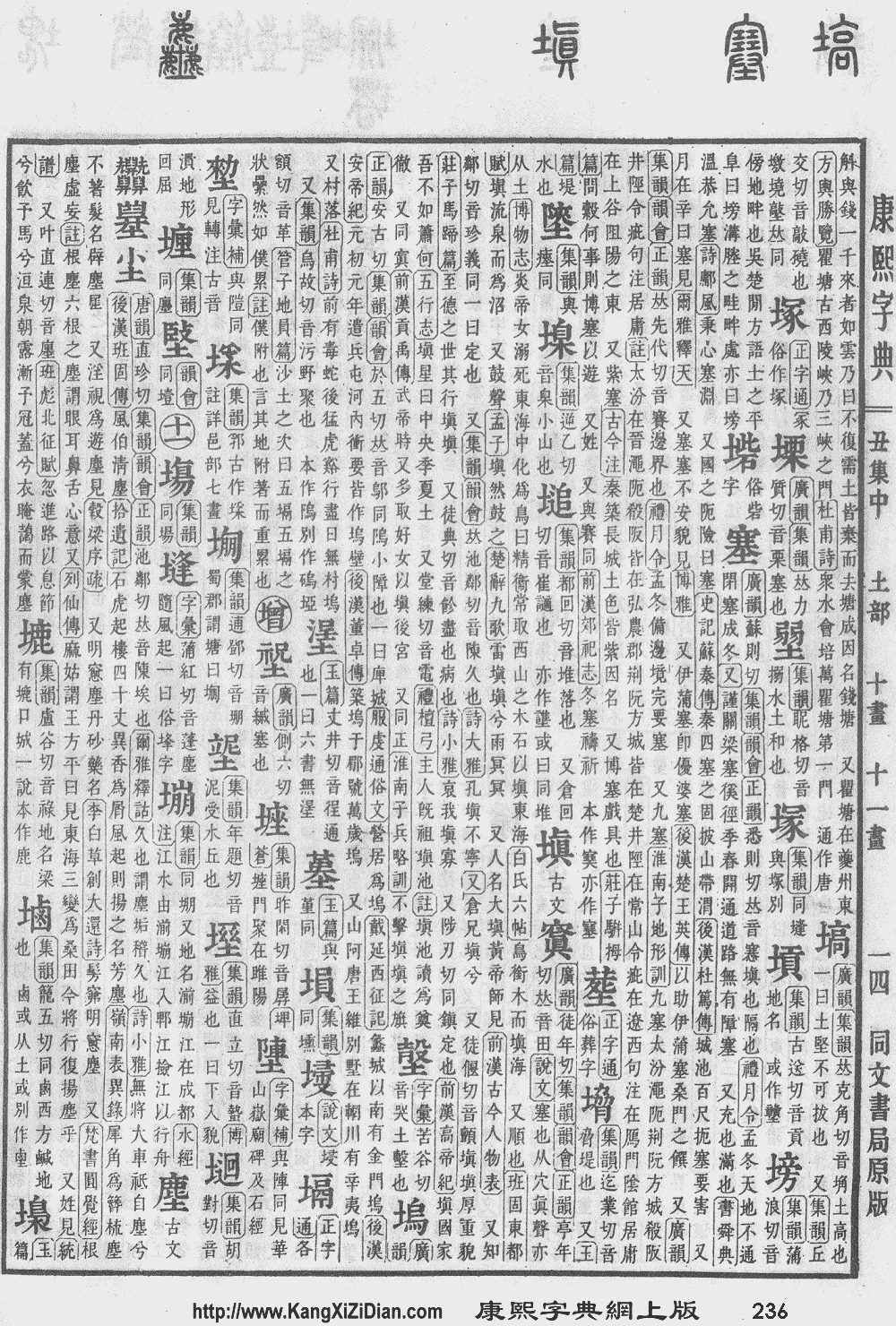
- Kangxi Dictionary: page 236, character 9
- Dai Kanwa Jiten: character 5349
- Dae Jaweon: page 474, character 2
- Hanyu Da Zidian (first edition): volume 1, page 475, character 1
- Unihan data for U+585E
- Unihan data for U+F96C
Chinese
| simp. and trad. |
塞 | |
|---|---|---|
| alternative forms | 㩙 | |
Glyph origin
| Historical forms of the character 塞 | ||
|---|---|---|
| Shang | Shuowen Jiezi (compiled in Han) | Liushutong (compiled in Ming) |
| Oracle bone script | Small seal script | Transcribed ancient scripts |
 |
 |
 |
Characters in the same phonetic series (塞) (Zhengzhang, 2003)
Oracle bone script: Ideogrammic compound (會意/会意) : 宀 (“house”) + 工 (“two items”) + 廾 (“two hands”) – stuffing the house with items.
Pronunciation 1
Definitions
塞
- to stop up; to block up
- to stuff; to cram; to squeeze in
- to be blocked; to be jammed
- to forbid; to suppress; to prohibit
- to satisfy; to fulfil
- to compensate; to remedy
- to answer; to repay
- to manage to arrange a position for someone
- to practise bribe
- to evade; to stall
- stopper; cork
- to be in a difficult position; destitute
- honest; truthful
- (historial) Saka people
Synonyms
- (to stop up): 堵 (dǔ)
Compounds
- 亞塞拜然/亚塞拜然
- 交通壅塞
- 但求塞責/但求塞责
- 優婆塞/优婆塞 (yōupósè)
- 充塞 (chōngsè)
- 兩豆塞耳/两豆塞耳
- 口塞 (kǒusāi)
- 唐塞
- 喉塞音
- 嗌塞
- 堆山塞海
- 堵塞
- 堰塞湖 (yànsèhú)
- 塞住
- 塞內加爾/塞内加尔
- 塞口
- 填塞
- 塞子 (sāizi)
- 塞席爾/塞席尔 (Sèxí'ěr)
- 塞擦化 (sècāhuà)
- 塞擦音 (sècāyīn)
- 塞淵/塞渊
- 塞滿/塞满 (sāimǎn)
- 塞爆音
- 塞爾維亞/塞尔维亚
- 塞牙
- 塞牙縫/塞牙缝
- 塞狗洞
- 塞納河/塞纳河
- 塞耳
- 塞耳偷鈴/塞耳偷铃
- 塞耳盜鐘/塞耳盗钟
- 塞聲/塞声
- 塞職/塞职
- 填街塞巷
- 塞話/塞话
- 塞責/塞责 (sèzé)
- 塞車/塞车
- 塞音
- 壅塞 (yōngsè)
- 壺漿塞道/壶浆塞道
- 奧登塞/奥登塞
- 屯街塞巷
- 屯蹶否塞
- 布魯塞爾/布鲁塞尔
- 廞塞/𫷷塞
- 心肌梗塞 (xīnjī gěngsè)
- 抑塞
- 抑塞磊落
- 拍塞
- 拒塞
- 拔本塞原
- 拔本塞源
- 挨山塞海
- 推諉塞責/推诿塞责
- 搪塞 (tángsè)
- 擁塞/拥塞 (yōngsè)
- 擔雪塞井/担雪塞井
- 敷衍塞責/敷衍塞责 (fūyǎnsèzé)
- 敷衍搪塞 (fūyǎntángsè)
- 晦盲否塞
- 木塞
- 杜塞
- 栓塞 (shuānsè)
- 梗塞
- 氣塞/气塞
- 泥塞竹管
- 活塞 (huósāi)
- 淵塞/渊塞
- 淤塞 (yūsè)
- 漫天塞地
- 漫山塞野 (mànshān sè yě)
- 潦草塞責/潦草塞责
- 火星塞
- 無以塞責/无以塞责
- 理塞
- 瓶塞 (píngsāi)
- 白塞木
- 窒塞
- 耳塞
- 聊以塞責/聊以塞责
- 腦栓塞/脑栓塞 (nǎoshuānsè)
- 腸阻塞/肠阻塞 (chángzǔsè)
- 苟且唐塞
- 茅塞
- 茅塞頓開/茅塞顿开 (máosèdùnkāi)
- 葉尼塞河/叶尼塞河
- 蔽塞 (bìsè)
- 蔽聰塞明/蔽聪塞明
- 衛塞/卫塞 (Wèisài)
- 衛塞節/卫塞节
- 補垣塞穴/补垣塞穴
- 語塞/语塞 (yǔsè)
- 譽塞天下/誉塞天下
- 豺狼塞路
- 赭衣塞路
- 距塞
- 通塞
- 閉塞/闭塞 (bìsè)
- 閉明塞聰/闭明塞聪
- 閉目塞聽/闭目塞听 (bìmùsètīng)
- 閉門塞竇/闭门塞窦
- 閼塞/阏塞 (èsè)
- 阻塞
- 障塞
- 險塞/险塞
- 頓開茅塞/顿开茅塞
- 鬱塞/郁塞
- 鼻塞聲重/鼻塞声重
Pronunciation 2
Definitions
塞
- (historical) place of strategic importance; pass; fortress
- to build fortress; to construct fortifications
- frontier; border
- (specifically) the northern frontier of imperial China, as demarcated by the Great Wall
- Alternative form of 賽/赛 (sài, “to compete, contend; contest, race”)
- Alternative form of 簺 (sài, “an ancient gambling game”)
Compounds
- 出塞 (chūsài)
- 四塞
- 塞下曲
- 塞上曲
- 塞內/塞内
- 塞內加爾/塞内加尔
- 塞北 (Sàiběi)
- 塞外 (sàiwài)
- 塞得港
- 塞拉利昂 (Sàilālì'áng)
- 塞浦路斯 (Sàipǔlùsī)
- 塞爾維亞/塞尔维亚
- 塞班島/塞班岛 (Sàibān Dǎo)
- 塞納河/塞纳河
- 塞維利亞/塞维利亚 (Sàiwéilìyà)
- 塞翁失馬/塞翁失马 (sàiwēngshīmǎ)
- 塞舌爾/塞舌尔 (Sàishé'ěr)
- 塞門/塞门
- 巴塞爾/巴塞尔 (Bāsài'ěr)
- 巴塞羅那/巴塞罗那 (Bāsàiluónà)
- 巴塞隆納/巴塞隆纳 (Bāsàilóngnà)
- 文姬入塞
- 昭君出塞
- 榆塞
- 款塞
- 玄塞
- 紫塞
- 絕塞/绝塞
- 要塞 (yàosài)
- 邊塞/边塞 (biānsài)
- 邊塞詩/边塞诗 (biānsàishī)
- 關塞/关塞 (guānsài)
- 阨塞
- 阿克塞 (Ākèsài)
- 阿克塞哈薩克族自治縣/阿克塞哈萨克族自治县 (Ākèsài Hāsàkèzú Zìzhìxiàn)
- 阿塞拜疆 (Āsàibàijiāng)
- 雞鹿塞/鸡鹿塞
- 麻薩諸塞/麻萨诸塞 (Másàzhūsài)
Japanese
Readings
Idioms
- 塞翁が馬 (sai ō ga uma, “The old man lost his horse”): "Good luck brings bad luck, and good luck brings bad luck"; "Luck is fickle"
Korean
Etymology 1
From Middle Chinese 塞 (MC sojH).
| Historical readings |
|---|
|
Pronunciation
- (SK Standard/Seoul) IPA(key): [sʰɛ] ~ [sʰe̞]
- Phonetic hangul: [새/세]
Etymology 2
From Middle Chinese 塞 (MC sok).
| Historical readings |
|---|
|
Pronunciation
- (SK Standard/Seoul) IPA(key): [sʰɛk̚] ~ [sʰe̞k̚]
- Phonetic hangul: [색/섹]
Compounds
Vietnamese
This article is issued from Wiktionary. The text is licensed under Creative Commons - Attribution - Sharealike. Additional terms may apply for the media files.