參
| ||||||||
| ||||||||
Translingual
| Traditional | 參 |
|---|---|
| Simplified | 参 |
| Japanese | 参 |
| Korean | 參 |
Han character
參 (Kangxi radical 28, 厶+9, 11 strokes, cangjie input 戈戈戈竹 (IIIH), four-corner 23202, composition ⿱厽㐱)
Derived characters
Descendants
- 参 (Japanese shinjitai and simplified Chinese)
References
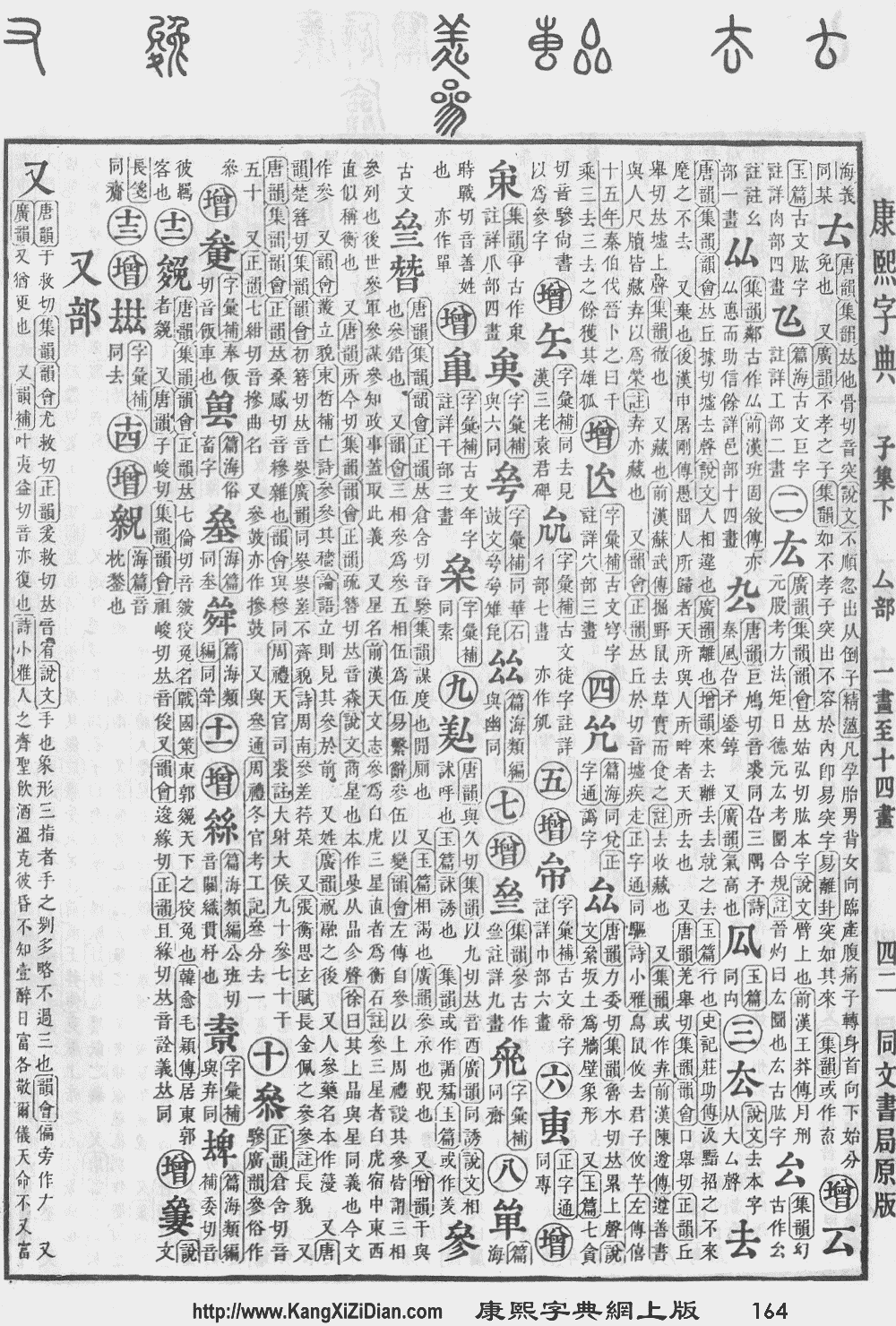
- Kangxi Dictionary: page 164, character 28
- Dai Kanwa Jiten: character 3098
- Dae Jaweon: page 372, character 28
- Hanyu Da Zidian (first edition): volume 1, page 387, character 23
- Unihan data for U+53C3
- Unihan data for U+F96B
Chinese
Glyph origin
| Historical forms of the character 參 | ||
|---|---|---|
| Western Zhou | Shuowen Jiezi (compiled in Han) | Liushutong (compiled in Ming) |
| Bronze inscriptions | Small seal script | Transcribed ancient scripts |
 |
 |
 |
| Old Chinese | |
|---|---|
| 篸 | *ʔsluːm, *ʔsluːms |
| 參 | *sʰluːm, *sʰluːms, *sloːm, *sʰrum, *srum |
| 驂 | *sʰluːm |
| 傪 | *sʰluːm, *sʰluːmʔ |
| 慘 | *sʰluːmʔ |
| 黲 | *sʰluːmʔ, *sʰloːmʔ |
| 謲 | *sʰluːms |
| 毿 | *sluːm |
| 蔘 | *sluːm, *srum |
| 犙 | *sluːm, *sru, *srɯu |
| 糝 | *sluːmʔ |
| 槮 | *sluːmʔ, *sʰrum, *srum, *srumʔ |
| 鬖 | *sloːm |
| 摻 | *sruːm, *sruːmʔ |
| 醦 | *sruːmʔ, *sʰrumʔ |
| 縿 | *sroːm |
| 穇 | *sroːm |
| 嵾 | *sʰrum |
| 磣 | *sʰrumʔ |
| 墋 | *sʰrumʔ |
| 曑 | *srum |
| 瘮 | *srumʔ |
| 滲 | *srums |
The bronze script form is an ideogrammic compound (會意/会意) : 晶 (“stars”) + 光 (“light; brightness”) + 彡 (“light rays”) – Three Stars mansion. 彡 (OC *sroːm, *slom) also acts as a phonetic component. Ignoring the lines connecting the three stars, 光 may be interpreted as 卩 (“kneeling person”), representing someone looking at the shining stars above him.
Alternatively, it may be the original character of 簪 (OC *ʔsɯːm, *ʔsrɯm, “hairpin”), since the bronze script forms resemble a person wearing a hat with three stars.
Based on the seal script form, Shuowen interprets the character as a phono-semantic compound (形聲/形声, OC *sʰluːm, *sʰluːms, *sloːm, *sʰrum, *srum) : semantic 晶 (“stars”) + phonetic 㐱 ().
Etymology 1
| trad. | 參 | |
|---|---|---|
| simp. | 参 | |
| alternative forms | 曑 叄 㕘 叅 | |
From 三 (OC *suːm, *suːms, “three”) + other element (Schuessler, 2007).
Pronunciation
Definitions
參
- (~宿) (Chinese astronomy) Three Stars mansion (one of the Twenty-Eight Mansions)
- a surname
Compounds
Etymology 2
| trad. | 參/蔘* | |
|---|---|---|
| simp. | 参 | |
| alternative forms | ||
Related to Japhug tɤzrɤm (“root”), Yakkha साम (“root”) (Jacques, 2015b).
Pronunciation
Synonyms
- (ginseng):
| Variety | Location | Words |
|---|---|---|
| Formal (Written Standard Chinese) | 人參 | |
| Mandarin | Taiwan | 人參 |
| Luoyang | 人參 | |
| Wanrong | 人參 | |
| Xi'an | 人參 | |
| Yangzhou | 參 | |
| Singapore | 人參 | |
| Cantonese | Guangzhou | 參 |
| Hong Kong | 人參, 參 | |
| Gan | Nanchang | 人參 |
| Lichuan | 人參 | |
| Pingxiang | 人參, 參 | |
| Eastern Min | Fuzhou | 參 |
| Southern Min | Xiamen | 人參 |
| Quanzhou | 人參 | |
| Zhangzhou | 人參 | |
| Tainan | 參仔 | |
| Leizhou | 參 | |
| Southern Pinghua | Nanning (Tingzi) | 人參 |
| Wu | Suzhou | 人參 |
Compounds
Etymology 3
| trad. | 參 | |
|---|---|---|
| simp. | 参 | |
| alternative forms | 叄 㕘 叅 𠫵 | |
(This etymology is missing or incomplete. Please add to it, or discuss it at the Etymology scriptorium. Particularly: “derived from 三? related to 審?”)
Pronunciation
Definitions
參
Compounds
- 免參/免参
- 內參/内参
- 公眾參與/公众参与
- 利弊參半/利弊参半
- 功過參半/功过参半
- 參事/参事 (cānshì)
- 參伍/参伍
- 參佐/参佐 (cānzuǒ)
- 參假/参假 (cānjià)
- 參前落後/参前落后
- 參加/参加 (cānjiā)
- 參劾/参劾 (cānhé)
- 參半/参半 (cānbàn)
- 參同契/参同契
- 參堂/参堂
- 參場/参场
- 參天/参天 (cāntiān)
- 參孫/参孙 (Cānsūn)
- 參將/参将
- 參展/参展 (cānzhǎn)
- 參度/参度
- 參悟/参悟 (cānwù)
- 參戰/参战 (cānzhàn)
- 參拜/参拜 (cānbài)
- 參政/参政 (cānzhèng)
- 參政權/参政权
- 參數/参数 (cānshù)
- 參朝/参朝
- 參本/参本
- 參校/参校 (cānjiào)
- 參照/参照 (cānzhào)
- 參看/参看 (cānkàn)
- 參知政事/参知政事
- 參破/参破
- 參禪/参禅 (cānchán)
- 參綜/参综
- 參考/参考 (cānkǎo)
- 參考書/参考书 (cānkǎoshū)
- 參與/参与
- 參見/参见 (cānjiàn)
- 參觀/参观 (cānguān)
- 參訂/参订 (cāndìng)
- 參詳/参详 (cānxiáng)
- 參話頭/参话头
- 參請/参请
- 參謀/参谋 (cānmóu)
- 參謁/参谒 (cānyè)
- 參譚/参谭
- 參議/参议 (cānyì)
- 參議會/参议会
- 參議院/参议院 (cānyìyuàn)
- 參賽/参赛 (cānsài)
- 參贊/参赞 (cānzàn)
- 參軍/参军 (cānjūn)
- 參透/参透 (cāntòu)
- 參選/参选 (cānxuǎn)
- 參酌/参酌 (cānzhuó)
- 參閱/参阅 (cānyuè)
- 參雜/参杂
- 參靈/参灵
- 參革/参革
- 參預/参预
- 參頭/参头
- 參驗/参验 (cānyàn)
- 同參/同参
- 喝參/喝参
- 形名參同/形名参同
- 憂喜參半/忧喜参半
- 打參/打参
- 拔地參天/拔地参天
- 放參/放参 (fàngcān)
- 早參/早参
- 晚參/晚参
- 晨參暮省/晨参暮省
- 晨參暮禮/晨参暮礼
- 暮禮晨參/暮礼晨参
- 朝參暮禮/朝参暮礼
- 毀譽參半/毁誉参半 (huǐyùcānbàn)
- 疑信參半/疑信参半
- 筆參造化/笔参造化
- 聯合參謀/联合参谋
- 說參請/说参请
- 違紀參選/违纪参选
- 飽參/饱参
- 魚頭參政/鱼头参政
Pronunciation
Definitions
參
- (obsolete or financial) Alternative form of 三 (“three”)
- 先王之制,大都不過參國之一。 [Classical Chinese, trad.]
- From: Commentary of Zuo, c. 4th century BCE
- Xiānwáng zhī zhì, dàdū bù guò sān guó zhī yī. [Pinyin]
- According to the regulations of the former kings, such a city of the first order can have its wall only a third as long as that of the capital.
先王之制,大都不过参国之一。 [Classical Chinese, simp.]- 足下與項王有故,何不反漢與楚連和,參分天下王之? [Classical Chinese, trad.]
- From: The Records of the Grand Historian, by Sima Qian, c. 91 BCE
- Zúxià yǔ Xiàng wáng yǒugù, hé bù fǎn Hàn yǔ Chǔ liánhé, sān fēn tiānxià wàng zhī? [Pinyin]
- (please add an English translation of this usage example)
足下与项王有故,何不反汉与楚连和,参分天下王之? [Classical Chinese, simp.]
See also
| Chinese numbers | |||||||||||||||||
|---|---|---|---|---|---|---|---|---|---|---|---|---|---|---|---|---|---|
| 0 | 1 | 2 | 3 | 4 | 5 | 6 | 7 | 8 | 9 | 10 | 102 | 103 | 104 | 106 | 108 | 1012 | |
| Normal (小寫/小写) |
〇, 零, 空 | 一, 蜀 | 二, 兩/两 | 三 | 四 | 五 | 六 | 七 | 八 | 九 | 十 | 百 | 千 | 萬/万, 十千 (Malaysia, Singapore) |
百萬/百万, 桶(Philippines), 面桶 (Philippines) |
億/亿 | 兆 (Taiwan) 萬億/万亿 (Mainland China) |
| Financial (大寫/大写) |
零 | 壹 | 貳/贰 | 參/叁 | 肆 | 伍 | 陸/陆 | 柒 | 捌 | 玖 | 拾 | 佰 | 仟 | ||||
Etymology 5
| trad. | 參 | |
|---|---|---|
| simp. | 参 | |
| alternative forms | 叄 㕘 叅 | |
Related to 巉 (OC *zraːm, *zraːmʔ, “craggy”) (Schuessler, 2007).
Pronunciation
Pronunciation
Synonyms
Pronunciation
Korean
Etymology 1
From Middle Chinese 參 (MC tshom, “add; influence; join”).
| Historical Readings | ||
|---|---|---|
| Dongguk Jeongun Reading | ||
| Dongguk Jeongun, 1448 | 참 (Yale: chàm) | |
| Middle Korean | ||
| Text | Eumhun | |
| Gloss (hun) | Reading | |
| Sinjeung Yuhap, 1576 | 참예 (Yale: chamyey) | 참 (Yale: cham) |
| Early Modern Korean | ||
| Text | Final (韻) | Reading |
| Samun Seonghwi, 1751 | 覃 | 참 (cham) |
Pronunciation
- (SK Standard/Seoul) IPA(key): [t͡ɕʰa̠m]
- Phonetic hangul: [참]
Hanja
Wikisource 參 (eumhun 참여할 참 (chamyeohal cham))
- Hanja form? of 참 (“to join; to participate”). [affix]
Compounds
Etymology 2
From Middle Chinese 參 (MC tsrhim, “jagged; uneven”).
| Historical Readings | ||
|---|---|---|
| Dongguk Jeongun Reading | ||
| Dongguk Jeongun, 1448 | ᄎᆞᆷ (Yale: chòm) | |
| Early Modern Korean | ||
| Text | Final (韻) | Reading |
| Samun Seonghwi, 1751 | 侵 | ᄎᆞᆷ (cham) |
Pronunciation
- (SK Standard/Seoul) IPA(key): [t͡ɕʰa̠m]
- Phonetic hangul: [참]
Etymology 3
From Middle Chinese 參 (MC srim, “Three Stars mansion”).
| Historical Readings | ||
|---|---|---|
| Dongguk Jeongun Reading | ||
| Dongguk Jeongun, 1448 | ᄉᆞᆷ (Yale: sòm) | |
| Early Modern Korean | ||
| Text | Final (韻) | Reading |
| Samun Seonghwi, 1751 | 侵 | ᄉᆞᆷ (sam) |
Pronunciation
- (SK Standard/Seoul) IPA(key): [sʰa̠m]
- Phonetic hangul: [삼]
Hanja
參 (eumhun 별 이름 삼 (byeol ireum sam))
- Hanja form? of 삼 (“(Chinese astronomy) Three Stars mansion (one of the Twenty-Eight Mansions)”).
Etymology 4
From Middle Chinese 參 (MC sam, “three”).