壯
See also: 壮
| ||||||||
Translingual
| Japanese | 壮 |
|---|---|
| Simplified | 壮 |
| Traditional | 壯 |
Han character
壯 (Kangxi radical 33, 士+4, 7 strokes, cangjie input 女一土 (VMG), four-corner 24210, composition ⿰爿士)
References
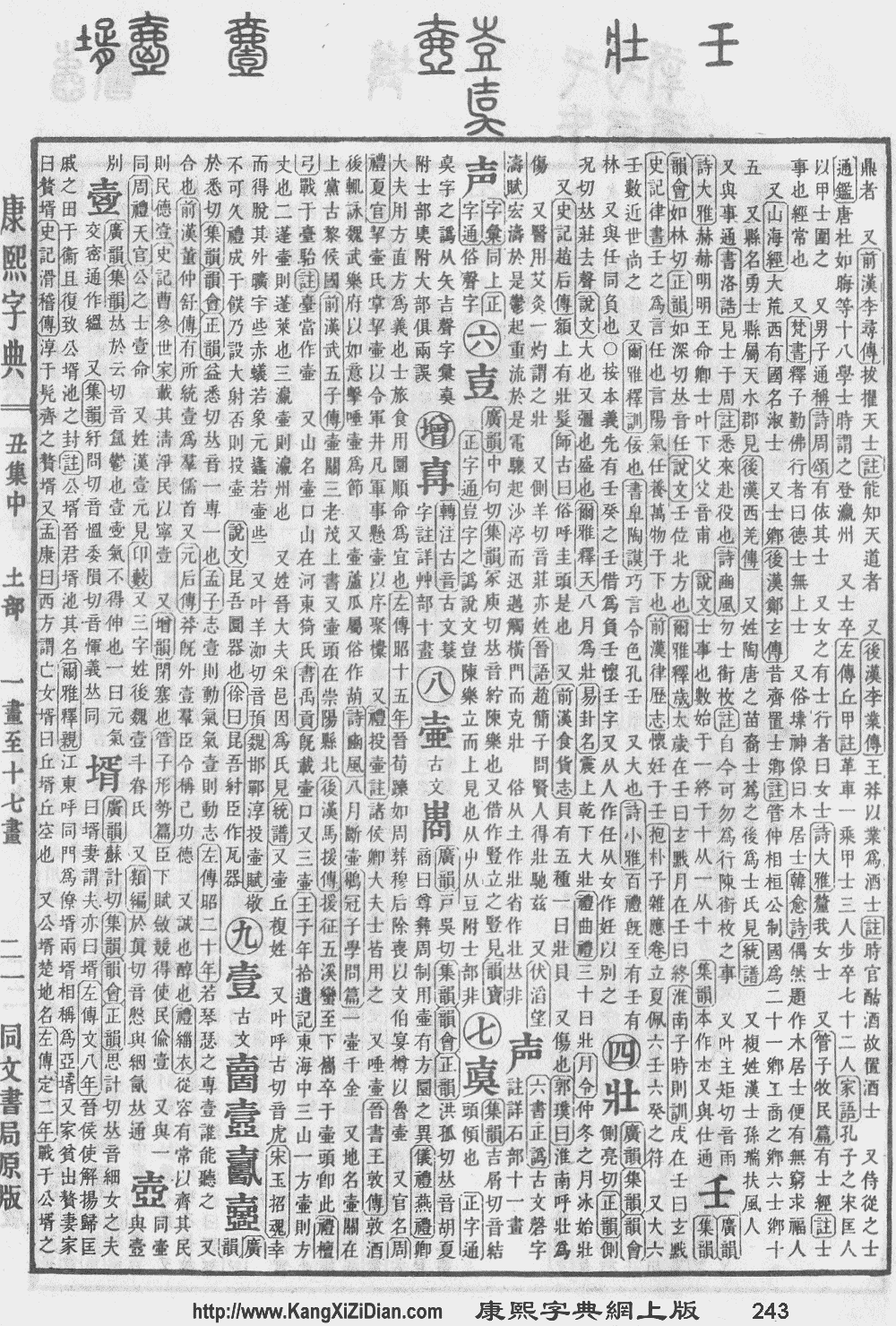
- Kangxi Dictionary: page 243, character 2
- Dai Kanwa Jiten: character 5643
- Dae Jaweon: page 483, character 4
- Hanyu Da Zidian (first edition): volume 1, page 428, character 7
- Unihan data for U+58EF
Chinese
Glyph origin
Characters in the same phonetic series (爿) (Zhengzhang, 2003)
| Old Chinese | |
|---|---|
| 臧 | *ʔsaːŋ |
| 牂 | *ʔsaːŋ |
| 戕 | *kaːl, *ʔsaːŋ, *zaŋ |
| 贓 | *ʔsaːŋ |
| 藏 | *zaːŋ, *zaːŋs |
| 奘 | *zaːŋʔ, *zaːŋs |
| 臟 | *zaːŋs |
| 將 | *ʔsaŋ, *ʔsaŋs |
| 漿 | *ʔsaŋ |
| 鱂 | *ʔsaŋ |
| 蔣 | *ʔsaŋ, *ʔsaŋʔ |
| 螿 | *ʔsaŋ |
| 槳 | *ʔsaŋʔ |
| 獎 | *ʔsaŋʔ |
| 醬 | *ʔsaŋs |
| 鏘 | *sʰaŋ |
| 蹡 | *sʰaŋ, *ʔshaŋs |
| 嶈 | *sʰaŋ |
| 斨 | *sʰaŋ |
| 爿 | *braːn, *zaŋ |
| 牆 | *zaŋ |
| 妝 | *ʔsraŋ |
| 莊 | *ʔsraŋ |
| 裝 | *ʔsraŋ, *ʔsraŋs |
| 壯 | *ʔsraŋs |
| 疒 | *rnɯːɡ, *zraŋ |
| 床 | *zraŋ |
| 牀 | *zraŋ |
| 狀 | *zraŋs |
Phono-semantic compound (形聲/形声, OC *ʔsraŋs) : phonetic 爿 (OC *braːn, *zaŋ) + semantic 士.
Pronunciation
Definitions
壯
- strong; robust
- to strengthen
- (dialectal, chiefly Hakka or Wu, of a person or an animal) fat
- (traditional Chinese medicine) one burn of moxa in moxibustion
Synonyms
- (to strengthen):
- (fat):
Dialectal synonyms of 胖 (“fat (a.)”) [map]
Compounds
- 丁壯/丁壮 (dīngzhuàng)
- 人強馬壯/人强马壮 (rénqiángmǎzhuàng)
- 健壯/健壮 (jiànzhuàng)
- 八百壯士/八百壮士
- 兵強馬壯/兵强马壮 (bīngqiángmǎzhuàng)
- 兵精馬壯/兵精马壮
- 凌雲壯志/凌云壮志
- 壯丁/壮丁 (zhuàngdīng)
- 壯偉/壮伟 (zhuàngwěi)
- 壯健/壮健 (zhuàngjiàn)
- 壯劇/壮剧
- 壯圍/壮围 (Zhuàngwéi)
- 壯圖/壮图
- 壯士/壮士 (zhuàngshì)
- 壯士斷腕/壮士断腕 (zhuàngshìduànwàn)
- 壯士解腕/壮士解腕
- 壯大/壮大 (zhuàngdà)
- 壯夫/壮夫
- 壯室之秋/壮室之秋
- 壯實/壮实 (zhuàngshi)
- 壯工/壮工
- 壯年/壮年 (zhuàngnián)
- 壯心/壮心 (zhuàngxīn)
- 壯心不已/壮心不已
- 壯志/壮志 (zhuàngzhì)
- 壯志凌雲/壮志凌云 (zhuàngzhìlíngyún)
- 壯志未酬/壮志未酬 (zhuàngzhìwèichóu)
- 壯族/壮族 (Zhuàngzú)
- 壯月/壮月
- 壯氣/壮气
- 壯氣吞牛/壮气吞牛
- 壯浪/壮浪
- 壯烈/壮烈 (zhuàngliè)
- 壯烈成仁/壮烈成仁
- 壯猷/壮猷
- 壯盛/壮盛 (zhuàngshèng)
- 壯碩/壮硕
- 壯竄/壮窜
- 壯美/壮美 (zhuàngměi)
- 壯膽/壮胆 (zhuàngdǎn)
- 壯舉/壮举 (zhuàngjǔ)
- 壯行/壮行
- 壯觀/壮观 (zhuàngguān)
- 壯語/壮语 (zhuàngyǔ)
- 壯遊/壮游
- 壯門面/壮门面
- 壯闊/壮阔 (zhuàngkuò)
- 壯陽/壮阳 (zhuàngyáng)
- 壯麗/壮丽 (zhuànglì)
- 壯麵/壮面
- 壯齒/壮齿
- 宏偉壯觀/宏伟壮观
- 宏壯/宏壮 (hóngzhuàng)
- 少壯/少壮 (shàozhuàng)
- 師直為壯/师直为壮
- 年輕力壯/年轻力壮 (niánqīnglìzhuàng)
- 幼學壯行/幼学壮行
- 強壯/强壮 (qiángzhuàng)
- 強壯劑/强壮剂
- 心麤膽壯/心粗胆壮
- 悲壯/悲壮 (bēizhuàng)
- 打旺壯/打旺壮
- 日益壯大/日益壮大
- 根壯葉茂/根壮叶茂
- 民壯/民壮
- 氣壯山河/气壮山河
- 氣壯河山/气壮河山
- 氣壯理直/气壮理直
- 波瀾壯闊/波澜壮阔 (bōlánzhuàngkuò)
- 波路壯闊/波路壮阔
- 理直氣壯/理直气壮 (lǐzhíqìzhuàng)
- 盛壯/盛壮 (shèngzhuàng)
- 稍長膽壯/稍长胆壮
- 粗壯/粗壮 (cūzhuàng)
- 精壯/精壮 (jīngzhuàng)
- 結壯/结壮
- 老當益壯/老当益壮 (lǎodāngyìzhuàng)
- 肥壯/肥壮 (féizhuàng)
- 膽壯/胆壮
- 英勇雄壯/英勇雄壮
- 茁壯/茁壮 (zhuózhuàng)
- 血氣方壯/血气方壮
- 豪壯/豪壮 (háozhuàng)
- 豪情壯志/豪情壮志
- 豪言壯語/豪言壮语 (háoyánzhuàngyǔ)
- 身強力壯/身强力壮 (shēnqiánglìzhuàng)
- 遒文壯節/遒文壮节
- 閎壯/闳壮
- 雄偉壯麗/雄伟壮丽
- 雄壯/雄壮 (xióngzhuàng)
- 雄心壯志/雄心壮志 (xióngxīnzhuàngzhì)
- 青壯/青壮
- 頂門壯戶/顶门壮户
- 飽壯/饱壮
- 馬壯人強/马壮人强
- 高壯/高壮
Etymology 2
| trad. | 壯 | |
|---|---|---|
| simp. | 壮* | |
| alternative forms | 獞 obsolete 僮 obsolete | |
First written as 獞 (composed of 犭 (quǎn), the “beast” radical, and 童 (tóng), “servant”). Following the foundation of the People’s Republic of China, it was written as 僮 (with 亻 (rén), the “person” radical). Due to the derogatory connotations of the previous characters, it was officially amended to 壯/壮 (zhuàng, “strong; robust”) in 1965.
Pronunciation
Definitions
壯
Pronunciation
References
- “壯”, in 漢語多功能字庫 (Multi-function Chinese Character Database), 香港中文大學 (the Chinese University of Hong Kong), 2014–
Japanese
| 壮 | |
| 壯 |
Kanji
壯
(“Jinmeiyō” kanji used for names, kyūjitai kanji, shinjitai form 壮)
- Big, robust This term needs a translation to English. Please help out and add a translation, then remove the text
{{rfdef}}.
Korean
Hanja
壯 (eum 장 (jang))
- This term needs a translation to English. Please help out and add a translation, then remove the text
{{rfdef}}.
Vietnamese
This article is issued from Wiktionary. The text is licensed under Creative Commons - Attribution - Sharealike. Additional terms may apply for the media files.