肥
| ||||||||
Translingual
Han character
肥 (Kangxi radical 130, 肉+4, 8 strokes, cangjie input 月日山 (BAU), four-corner 77217, composition ⿰月巴(GJKV) or ⿰⺼巴(HT))
Derived characters
References
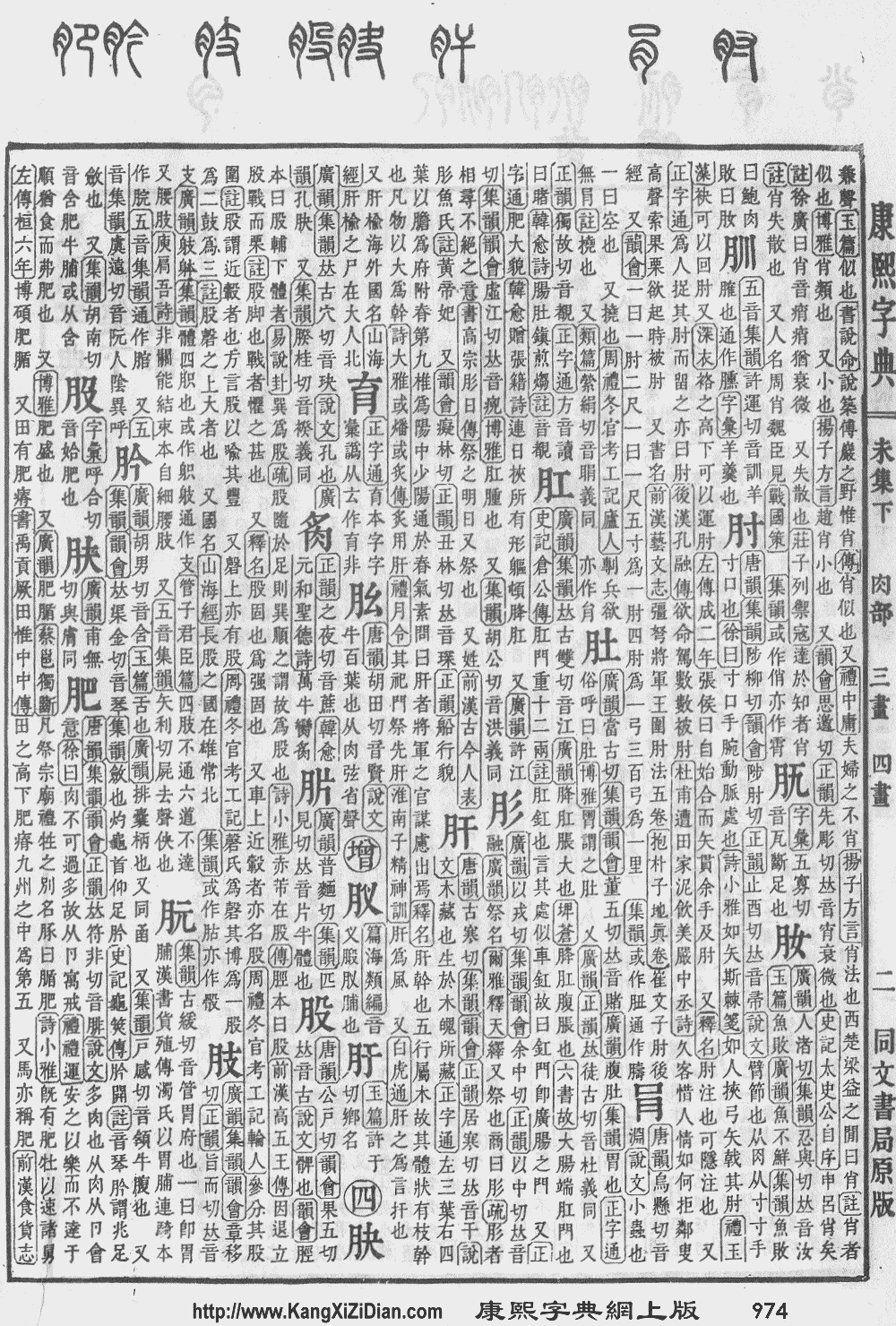
- Kangxi Dictionary: page 974, character 23
- Dai Kanwa Jiten: character 29290
- Dae Jaweon: page 1426, character 13
- Hanyu Da Zidian (first edition): volume 3, page 2055, character 1
- Unihan data for U+80A5
Chinese
| trad. | 肥 | |
|---|---|---|
| simp. # | 肥 | |
Glyph origin
| Historical forms of the character 肥 |
|---|
| Liushutong (compiled in Ming) |
| Transcribed ancient scripts |
 |
Characters in the same phonetic series (肥) (Zhengzhang, 2003)
Shuowen Jiezi: Ideogrammic compound (會意/会意) : 肉 (“meat”) + 卪 (“person kneeling”). Ji Xusheng (2004) posits that its actually a phono-semantic compound (形聲/形声, OC *bɯl) : semantic 肉 + abbreviated phonetic 妃 (OC *pʰɯːls, *pʰɯl).
Etymology 1
STEDT provisionally assigns this to Proto-Sino-Tibetan *bu ~ bur.
Pronunciation
Definitions
肥
Usage notes
Synonyms
- (fat):
Dialectal synonyms of 胖 (“fat (a.)”) [map]
- (benefit):
Antonyms
- (antonym(s) of “fat”): 瘦 (shòu, “skinny”)
Compounds
- 乘堅策肥/乘坚策肥
- 乘肥衣輕/乘肥衣轻
- 乘輕驅肥/乘轻驱肥
- 乾肥/干肥
- 供膳甘肥
- 保肥
- 兄肥弟瘦
- 分肥
- 化學肥料/化学肥料 (huàxué féiliào)
- 合肥 (Héféi)
- 圊肥
- 圈肥
- 基肥
- 堆肥 (duīféi)
- 壅肥
- 子夏肥
- 完全肥料
- 尿肥
- 底肥
- 廄肥/厩肥 (jiùféi)
- 心寬體肥/心宽体肥
- 挑肥揀瘦/挑肥拣瘦 (tiāoféijiǎnshòu)
- 揀精揀肥/拣精拣肥
- 損人肥己/损人肥己
- 擇肥而噬/择肥而噬
- 施肥 (shīféi)
- 春肥
- 有機肥料/有机肥料 (yǒujī féiliào)
- 氮肥 (dànféi)
- 水肥
- 泥肥
- 減肥/减肥 (jiǎnféi)
- 漚肥/沤肥 (òuféi)
- 無機肥料/无机肥料 (wújī féiliào)
- 燕瘦環肥/燕瘦环肥
- 環肥燕瘦/环肥燕瘦
- 瓠肥
- 甘旨肥濃/甘旨肥浓
- 畜肥
- 痴肥 (chīféi)
- 瘠人肥己
- 瘠己肥人
- 直接肥料 (zhíjiē féiliào)
- 硬肥皂
- 硼肥
- 磷肥
- 秋高馬肥/秋高马肥
- 窖肥 (jiàoféi)
- 粒肥 (lìféi)
- 糞肥/粪肥 (fènféi)
- 紅瘦綠肥/红瘦绿肥
- 綠肥/绿肥 (lǜféi)
- 綠肥作物/绿肥作物
- 綠肥紅瘦/绿肥红瘦
- 肥仔 (féizǎi)
- 肥佬
- 肥冬瘦年
- 肥分
- 肥力 (féilì)
- 肥勻明秀/肥匀明秀
- 肥厚
- 肥吃海喝
- 肥喏
- 肥嘟嘟 (féidūdū)
- 肥土 (féitǔ)
- 肥地 (féidì)
- 肥壯/肥壮 (féizhuàng)
- 肥大 (féidà)
- 肥妹
- 肥婆 (féipó)
- 肥嫩
- 肥家
- 肥實/肥实 (féishí)
- 肥屍大隻/肥尸大只
- 肥差 (féichāi)
- 肥強/肥强
- 肥效
- 肥料 (féiliào)
- 肥水
- 肥沃 (féiwò)
- 肥沃月灣/肥沃月湾
- 肥油 (féiyóu)
- 肥河
- 肥源 (féiyuán)
- 肥溜溜
- 肥滿/肥满 (féimǎn)
- 肥滾滾/肥滚滚
- 肥澤/肥泽
- 肥煤
- 肥甘
- 肥田 (féitián)
- 肥田粉
- 肥田草
- 肥瘠 (féijí)
- 肥瘦 (féishòu)
- 肥瘦兒/肥瘦儿
- 肥皂 (féizào)
- 肥皂劇/肥皂剧 (féizàojù)
- 肥皂泡 (féizàopào)
- 肥皂粉 (féizàofěn)
- 肥皂絲/肥皂丝
- 肥皂莢/肥皂荚
- 肥盛
- 肥碩/肥硕 (féishí)
- 肥缺 (féiquē)
- 肥羊 (féiyáng)
- 肥羊肉
- 肥美 (féiměi)
- 肥肉 (féiròu)
- 肥育 (féiyù)
- 肥肥胖胖
- 肥胖 (féipàng)
- 肥胖症 (féipàngzhèng)
- 肥腸/肥肠 (féicháng)
- 肥腴
- 肥腯
- 肥腸兒/肥肠儿
- 肥腸滿腦/肥肠满脑
- 肥膘
- 肥膩/肥腻 (féinì)
- 肥蟲蟻/肥虫蚁
- 肥豬/肥猪 (féizhū)
- 肥遁
- 肥遯/肥遁
- 肥遯鳴高/肥遁鸣高
- 肥頭大耳/肥头大耳 (féitóudà'ěr)
- 肥頭耷耳/肥头耷耳
- 肥饒/肥饶 (féiráo)
- 肥馬輕裘/肥马轻裘
- 肥鮮/肥鲜
- 腦滿腸肥/脑满肠肥 (nǎomǎnchángféi)
- 腸肥腦滿/肠肥脑满
- 自肥 (zìféi)
- 苦土肥料
- 葉肥/叶肥
- 葉面施肥/叶面施肥
- 裘馬輕肥/裘马轻肥
- 複合肥料/复合肥料
- 複肥/复肥
- 豬頭肥/猪头肥
- 趙禮讓肥/赵礼让肥
- 軟肥皂/软肥皂 (ruǎnféizào)
- 輕肥/轻肥
- 輕裘肥馬/轻裘肥马
- 追肥 (zhuīféi)
- 速效肥料
- 遲效肥料/迟效肥料
- 鉀肥/钾肥
- 雜肥/杂肥
- 非肥皂
- 食言而肥 (shíyán'érféi)
- 飫甘饜肥/饫甘餍肥
- 養家肥己/养家肥己
- 骨肥
- 魚肥/鱼肥
- 麵肥/面肥 (miànfěi)
Descendants
Pronunciation
Definitions
肥
- (Hong Kong Cantonese) to fail (a test)
- (Hong Kong Cantonese) to fail (someone) in a test
References
- “肥”, in 漢語多功能字庫 (Multi-function Chinese Character Database), 香港中文大學 (the Chinese University of Hong Kong), 2014–
Japanese
Readings
Etymology
| Kanji in this term |
|---|
| 肥 |
| こえ Grade: 5 |
| kun’yomi |
(This etymology is missing or incomplete. Please add to it, or discuss it at the Etymology scriptorium.)
Korean
Hanja
肥 • (bi) (hangeul 비)
- This term needs a translation to English. Please help out and add a translation, then remove the text
{{rfdef}}.
Vietnamese
This article is issued from Wiktionary. The text is licensed under Creative Commons - Attribution - Sharealike. Additional terms may apply for the media files.