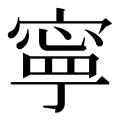
寧
| ||||||||
 | ||||||||
| ||||||||
 | ||||||||
Translingual
Han character
寧 (Kangxi radical 40, 宀+11, 14 strokes, cangjie input 十心月弓 (JPBN), four-corner 30201, composition ⿱寍丁)
Derived characters
References
- Kangxi Dictionary: page 291, character 8
- Dai Kanwa Jiten: character 7296
- Dae Jaweon: page 577, character 2
- Hanyu Da Zidian (first edition): volume 2, page 949, character 5
- Unihan data for U+5BE7
- Unihan data for U+F95F
- Unihan data for U+F9AA
- Unihan data for U+2F86F

Chinese
| trad. | 寧 | |
|---|---|---|
| simp. | 宁* | |
| alternative forms | ||
Glyph origin
| Historical forms of the character 寧 | |||
|---|---|---|---|
| Shang | Western Zhou | Shuowen Jiezi (compiled in Han) | Liushutong (compiled in Ming) |
| Oracle bone script | Bronze inscriptions | Small seal script | Transcribed ancient scripts |
 |
 |
 |
 |
Oracle bone script: Ideogrammic compound (會意/会意) : 宀 (“house”) + 皿 (“food or wine vessel”) + 丂 (“table (?)”) – contentment. The 心 (“heart”) component was added in bronze inscriptions to yield 寧, and the 丂 component was sometimes omitted to yield 寍.
Shuowen: Phono-semantic compound (形聲/形声, OC *neːŋ) : phonetic 寍 (OC *neːŋ) + semantic 丂 (“speech (?)”).
Note that the simplified form 宁 (zhù) is also a traditional character on its own.
Etymology 1
Either related to Burmese ညင်း (nyang:, “soft, gentle, quiet”) or connected to Proto-Sino-Tibetan *s/k-niŋ (“heart, mind, brain”) (Schuessler, 2007)
Pronunciation 1
Definitions
寧
Compounds
- 丁寧/丁宁 (dīngníng)
- 不寧/不宁 (bùníng)
- 不寧不耐/不宁不耐
- 不寧奈/不宁奈
- 不遑寧處/不遑宁处
- 伊寧/伊宁 (Yīníng)
- 保寧/保宁 (bǎoníng)
- 克寧/克宁
- 列寧主義/列宁主义 (Lièníng zhǔyì)
- 列寧格勒/列宁格勒 (Liènínggélè)
- 北寧鐵路/北宁铁路
- 南寧/南宁 (Nánníng, “Nanning”)
- 咸寧 (Xiánníng)
- 唐寧街/唐宁街 (Tángníng Jiē)
- 單寧/单宁 (dānníng)
- 單寧酸/单宁酸 (dānníngsuān)
- 坐臥不寧/坐卧不宁 (zuòwòbùníng)
- 坤寧宮/坤宁宫
- 太寧/太宁
- 奉寧/奉宁
- 奎寧/奎宁 (kuíníng)
- 安寧/安宁 (ānníng)
- 安寧照顧/安宁照顾
- 寧夏/宁夏 (Níngxià)
- 寧奈/宁奈
- 寧家/宁家
- 寧帖/宁帖
- 寧德/宁德 (Níngdé)
- 寧心/宁心
- 寧息/宁息
- 寧日/宁日 (níngrì)
- 寧武/宁武 (Níngwǔ)
- 寧武關/宁武关 (Níngwǔguān)
- 寧波/宁波 (Níngbō)
- 寧漢分裂/宁汉分裂
- 寧瑪派/宁玛派 (Níngmǎpài)
- 寧神/宁神
- 寧綢/宁绸
- 寧謐/宁谧 (níngmì)
- 寧貼/宁贴
- 寧遠/宁远 (Níngyuǎn)
- 寧靖/宁靖 (níngjìng)
- 寧靜/宁静 (níngjìng)
- 崇寧/崇宁
- 平寧/平宁
- 底寧/底宁
- 康寧/康宁
- 建寧/建宁 (Jiànníng)
- 心神不寧/心神不宁
- 息事寧人/息事宁人 (xīshìníngrén)
- 攖寧/撄宁
- 普寧/普宁 (Pǔníng)
- 東寧王國/东宁王国
- 歸寧/归宁 (guīníng)
- 永無寧日/永无宁日 (yǒngwúníngrì)
- 江寧/江宁 (Jiāngníng)
- 洛寧/洛宁 (Luòníng)
- 海寧/海宁 (Hǎiníng)
- 海寧觀潮/海宁观潮
- 濟寧/济宁 (Jǐníng)
- 白朗寧/白朗宁
- 睡臥不寧/睡卧不宁
- 瞑目寧心/瞑目宁心
- 福壽康寧/福寿康宁
- 萬寧/万宁 (Wànníng)
- 管寧割席/管宁割席
- 綏寧/绥宁 (suíníng)
- 荒寧/荒宁
- 西寧/西宁 (Xīníng)
- 西寧毛/西宁毛
- 遂寧/遂宁 (Suìníng)
- 遼寧/辽宁 (Liáoníng)
- 金寧/金宁 (Jīnníng)
- 雞犬不寧/鸡犬不宁 (jīquǎnbùníng)
Pronunciation 2
Definitions
寧
- rather; would rather
- 旣而悽愴曰:「寧我負人,毋人負我!」遂行。 [Classical Chinese, trad.]
- From: 4th century CE, Sun Sheng,《雜記》Miscellaneous Records; quoted in 5th century CE, Pei Songzhi, Annotations to 3rd century CE, Records of the Three Kingdoms by Chen Shou
- Jì ér qīchuàng yuē: “Níng wǒ fù rén, wú rén fù wǒ!” Suì xíng. [Pinyin]
- Later, [Cao Cao] sorrowfully said: "I would rather betray others than let others betray me!" Then left.
既而凄怆曰:「宁我负人,毋人负我!」遂行。 [Classical Chinese, simp.]
- † could there be
- † such; like this; so
- † unexpectedly; in spite of everything
- † modal particle
Compounds
- 不自由毋寧死/不自由毋宁死 (bù zìyóu wúnìng sǐ)
- 寧個/宁个
- 寧可/宁可 (nìngkě)
- 寧折不彎/宁折不弯
- 寧教我負天下人,休教天下人負我/宁教我负天下人,休教天下人负我 (nìngjiào wǒ fù tiānxià rén, xiū jiào tiānxià rén fù wǒ)
- 寧死不屈/宁死不屈 (níngsǐbùqū)
- 寧死不從/宁死不从
- 寧死不辱/宁死不辱
- 寧為太平犬,不做亂世人/宁为太平犬,不做乱世人 (nìng wéi tàipíng quǎn, bù zuò luànshì rén)
- 寧為玉碎,不為瓦全/宁为玉碎,不为瓦全
- 寧為雞口,毋為牛後/宁为鸡口,毋为牛后
- 寧為雞頭,不做鳳尾/宁为鸡头,不做凤尾 (nìng wéi jītóu, bù zuò fèngwěi)
- 寧當玉碎/宁当玉碎
- 寧缺勿濫/宁缺勿滥
- 寧缺毋濫/宁缺毋滥 (nìngquēwúlàn)
- 寧肯/宁肯 (nìngkěn)
- 寧許/宁许
- 寧願/宁愿 (nìngyuàn)
- 寧馨/宁馨
- 寧馨兒/宁馨儿
- 毋寧/毋宁 (wúnìng)
- 無寧/无宁 (wúnìng)
- 盜泉寧渴/盗泉宁渴
- 禮奢寧儉/礼奢宁俭
- 禮存寧儉/礼存宁俭
- 胡寧/胡宁
Pronunciation 3
Usage notes
Etymology 2
Used due to Standard Mandarin pronunciation matching that of regional language.
Pronunciation
Definitions
寧
- (Northern Wu, especially Shanghainese) Alternative form of 人
- 上海寧/上海宁 [Shanghainese] ― 6zaon-he-gnin [Wugniu] ― Shanghainese person
- 隔壁寧家屋裡頭,交交關關小居頭,阿杜阿膩阿三頭,一直排到阿八頭。 [Shanghainese, trad.]
- From:
- 7kaq-piq 6gnin-ka 7oq-li-deu 1ciau-ciau-kue-kue 5shiau-ciu-deu 7aq 6du 7aq 6gni 7aq-se-deu 7iq-zeq 6ba-tau 7aq-paq-deu [Wugniu]
- In my neighbor’s place, there are many children; the eldest, the second, the third, all the way to the eighth.
隔壁宁家屋里头,交交关关小居头,阿杜阿腻阿三头,一直排到阿八头。 [Shanghainese, simp.]
Japanese
| Shinjitai | 寧 | |
| Kyūjitai [1] |
寧 寧or 寧+ ︀? |
|
| 寧󠄀 寧+ 󠄀?(Adobe-Japan1) | ||
| 寧󠄃 寧+ 󠄃?(Hanyo-Denshi) (Moji_Joho) | ||
| The displayed kanji may be different from the image due to your environment. See here for details. | ||
Readings
- Go-on: にょう (nyō)←にやう (nyau, historical)
- Kan-on: ねい (nei, Jōyō)
- Kun: いずくんぞ (izukunzo, 寧くんぞ)←いづくんぞ (idukunzo, 寧, historical); なんぞ (nanzo, 寧ぞ); むしろ (mushiro, 寧ろ); やすい (yasui, 寧い); やすらか (yasuraka, 寧らか); やすんずる (yasunzuru, 寧んずる)←やすんず (yasunzu, 寧んず, historical)
- Nanori: あき (aki); さだ (sada); しず (shizu); やす (yasu); やすし (yasushi); よし (yoshi)
Korean
Compounds
- 安寧 (안녕, annyeong)
Vietnamese
Han character
- This term needs a translation to English. Please help out and add a translation, then remove the text
{{rfdef}}.
Compounds
- 安寧 (an ninh)