寺
| ||||||||
Translingual
| Stroke order | |||
|---|---|---|---|
 | |||
| Traditional | 寺 |
|---|---|
| Simplified | 寺 |
| Japanese | 寺 |
| Korean | 寺 |
Han character
寺 (Kangxi radical 41, 寸+3, 6 strokes, cangjie input 土木戈 (GDI), four-corner 40341, composition ⿱土寸(GJKV) or ⿱士寸(HT))
Alternative forms
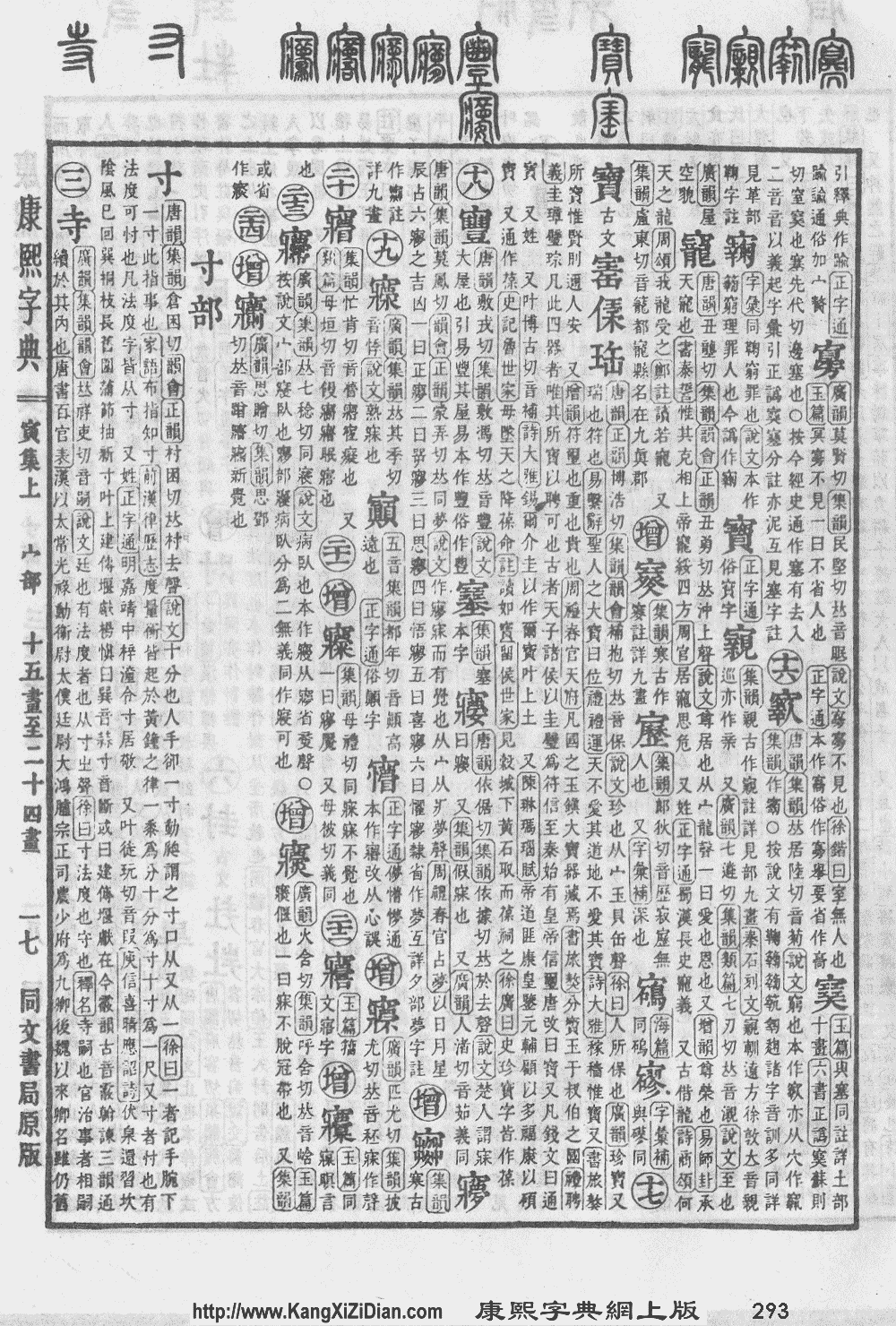
- Note that in Japanese, Korean and Simplified Chinese scripts, the top half of the character is 土 (instead of 士 as seen in Traditional Chinese), which is also the historical form found in the Kangxi Dictionary.
Derived characters
References
- Kangxi Dictionary: page 293, character 33
- Dai Kanwa Jiten: character 7414
- Dae Jaweon: page 581, character 8
- Hanyu Da Zidian (first edition): volume 1, page 503, character 11
- Unihan data for U+5BFA
Chinese
| trad. | 寺 | |
|---|---|---|
| simp. # | 寺 | |
Glyph origin
| Historical forms of the character 寺 | |||
|---|---|---|---|
| Western Zhou | Warring States | Shuowen Jiezi (compiled in Han) | Liushutong (compiled in Ming) |
| Bronze inscriptions | Chu slip and silk script | Small seal script | Transcribed ancient scripts |
 |
 |
 |
 |
Phono-semantic compound (形聲/形声, OC *ljɯs) : phonetic 𡳿 (OC *tjɯ, “to go”) + semantic 又 (“hand”) – to grasp, to hold. Phonetic 𡳿 (之) became 土 or 士 in the clerical script from the late Western Han to the Eastern Han, and semantic 又 become 寸 in Small Seal Script. The derivative 持 (OC *l'ɯ) refers to the original word.
The character was often used in the place of a more specialized form. For example, in the Chu Silk Manuscript (see table above) it clearly stood for 時 (OC *djɯ, “season”).
Etymology
(This etymology is missing or incomplete. Please add to it, or discuss it at the Etymology scriptorium.)
Pronunciation 1
Definitions
寺
- (historical) government court; office (before the Han dynasty)
- 大理寺 ― Dàlǐsì ― Court of Judicature and Revision
- (Buddhism) temple; monastery
- 白馬寺/白马寺 ― Báimǎsì ― White Horse Temple
- 少林寺 ― Shàolínsì ― Shaolin Monastery
- 哲蚌寺 ― Zhébàngsì ― Drepung Monastery
- place of worship; shrine
- 清真寺 ― qīngzhēnsì ― mosque
- 仙鶴寺/仙鹤寺 ― Xiānhèsì ― Crane Mosque
- 西敏寺 ― Xīmǐnsì ― Westminster Abbey
- (obsolete) Original form of 持 (chí, “to hold; to grasp”).
- a surname
Usage notes
Not used for places of worship of Taoism and Chinese folk religion.
Synonyms
- (temple):
- 佛寺 (fósì) (Buddhist temple)
- 宮廟/宫庙 (Hokkien, Teochew)
- 寶剎/宝刹 (bǎochà) (Buddhist temple)
- 寺廟/寺庙 (sìmiào)
- 尪廟/尪庙 (Zhangzhou Hokkien)
- 廟/庙 (miào)
- 廟宇/庙宇 (miàoyǔ)
- 廟寺/庙寺 (Taiwanese Hokkien)
- 梵宇 (fànyǔ) (literary, Buddhist temple)
- 禪寺/禅寺 (chánsì) (Buddhist temple)
- 禪寺/禅寺 (chánsì) (Buddhist temple)
- 禪房/禅房 (chánfáng) (Buddhist temple)
- 禪林/禅林 (chánlín) (Buddhist temple)
- 禪院/禅院 (chányuàn) (Buddhist temple)
Compounds
- 佛寺 (fósì)
- 光祿寺/光禄寺
- 化度寺碑
- 南菊寺 (Nánjúsì)
- 古寺
- 團山寺/团山寺 (Tuánshānsì)
- 地藏寺
- 大招寺
- 大理寺
- 大相國寺/大相国寺
- 太常寺 (Tàichángsì)
- 婦寺/妇寺 (fùsì)
- 安福寺 (Ānfúsì)
- 寒山寺
- 寶月寺/宝月寺 (Bǎoyuèsì)
- 寺人 (sìrén)
- 寺卿
- 寺坪 (Sìpíng)
- 寺庫/寺库
- 寺廟/寺庙 (sìmiào)
- 寺舍
- 寺院 (sìyuàn)
- 少林寺 (Shàolínsì)
- 左溪寺 (Zuǒxīsì)
- 布達拉寺/布达拉寺
- 庵寺
- 慈恩寺
- 普救寺
- 普濟寺/普济寺
- 棘寺
- 水月寺 (Shuǐyuèsì)
- 法源寺
- 法門寺/法门寺
- 清真寺 (qīngzhēnsì)
- 炳靈寺/炳灵寺
- 白馬寺/白马寺 (Báimǎsì)
- 監寺/监寺
- 知寺
- 破山寺
- 碧雲寺/碧云寺 (Bìyúnsì)
- 福田寺 (Fútiánsì)
- 禪寺/禅寺 (chánsì)
- 禮拜寺/礼拜寺 (lǐbàisì)
- 紅寺堡/红寺堡 (Hóngsìbǔ, “Hongsibu”)
- 紅岩寺/红岩寺 (Hóngyánsì)
- 花林寺 (Huālínsì)
- 蕭寺/萧寺
- 藏寺
- 西敏寺 (Xīmǐnsì)
- 貂寺
- 都寺
- 金山寺
- 門古寺/门古寺 (Méngǔsì)
- 閽寺/阍寺
- 閹寺/阉寺 (yānsì)
- 雲林寺/云林寺
- 章田寺 (Zhāngtiánsì)
- 顓褚寺/颛褚寺 (Zhuānchǔsì)
- 鴻臚寺/鸿胪寺
- 麓山寺碑
- 龍山寺/龙山寺 (Lóngshānsì)
- 龍藏寺碑/龙藏寺碑
Descendants
Pronunciation 2
Further reading
- “寺”, in 漢語多功能字庫 (Multi-function Chinese Character Database), 香港中文大學 (the Chinese University of Hong Kong), 2014–
Japanese
Compounds
Etymology 1
| Kanji in this term |
|---|
| 寺 |
| てら Grade: 2 |
| kun’yomi |
From Old Japanese. Appears in the Nihon Shoki of 720 CE,[1] and in the Man'yōshū, completed some time after 759 CE.[2]
There are various theories regarding the ultimate derivation.
- Some sources[3][4] derive Japanese tera from an ancestor of Middle Korean 졀 (jeol) (likely Baekje). This is from earlier 뎔 (dyeol, “temple”) and is the nativised reading of 찰 (刹, chal, “Buddhist temple”) below, deriving in turn from Middle Chinese 剎 (MC tsrhaet), shortened from 剎多羅 (MC tsrhaet ta la, “Buddhist monastery, temple or shrine”), borrowed from Sanskrit क्षेत्र (kṣetra, “land, area, domain”), from Proto-Indo-Aryan *ṭṣáytram, from Proto-Indo-Iranian *ćšáytram, from Proto-Indo-European *tḱéytrom.
- Other sources[5] describe Japanese tera as cognate with modern Korean 찰 (刹, chal, “temple”), appearing as a component in terms such as 선찰 (禪刹, seonchal, “Zen temple”), 사찰 (寺刹, sachal, “Buddhist temple”).
- Another derivation[4][5] is given as Pali thera (“elders”) in reference to the monks.
Considering the phonetic development in Korean, the avenues for transmission of Buddhist terms to Japan, and the consistent temple sense of the Japanese term throughout recorded history, the now-obsolete Korean 뎔 (dyeol, “temple”) may be a more likely source than Pali thera (“elders”).
Pronunciation
Pronunciation
- IPA(key): [d͡ʑi]
- The pitch accent depends on the suffixed term.
References
- “寺”, in 日本国語大辞典 (Nihon Kokugo Daijiten, “Nihon Kokugo Daijiten”) (in Japanese), concise edition, Tōkyō: Shogakukan, 2000
- , text here
- Matsumura, Akira, editor (2006), 大辞林 [Daijirin] (in Japanese), Third edition, Tōkyō: Sanseidō, →ISBN
- Matsumura, Akira (1995) 大辞泉 [Daijisen] (in Japanese), First edition, Tōkyō: Shogakukan, →ISBN
- Shōgaku Tosho (1988) 国語大辞典(新装版) [Unabridged Dictionary of Japanese (Revised Edition)] (in Japanese), Tōkyō: Shogakukan, →ISBN
- NHK Broadcasting Culture Research Institute, editor (1998), NHK日本語発音アクセント辞典 [NHK Japanese Pronunciation Accent Dictionary] (in Japanese), Tōkyō: NHK Publishing, →ISBN
- Kindaichi, Kyōsuke et al., editors (1997), 新明解国語辞典 [Shin Meikai Kokugo Jiten] (in Japanese), Fifth edition, Tōkyō: Sanseidō, →ISBN
Korean
Etymology
(This etymology is missing or incomplete. Please add to it, or discuss it at the Etymology scriptorium. Particularly: “Middle Korean readings, if any”)
Pronunciation
- (SK Standard/Seoul) IPA(key): [sʰa̠]
- Phonetic hangul: [사]