等
| ||||||||
Translingual
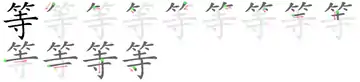
| Stroke order | |||
|---|---|---|---|
 | |||
Han character
等 (Kangxi radical 118, 竹+6, 12 strokes, cangjie input 竹土木戈 (HGDI), four-corner 88341, composition ⿱𥫗寺)
Derived characters
- 𠎬, 𬼑, 𠾡, 𫮨, 𢡩, 㩐, 𣛆, 𥢜, 𥪸, 𦅯, 𮖴, 𨅸, 𨬻, 𠟚, 𫂨, 𮆠, 𮆩
References
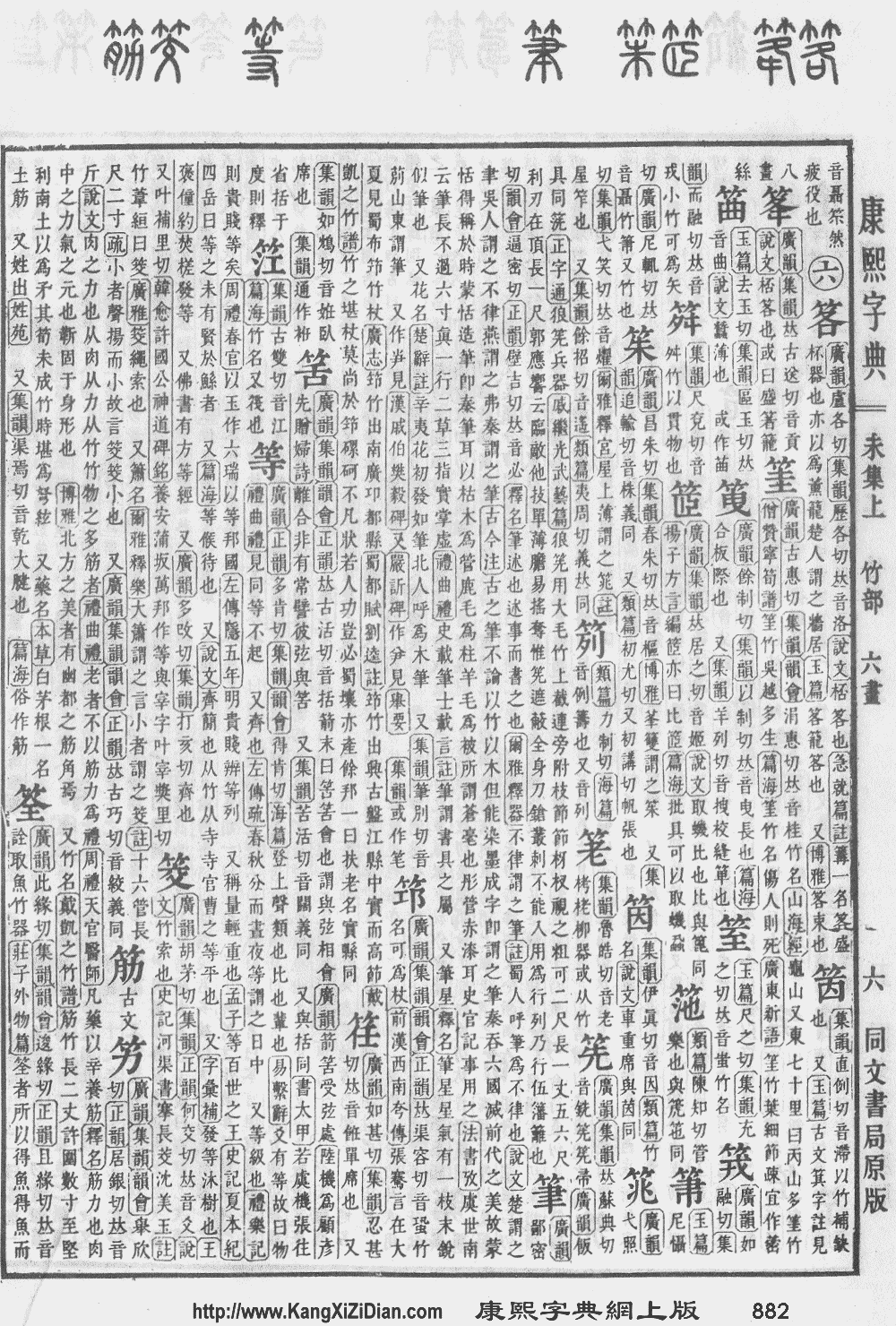
- Kangxi Dictionary: page 882, character 24
- Dai Kanwa Jiten: character 25992
- Dae Jaweon: page 1311, character 5
- Hanyu Da Zidian (first edition): volume 5, page 2962, character 1
- Unihan data for U+7B49
Chinese
Glyph origin
Phono-semantic compound (形聲/形声, OC *tɯːʔ, *tɯːŋʔ) : semantic 竹 (“bamboo”) + phonetic 寺 (OC *ljɯs).
竹 here refers to the bamboo strips used for writing (e.g. grading, classification) in ancient times. 寺 (OC *ljɯs) was originally used phonetically; the character was subsequently borrowed for another word with the same meaning, but with no phonetic resemblance to 寺.
Etymology 1
| trad. | 等 | |
|---|---|---|
| simp. # | 等 | |
| 2nd round simp. | ⿱艹寸 | |
From Proto-Sino-Tibetan *s-tjaŋ (“top; to rise; to raise”) (STEDT). Endoactive of 登 (OC *tɯːŋ, “to rise; to ascend”) (Schuessler, 2007).
Pronunciation
Definitions
等
- † to arrange bamboo slips neatly
- rank; grade; class
- sort; kind; type
- (Chinese phonetics) one of the "divisions" of a rime table, encoding some phonological distinction; see
 Middle Chinese finals on Wikipedia.Wikipedia
- 重紐三等/重纽三等 ― chóngniǔ sānděng ― the third division member of a rime doublet
- (in compounds or after a number/degree) equal; equivalent
- and the like; and so on; etc.; et al.
- 秦二世元年七月,陳涉等起大澤中。 [Classical Chinese, trad.]
- From: The Records of the Grand Historian, by Sima Qian, c. 91 BCE
- Qín èrshì yuánnián qīyuè, Chén Shè děng qǐ Dàzé zhōng. [Pinyin]
- In the seventh month of the first year under Qin Er Shi's rule, Chen She, with others, rebelled in Dazexiang.
秦二世元年七月,陈涉等起大泽中。 [Classical Chinese, simp.]
- Particle indicating the ending of enumeration.
- 沛公則置車騎,脫身獨騎,與樊噲、夏侯嬰、靳彊、紀信等四人持劍盾步走。 [Classical Chinese, trad.]
- From: The Records of the Grand Historian, by Sima Qian, c. 91 BCE
- Pèigōng zé zhì chēqí, tuōshēn dú qí, yǔ Fán Kuài, Xiàhóu Yīng, Jìn Qiáng, Jǐ Xìn děng sì rén chí jiàn dùn bùzǒu. [Pinyin]
- Duke of Pei then left behind his entourage and rode off by himself, before fleeing on foot with Fan Kuai, Xiahou Ying, Jin Qiang and Ji Xin, swords and shields in hand.
沛公则置车骑,脱身独骑,与樊哙、夏侯婴、靳强、纪信等四人持剑盾步走。 [Classical Chinese, simp.]
- (literary or Hakka) Plural particle used after personal pronouns or nouns.
- 爾等/尔等 [Classical Chinese] ― ěrděng [Pinyin] ― you (plural)
- 𠊎等 [Sixian Hakka] ― ngài-tén [Pha̍k-fa-sṳ] ― we; us
- a surname
Etymology 2
| trad. | 等 | |
|---|---|---|
| simp. # | 等 | |
| 2nd round simp. | ⿱艹寸 | |
A medieval word, probably related to 待 (OC *dɯːʔ, “to wait”) (Wang, 1982).
Pronunciation
Definitions
等
- to wait (for)
- when (something happens at a point in time in the future)
- (Cantonese) to be in need of
- (Cantonese, Xiang) to let; to allow; to permit
- (Cantonese) to let (used to give notice to something in the future)
- (Cantonese) to cause; to make
- Synonym: 讓/让 (ràng) (Mandarin)
- 細佬唔記得交學費,我專登冇提佢,等佢畀爸爸鬧餐飽。 [Cantonese, trad.]
- sai3 lou2 m4 gei3 dak1 gaau1 hok6 fai3, ngo5 zyun1 dang1 mou5 tai4 keoi5, dang2 keoi5 bei2 baa1-4 baa1 naau6 caan1 baau2. [Jyutping]
- My little brother forgot to pay his tuition fees. I intentionally didn't remind him of it to make him get a good scolding from Dad.
细佬唔记得交学费,我专登冇提佢,等佢畀爸爸闹餐饱。 [Cantonese, simp.]
- (Cantonese) Introduces a clause that expresses negative surprise.
- 原來你哋冇一個識揸車㗎,等我仲以為實有人車我添。 [Cantonese, trad.]
- jyun4 loi4 nei5 dei6 mou5 jat1 go3 sik1 zaa1 ce1 gaa4, dang2 ngo5 zung6 ji5 wai4 sat6 jau5 jan4 ce1 ngo5 tim1. [Jyutping]
- It turns out that none of you know how to drive? I thought there had to be someone who would drive me.
原来你哋冇一个识揸车㗎,等我仲以为实有人车我添。 [Cantonese, simp.]
- (Gan) by
- (Hakka) Progressive particle, used after verbs to indicate the continuation of an action or a state.
Synonyms
- (to wait):
- (by):
- (progressive marker):
| Variety | Location | Words |
|---|---|---|
| Formal (Written Standard Chinese) | 著 | |
| Mandarin | Beijing | 著 |
| Taiwan | 著 | |
| Harbin | 著 | |
| Yantai (Muping) | 著 | |
| Jinan | 著 | |
| Wanrong | 著 | |
| Xi'an | 著 | |
| Wuhan | 倒 | |
| Guiyang | 倒 | |
| Guilin | 倒 | |
| Liuzhou | 倒, 穩 | |
| Xuzhou | 著 | |
| Nanjing | 著 | |
| Singapore | 著 | |
| Cantonese | Guangzhou | 緊 |
| Hong Kong | 緊 | |
| Singapore (Guangfu) | 緊 | |
| Gan | Nanchang | 倒 |
| Hakka | Meixian | 等 |
| Miaoli (N. Sixian) | 等 | |
| Pingtung (Neipu; S. Sixian) | 等 | |
| Hsinchu County (Zhudong; Hailu) | 等 | |
| Taichung (Dongshi; Dabu) | 緊 | |
| Hsinchu County (Qionglin; Raoping) | 等 | |
| Kuching (Hepo) | 緊 | |
| Jin | Taiyuan | 著 |
| Southern Pinghua | Nanning (Tingzi) | 緊 |
| Wu | Shanghai | 勒海, 勒該 |
| Ningbo | 的, 該, 當, 東, 仔, 勒眼 | |
| Zhoushan | 底, 的 rare, 該, 當, 仔, 勒眼 | |
Compounds
- 一等 (yīděng)
- 一等一
- 丁等特考
- 下三等
- 三六九等 (sānliùjiǔděng)
- 三等 (sānděng)
- 下等 (xiàděng)
- 上等 (shàngděng)
- 三等九格
- 下等植物
- 三親等/三亲等
- 不平等 (bùpíngděng)
- 不平等條約/不平等条约 (bùpíngděng tiáoyuē)
- 不等 (bùděng)
- 不等式 (bùděngshì)
- 不等號/不等号 (bùděnghào)
- 丙等特考
- 中等 (zhōngděng)
- 中等教育 (zhōngděng jiàoyù)
- 久等 (jiǔděng)
- 乙等特考
- 乾等/干等
- 二等 (èrděng)
- 二等分
- 二等分線/二等分线
- 二等國/二等国
- 二親等/二亲等
- 何等 (héděng)
- 伴等
- 低等 (dīděng)
- 低等動物/低等动物 (dīděng dòngwù)
- 假平等
- 優等/优等 (yōuděng)
- 全等 (quánděng)
- 初等 (chūděng)
- 初等函數/初等函数 (chūděng hánshù)
- 初等教育 (chūděng jiàoyù)
- 加人一等
- 劣等 (lièděng)
- 劣等生 (lièděngshēng)
- 升等 (shēngděng)
- 升等考試
- 同等 (tóngděng)
- 同等學力/同等学力
- 四等 (sìděng)
- 均等 (jūnděng)
- 官等
- 對等/对等 (duìděng)
- 對等條約/对等条约
- 對等貿易/对等贸易
- 差等 (cīděng)
- 平等 (píngděng)
- 平等主義/平等主义 (píngděngzhǔyì)
- 平等互惠
- 平等權/平等权
- 平等百姓
- 恆等式/恒等式 (héngděngshì)
- 星等 (xīngděng)
- 有等
- 末等
- 本等
- 本等伎倆/本等伎俩
- 某等 (mǒuděng)
- 次等 (cìděng)
- 死等
- 減等/减等
- 潛潛等等/潜潜等等
- 灰度等級/灰度等级
- 爾等/尔等 (ěrděng)
- 特等 (tèděng)
- 獃等
- 甲等 (jiǎděng)
- 甲等特考
- 男女平等
- 相等 (xiāngděng)
- 視星等/视星等 (shìxīngděng)
- 稜等登/棱等登
- 種族平等/种族平等
- 空等
- 立等 (lìděng)
- 第一等
- 等一下 (děng yīxià)
- 等一會兒/等一会儿
- 等不及 (děngbùjí)
- 等不得
- 等人 (děngrén)
- 等候 (děnghòu)
- 等倫/等伦
- 等值 (děngzhí)
- 等值價格/等值价格
- 等價/等价 (děngjià)
- 等價交換/等价交换 (děngjià jiāohuàn)
- 等分 (děngfēn)
- 等到 (děngdào)
- 等同 (děngtóng)
- 等因奉此
- 等地
- 等壓線/等压线 (děngyāxiàn)
- 等子 (děngzi)
- 等差 (děngchà)
- 等差級數/等差级数
- 等式 (děngshì)
- 等待 (děngdài)
- 等於/等于 (děngyú)
- 等期
- 等次
- 等死 (děngsǐ)
- 等比 (děngbǐ)
- 等溫線/等温线 (děngwēnxiàn)
- 等第
- 等等 (děngděng)
- 等等潛潛/等等潜潜
- 等米下鍋/等米下锅
- 等級/等级 (děngjí)
- 等而下之 (děng'érxiàzhī)
- 等耐
- 等腰梯形 (děngyāo tīxíng)
- 等號/等号 (děnghào)
- 等角線/等角线
- 等距
- 等身
- 等量 (děngliàng)
- 等量齊觀/等量齐观
- 等長/等长
- 等閒/等闲 (děngxián)
- 等閒之輩/等闲之辈 (děngxiánzhībèi)
- 等閒人物/等闲人物
- 等閒視之/等闲视之
- 等離子體/等离子体 (děnglízǐtǐ)
- 等韻/等韵
- 等韻學/等韵学
- 等高種植/等高种植
- 等高線/等高线
- 等高耕作
- 緊等/紧等
- 罪加一等
- 老等
- 職等/职等
- 茂才異等/茂才异等
- 苦等
- 著作等身
- 著述等身
- 親等/亲等
- 越次躐等
- 超等 (chāoděng)
- 路面等級/路面等级
- 踰等/逾等
- 躐等 (lièděng)
- 這等/这等 (zhèděng)
- 那等
- 閒雜人等/闲杂人等
- 頭等/头等 (tóuděng)
- 頭等票/头等票
- 頭等艙/头等舱 (tóuděngcāng)
- 高人一等 (gāorényīděng)
- 高等 (gāoděng)
- 高等動物/高等动物
- 高等學府/高等学府
- 高等學校/高等学校 (gāoděng xuéxiào)
- 高等教育 (gāoděng jiàoyù)
- 高等文官
- 高等植物
- 高等法院 (gāoděng fǎyuàn)
- 高等考試/高等考试
Further reading
- “等”, in 漢語多功能字庫 (Multi-function Chinese Character Database), 香港中文大學 (the Chinese University of Hong Kong), 2014–
- Dictionary of Chinese Character Variants (教育部異體字字典), A02997
- “Entry #8843”, in 臺灣閩南語常用詞辭典 [Dictionary of Frequently-Used Taiwan Minnan] (overall work in Mandarin and Hokkien), Ministry of Education, R.O.C., 2023.
- Yik-Po Lai (2020) “Multiple functions of the Cantonese ‘wait’ verb dang2 and their historical development”, in Studies in Language, volume 44, number 4, , →ISSN, pages 917–963
Japanese
Readings
Etymology 1
| Kanji in this term |
|---|
| 等 |
| とう Grade: 3 |
| on’yomi |
From Middle Chinese 等 (tongX, “step, grade”), extended to mean ... kind of thing.
Usage notes
For the et cetera sense, the tō reading is somewhat more formal than the nado reading.
Derived terms
Etymology 2
| Kanji in this term |
|---|
| 等 |
| など Grade: 3 |
| kun’yomi |
| Alternative spelling |
|---|
| 抔 (obsolete) |
From earlier なんど (nando, “etc., and so forth, and such like”), from earlier 何と (nani to, “etc., and so forth, and such like”, literally “and what”), itself a compound of 何 (nani, “what”) + と (to, “and”).[2][1][3]
Pronunciation
- IPA(key): [na̠do̞]
Adverb
等 • (nado)
Usage notes
For the et cetera sense, the tō reading is somewhat more formal than the nado reading.
Often spelled in hiragana, as など.
Etymology 3
| Kanji in this term |
|---|
| 等 |
| なんど Grade: 3 |
| kun’yomi |
From earlier 何と (nani to, “etc., and so forth, and such like”, literally “and what”), itself a compound of 何 (nani, “what”) + と (to, “and”).[2][1][3]
Pronunciation
- IPA(key): [nã̠ndo̞]
Pronunciation
- IPA(key): [ɾa̠]
Suffix
等 • (-ra)
Usage notes
Often spelled in hiragana, as ら.
References
- Matsumura, Akira, editor (2006), 大辞林 [Daijirin] (in Japanese), Third edition, Tōkyō: Sanseidō, →ISBN
- Shōgaku Tosho (1988) 国語大辞典(新装版) [Unabridged Dictionary of Japanese (Revised Edition)] (in Japanese), Tōkyō: Shogakukan, →ISBN
- Matsumura, Akira (1995) 大辞泉 [Daijisen] (in Japanese), First edition, Tōkyō: Shogakukan, →ISBN