少
See also: 𣥂
| ||||||||
Translingual
| Stroke order | |||
|---|---|---|---|
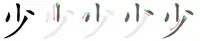 | |||
| Stroke order | |||
|---|---|---|---|
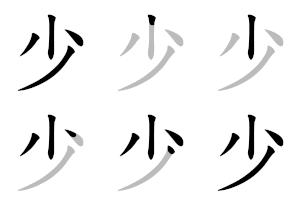 | |||
Alternative forms
Han character
少 (Kangxi radical 42, 小+1, 4 strokes, cangjie input 火竹 (FH), four-corner 90200, composition ⿱𡭔丿(GT) or ⿱小丿(HJKV))
Derived characters
References
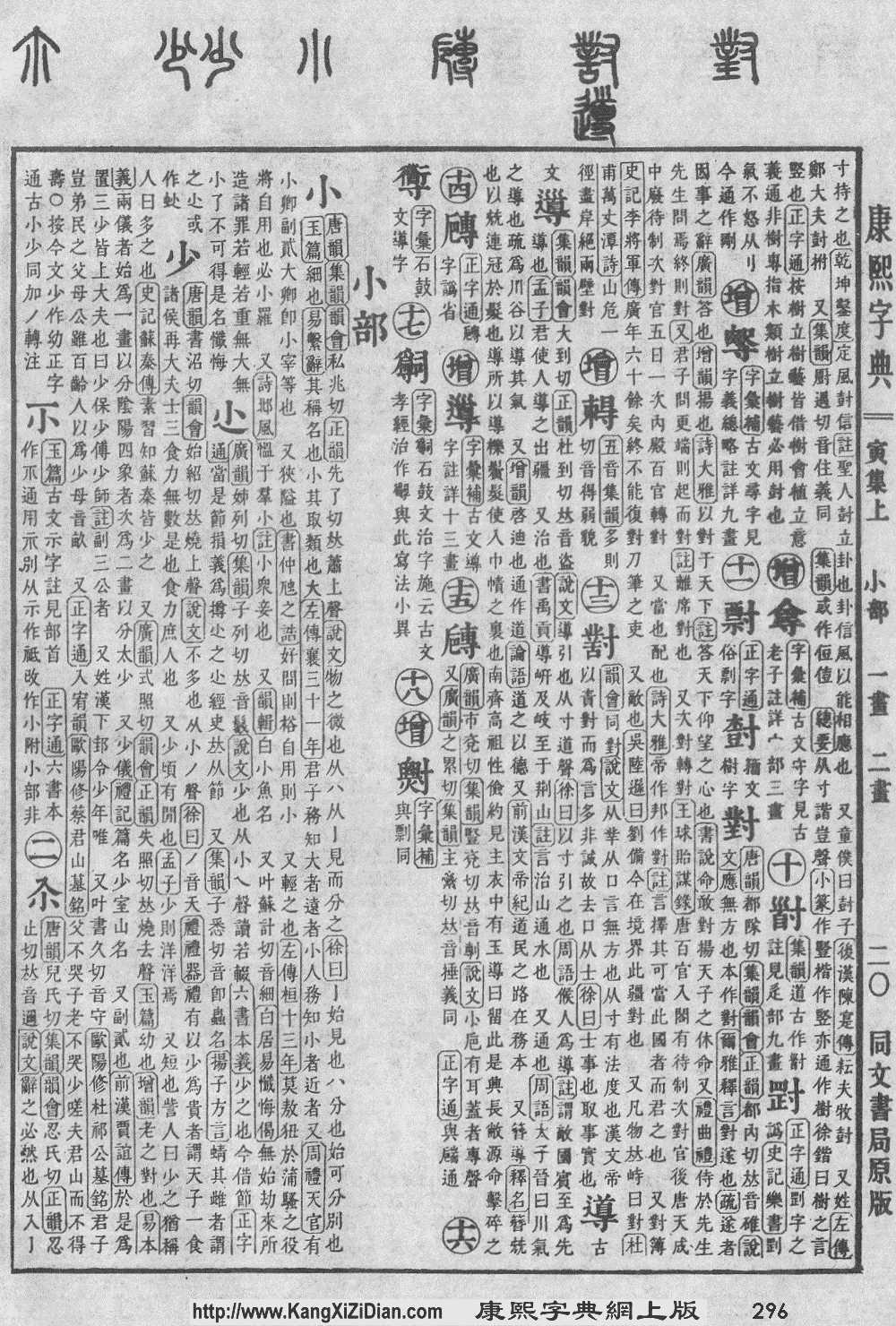
- Kangxi Dictionary: page 296, character 20
- Dai Kanwa Jiten: character 7475
- Dae Jaweon: page 590, character 2
- Hanyu Da Zidian (first edition): volume 1, page 561, character 2
- Unihan data for U+5C11
Chinese
| simp. and trad. |
少 | |
|---|---|---|
Glyph origin
| Historical forms of the character 少 |
|---|
| Shang |
| Oracle bone script |
 |
Characters in the same phonetic series (小) (Zhengzhang, 2003)
Pictogram (象形) – four dots; few; little. Phonetically borrowed from 小 (OC *smewʔ, “small”), which is depicted by three dots.
Pronunciation 1
Definitions
少
- few; little in number; less; not many
- weak; inadequate; insufficient
- † Alternative form of 小 (xiǎo, “small; tiny”)
- to lack; to be short of; to be deficient
- to reduce (the amount or extent); to weaken; to lose; to stop; to cease
- † to despise; to look down; to belittle
- slightly; moderately; a little; a bit
- seldom; rarely; infrequently
- in a little while; in a moment
- (Hong Kong Cantonese, Internet slang, neologism) slightly; somewhat
- 少癲/少癫 [Hong Kong Cantonese] ― siu2 din1 [Jyutping] ― somewhat crazy
- Antonym: 大 (daai6)
- Alternative form: 小 (siu2)
- 5th tetragram of the Taixuanjing (𝌊)
Synonyms
Dialectal synonyms of 少 (“few; little in number”) [map]
| Variety | Location | Words |
|---|---|---|
| Classical Chinese | 少 | |
| Formal (Written Standard Chinese) | 少 | |
| Mandarin | Beijing | 少 |
| Taiwan | 少 | |
| Jinan | 少 | |
| Xi'an | 少 | |
| Wuhan | 少 | |
| Chengdu | 少 | |
| Yangzhou | 少 | |
| Hefei | 少 | |
| Cantonese | Guangzhou | 少 |
| Hong Kong | 少 | |
| Yangjiang | 少 | |
| Gan | Nanchang | 少 |
| Hakka | Meixian | 少 |
| Miaoli (N. Sixian) | 少 | |
| Pingtung (Neipu; S. Sixian) | 少 | |
| Hsinchu County (Zhudong; Hailu) | 少 | |
| Taichung (Dongshi; Dabu) | 少 | |
| Hsinchu County (Qionglin; Raoping) | 少 | |
| Yunlin (Lunbei; Zhao'an) | 少 | |
| Jin | Taiyuan | 少 |
| Northern Min | Jian'ou | 少 |
| Eastern Min | Fuzhou | 少 |
| Southern Min | Xiamen | 少 |
| Chaozhou | 少 | |
| Wu | Suzhou | 少 |
| Ningbo | 缺 | |
| Wenzhou | 少 | |
| Xiang | Changsha | 少 |
| Shuangfeng | 少 | |
Antonyms
- (antonym(s) of “few”): 多 (duō)
Compounds
- 不在少數/不在少数 (bùzàishǎoshù)
- 不多不少
- 不少 (bùshǎo)
- 以少克眾/以少克众
- 僧多粥少 (sēngduōzhōushǎo)
- 兵少將微/兵少将微
- 最少 (zuìshǎo)
- 凶多吉少 (xiōngduōjíshǎo)
- 古今少有
- 多共少
- 多凶少吉
- 多多少少 (duōduōshǎoshǎo)
- 多少
- 多少是好
- 多退少補/多退少补
- 寡二少雙/寡二少双
- 寡恩少義/寡恩少义
- 寡情少義/寡情少义
- 寡聞少見/寡闻少见
- 寡見少聞/寡见少闻
- 少一缺二
- 少不了 (shàobuliǎo)
- 少不得
- 少之又少 (shǎozhīyòushǎo)
- 少來/少来 (shǎolái)
- 少候
- 少停
- 少刻 (shǎokè)
- 少吃無著/少吃无著
- 少坐
- 少安勿躁 (shǎo'ān wùzào)
- 少安毋躁
- 少安無躁/少安无躁
- 少少 (shǎoshǎo)
- 少差
- 少待
- 少心眼
- 少息 (shǎoxī)
- 少憩 (shǎoqì)
- 少懈
- 少敘/少叙
- 少數/少数 (shǎoshù)
- 少數民族/少数民族 (shǎoshù mínzú)
- 少日
- 少時/少时
- 少有 (shǎoyǒu)
- 少歇
- 少氣無力/少气无力
- 少焉
- 少禮/少礼 (xiǎolǐ)
- 少私寡慾/少私寡欲
- 少管閒事/少管闲事 (shǎoguǎnxiánshì)
- 少見/少见 (shǎojiàn)
- 少見多怪/少见多怪 (shǎojiànduōguài)
- 少親失眷/少亲失眷
- 少言寡語/少言寡语 (shǎoyánguǎyǔ)
- 少許/少许 (shǎoxǔ)
- 少調失教/少调失教
- 少量 (shǎoliàng)
- 少間/少间
- 少陪
- 少頃/少顷 (shǎoqǐng)
- 少頭無尾/少头无尾
- 少魂失魄
- 少魂沒識/少魂没识
- 很少 (hěnshǎo)
- 抵多少
- 會少離多/会少离多
- 沒多少/没多少
- 沉重少言
- 沉靜少言/沉静少言
- 沒魂少智/没魂少智
- 減少/减少 (jiǎnshǎo)
- 狼多肉少 (lángduōròushǎo)
- 疏謀少略/疏谋少略
- 眾少不敵/众少不敌
- 眾少成多/众少成多
- 短少 (duǎnshǎo)
- 稀少 (xīshǎo)
- 積少成多/积少成多 (jīshǎochéngduō)
- 粥少僧多
- 絕甘分少/绝甘分少
- 缺少 (quēshǎo)
- 缺斤少兩/缺斤少两 (quējīnshǎoliǎng)
- 缺衣少食 (quēyīshǎoshí)
- 至少 (zhìshǎo)
- 花多實少/花多实少
- 虛多實少/虚多实少
- 辭多受少/辞多受少
- 重厚少文
- 食少事煩/食少事烦
- 鮮少/鲜少 (xiǎnshǎo)
Pronunciation 2
Definitions
少
Synonyms
Dialectal synonyms of 年輕 (“young”) [map]
Compounds
- 不良少年 (bùliáng shàonián)
- 五陵年少 (wǔlíngniánshào)
- 卻少/却少
- 問題少年/问题少年
- 大少爺/大少爷 (dàshàoye)
- 太子少保
- 太子少師/太子少师
- 安老懷少/安老怀少
- 少不更事
- 少不經事/少不经事 (shàobùjīngshì)
- 少保
- 少傅
- 少像
- 少商
- 少壯/少壮 (shàozhuàng)
- 少女 (shàonǚ)
- 少女嫩婦/少女嫩妇 (shàonǚ nènfù)
- 少女情懷/少女情怀
- 少奶奶 (shàonǎinai)
- 少婦/少妇 (shàofù)
- 少子
- 少尉 (shàowèi)
- 少小
- 少師/少师
- 少年 (shàonián)
- 少年人
- 少年才俊
- 少年法庭
- 少年犯罪 (shàonián fànzuì)
- 少年組/少年组
- 少年老成
- 少年郎
- 少府 (shàofǔ)
- 少成若性
- 少昊
- 少東/少东 (shàodōng)
- 少林寺 (Shàolínsì)
- 少林拳 (Shàolínquán)
- 少林派
- 少棒
- 少爺/少爷 (shàoyé)
- 少牢 (shàoláo)
- 少白頭/少白头 (shàobáitóu)
- 少艾 (shào'ài)
- 嵩少
- 年少 (niánshào)
- 年少得志
- 年少氣盛/年少气盛
- 惡少/恶少 (èshào)
- 慘綠少年/惨绿少年
- 盧家少婦/卢家少妇
- 空中少爺/空中少爷 (kōngzhōng shàoyé)
- 老少 (lǎoshào)
- 老少一同
- 老少咸宜 (lǎoshàoxiányí)
- 老少年
- 老少無欺/老少无欺
- 老少男女 (lǎoshàonánnǚ)
- 老少配
- 老的少的
- 老老少少
- 老醫少卜/老医少卜
- 荷花大少
- 虞犯少年
- 裙屐少年
- 裴少俊
- 資淺齒少/资浅齿少
- 遺少/遗少
- 闊少/阔少 (kuòshào)
- 青少年 (qīngshàonián)
- 青少棒
References
- “少”, in 漢語多功能字庫 (Multi-function Chinese Character Database), 香港中文大學 (the Chinese University of Hong Kong), 2014–
Japanese
Readings
Korean
Etymology
(This etymology is missing or incomplete. Please add to it, or discuss it at the Etymology scriptorium. Particularly: “Middle Korean readings, if any”)
Pronunciation
- (SK Standard/Seoul) IPA(key): [sʰo̞(ː)]
- Phonetic hangul: [소(ː)]
- Though still prescribed in Standard Korean, most speakers in both Koreas no longer distinguish vowel length.
Vietnamese
Han character
少: Hán Việt readings: thiếu[1][2][3][4][5][6], thiểu[1][2][3][4][5][6]
少: Nôm readings: thiếu[1][2][3], thiểu[1][2][3], thểu[2], thỉu[2], thẹo[3], thẻo[3], ít[2]
References
- Nguyễn (2014).
- Nguyễn et al. (2009).
- Trần (2004).
- Trần (1999).
- Nguyễn (1974).
- Thiều Chửu (1942).
This article is issued from Wiktionary. The text is licensed under Creative Commons - Attribution - Sharealike. Additional terms may apply for the media files.