適
See also: 适
| ||||||||
| ||||||||
Translingual
Han character
適 (Kangxi radical 162, 辵+11, 14 strokes, cangjie input 卜卜金月 (YYCB), four-corner 30302, composition ⿺辶啇)
References
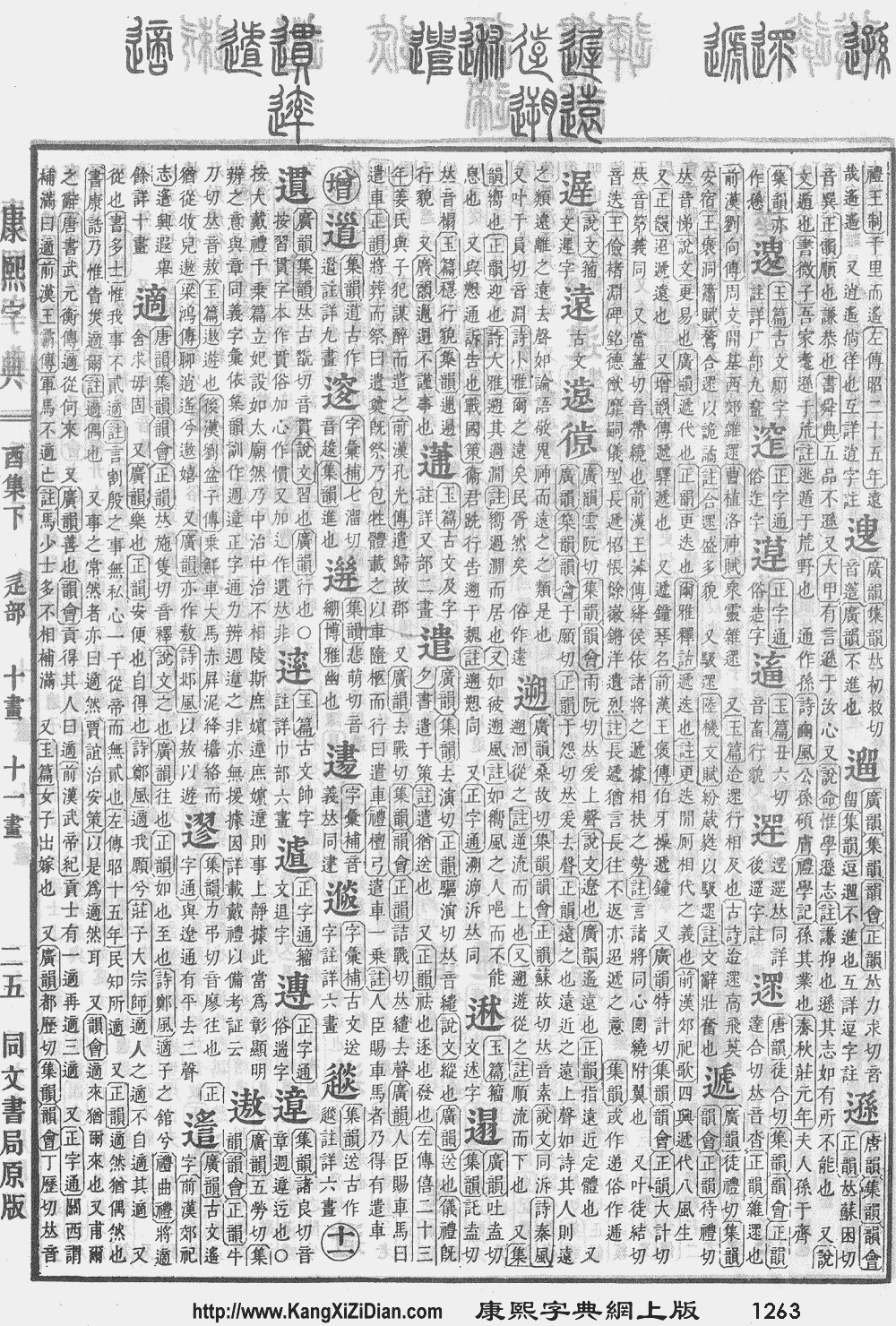
- Kangxi Dictionary: page 1263, character 34
- Dai Kanwa Jiten: character 39076
- Dae Jaweon: page 1759, character 9
- Hanyu Da Zidian (first edition): volume 6, page 3877, character 8
- Unihan data for U+9069
Chinese
| trad. | 適 | |
|---|---|---|
| simp. | 适* | |
| alternative forms | 𨗁 啻 | |
Glyph origin
Characters in the same phonetic series (帝) (Zhengzhang, 2003)
| Old Chinese | |
|---|---|
| 膪 | *rtaːɡs, *rteːɡs |
| 揥 | *tʰeds, *teː |
| 腣 | *teː, *teːɡs |
| 諦 | *teːɡs |
| 偙 | *teːɡs |
| 渧 | *teːɡs |
| 帝 | *teːɡs |
| 楴 | *tʰeːɡs |
| 啼 | *deː |
| 蹄 | *deː |
| 締 | *deː, *deːɡs |
| 崹 | *deː |
| 鶙 | *deː |
| 禘 | *deːɡs |
| 啻 | *hljeɡs |
| 嫡 | *rteɡ, *teːɡ |
| 摘 | *rteːɡ, *tʰeːɡ |
| 謫 | *rteːɡ |
| 讁 | *rteːɡ |
| 擿 | *deɡ |
| 蹢 | *deɡ, *teːɡ |
| 適 | *tjeɡ, *hljeɡ, *teːɡ |
| 啇 | *teːɡ |
| 滴 | *teːɡ |
| 鏑 | *teːɡ |
| 甋 | *teːɡ |
| 樀 | *teːɡ, *deːɡ |
| 敵 | *deːɡ |
Phono-semantic compound (形聲/形声, OC *tjeɡ, *hljeɡ, *teːɡ) : semantic 辶 + phonetic 啻 (OC *hljeɡs).
Pronunciation 1
Definitions
適
- to go; to proceed (to a place)
- 大夫七十而致事。若不得謝,則必賜之几杖,行役以婦人。適四方,乘安車。 [Classical Chinese, trad.]
- From: The Book of Rites, c. 4th – 2nd century BCE
- Dàfū qīshí ér zhìshì. Ruò bùdé xiè, zé bì cì zhī jīzhàng, xíngyì yǐ fùrén. Shì sìfāng, chéng ānjū. [Pinyin]
- A great officer, when he is seventy, should resign (his charge of) affairs.
If he be not allowed to resign, there must be given him a stool and staff.
When travelling on service, he must have the attendance of his wife.
When going to any other state, he will ride in an easy carriage.
大夫七十而致事。若不得谢,则必赐之几杖,行役以妇人。适四方,乘安车。 [Classical Chinese, simp.]- 三人行而一人惑,所適者猶可致也,惑者少也;二人惑則勞而不至,惑者勝也。 [Classical Chinese, trad.]
- From: Zhuangzi, circa 3rd – 2nd centuries BCE
- Sān rén xíng ér yī rén huò, suǒ shì zhě yóu kě zhì yě, huò zhě shǎo yě; èr rén huò zé láo ér bù zhì, huò zhě shèng yě. [Pinyin]
- If three men be walking together, and (only) one of them be under a delusion (as to their way), they may yet reach their goal [i.e. place they are going to], the deluded being the fewer; but if two of them be under the delusion, they will not do so, the deluded being the majority.
三人行而一人惑,所适者犹可致也,惑者少也;二人惑则劳而不至,惑者胜也。 [Classical Chinese, simp.]
- towards; to
- to get; to obtain
- fitting; proper; suitable; appropriate
- by chance; as it happens; as luck would have it
- occasionally; from time to time
- if; assuming
- just (now); only
- 近世各國所謂民權制度,往往為資產階級所專有,適成為壓迫平民之工具。 [MSC, trad.]
- From: 1924, 孫中山 (Sun Yat-sen), 《中國國民黨第一次全國代表大會宣言》 (Manifesto of the First National Congress of the Kuomintang), translation based on
- Jìnshì gèguó suǒwèi mínquán zhìdù, wǎngwǎng wéi zīchǎnjiējí suǒ zhuānyǒu, shì chéngwéi yāpò píngmín zhī gōngjù. [Pinyin]
- The so-called democratic system in modern states is usually monopolized by the bourgeoisie and has become simply an instrument for oppressing the common people.
近世各国所谓民权制度,往往为资产阶级所专有,适成为压迫平民之工具。 [MSC, simp.]
- (historical) collar of the mourning gown
- a surname
Synonyms
Dialectal synonyms of 恰巧 (“by chance; as it happens”) [map]
Compounds
- 不良適應/不良适应
- 不適/不适 (bùshì)
- 最適化/最适化 (zuìshìhuà)
- 刖足適屨/刖足适屦
- 刖趾適屨/刖趾适屦
- 刻足適屨/刻足适屦
- 削足適履/削足适履 (xuēzúshìlǚ)
- 削趾適屨/削趾适屦
- 北轅適楚/北辕适楚
- 合適/合适 (héshì)
- 各適其適/各适其适 (gèshìqíshì)
- 安適/安适 (ānshì)
- 安適如常/安适如常
- 心適/心适 (sim-sek) (Min Nan)
- 恬適/恬适
- 悠然自適/悠然自适
- 截趾適屨/截趾适屦
- 改適/改适
- 普適/普适 (pǔshì)
- 會逢其適/会逢其适
- 無所適從/无所适从 (wúsuǒshìcóng)
- 社會調適/社会调适
- 視覺適應/视觉适应
- 自適/自适 (zìshì)
- 舒適/舒适 (shūshì)
- 調適/调适 (tiáoshì)
- 適中/适中 (shìzhōng)
- 適中下懷/适中下怀
- 適人/适人
- 適任/适任 (shìrèn)
- 適來/适来 (shìlái)
- 適值/适值 (shìzhí)
- 適切/适切 (shìqiè)
- 適口/适口
- 適可而止/适可而止 (shìkě'érzhǐ)
- 適合/适合 (shìhé)
- 適婚年齡/适婚年龄
- 適宜/适宜 (shìyí)
- 適度/适度 (shìdù)
- 適從/适从 (shìcóng)
- 適得其反/适得其反 (shìdéqífǎn)
- 適得其所/适得其所 (shìdéqísuǒ)
- 適性/适性 (shìxìng)
- 適悶/适闷
- 適意/适意 (shìyì)
- 適應/适应 (shìyìng)
- 適才/适才 (shìcái)
- 適時/适时 (shìshí)
- 適材適用/适材适用
- 適然/适然
- 適用/适用 (shìyòng)
- 適當/适当 (shìdàng)
- 適者生存/适者生存 (shìzhě shēngcún)
- 適逢其會/适逢其会
- 適量/适量 (shìliàng)
- 適銷/适销
- 適銷對路/适销对路
- 適間/适间 (shìjiān)
- 適齡/适龄 (shìlíng)
- 閒適/闲适 (xiánshì)
- 難易適中/难易适中
- 順適/顺适 (shùnshì)
Pronunciation 2
Definitions
適
- to devote; to dedicate (to one thing)
- 子曰:「君子之於天下也,無適也,無莫也,義之與比。」 [Classical Chinese, trad.]
- From: The Analects of Confucius, c. 475 – 221 BCE, translated based on James Legge's version
- Zǐ yuē: “Jūnzǐ zhī yú tiānxià yě, wú dí yě, wú mò yě, yì zhī yǔ bǐ.” [Pinyin]
- The Master said, “The superior man, in the world, does not set his mind either for anything, or against anything; what is right he will follow.”
子曰:「君子之于天下也,无适也,无莫也,义之与比。」 [Classical Chinese, simp.]
- Alternative form of 嫡 (dí, “legal wife; legal wife's son”)
Compounds
- 嗣適/嗣适
- 無適無莫/无适无莫
- 適孫/适孙
Pronunciation 3
Pronunciation 4
Pronunciation 5
Japanese
| Shinjitai | 適 |  |
| Kyūjitai [1][2][3][4] |
適󠄁 適+ 󠄁?(Adobe-Japan1) |
 |
| 適󠄄 適+ 󠄄?(Hanyo-Denshi) (Moji_Joho) | ||
| 適󠄃 適+ 󠄃?(Hanyo-Denshi) (Moji_Joho) |
 | |
| The displayed kanji may be different from the image due to your environment. See here for details. | ||
Kanji
適
- suitable, appropriate, fit
- Alternative spelling of 嫡: direct; legitimate
- Alternative spelling of 敵: enemy
Readings
- Go-on: しゃく (shaku); じゃく (jaku); ちゃく (chaku)
- Kan-on: せき (seki); てき (teki, Jōyō)
- Kan’yō-on: てき (teki, Jōyō)
- Kun: ゆく (yuku, 適く); とつぐ (totsugu, 適ぐ); かなう (kanau, 適う)←かなふ (kanafu, 適ふ, historical); あう (au, 適う)←あふ (afu, 適ふ, historical); たまたま (tamatama, 適); ただ (tada, 適だ); まさに (masani, 適に); たとい (tatoi, 適い)←たとひ (tatofi, 適ひ, historical)
- Nanori: あたる (ataru); あつ (atsu); あり (ari); かなう (kanau); かのう (kanō); まさ (masa); ゆき (yuki); ゆく (yuku); より (yori)
Compounds
Compounds
- 適人 (sekijin)
- 適過 (takuka)
- 適徙 (takushi)
- 適戍 (takuju)
- 適卒 (takusotsu)
- 適民 (takumin) (讁民 (takumin))
- 適間 (tamahima)
- 適嗣 (chakushi) (嫡嗣 (chakushi))
- 適子 (chakushi) (嫡子 (chakushi))
- 適庶 (chakusho) (嫡庶 (chakusho))
- 適孫 (chakuson) (嫡孫 (chakuson))
- 適統 (chakutō) (嫡統 (chakutō))
- 適母 (chakubo) (嫡母 (chakubo))
- 適意 (tekī)
- 適逸 (tekītsu)
- 適応 (tekiō)
- 適温 (tekion)
- 適可 (tekika)
- 適格 (tekikaku)
- 適確 (tekikaku) (的確 (tekikaku))
- 適願 (tekigan)
- 適帰 (tekiki)
- 適期 (tekiki)
- 適宜 (tekigi)
- 適義 (tekigi)
- 適興 (tekikyō)
- 適業 (tekigyō)
- 適均 (tekikin)
- 適孽 (tekigetsu)
- 適言 (tekigen)
- 適口 (tekikō)
- 適郊 (tekikō)
- 適合 (tekigō)
- 適才 (tekisai)
- 適材 (tekizai)
- 適作 (tekisaku)
- 適志 (tekishi)
- 適嗣 (tekishi) (嫡嗣 (tekishi))
- 適士 (tekishi)
- 適子 (tekishi) (嫡子 (tekishi))
- 適時 (tekiji)
- 適式 (tekishiki)
- 適室 (tekishitsu)
- 適実 (tekijitsu)
- 適者 (tekisha)
- 適者生存 (tekisha seizon): survival of the fittest
- 適充 (tekijū)
- 適従 (tekijū)
- 適所 (tekisho)
- 適庶 (tekisho) (嫡庶 (tekisho))
- 適職 (tekishoku)
- 適情 (tekijō)
- 適心 (tekishin)
- 適寝 (tekishin)
- 適性 (tekisei)
- 適生 (tekisei)
- 適正 (tekisei)
- 適切 (tekisetsu): appropriate, suitable, proper
- 適然 (tekizen)
- 適俗 (tekizoku)
- 適孫 (tekison) (嫡孫 (tekison))
- 適体 (tekitai)
- 適地 (tekichi)
- 適中 (tekichū) (的中 (tekichū))
- 適長 (tekichō) (嫡長 (tekichō))
- 適丁 (tekitei)
- 適適 (tekiteki)
- 適度 (tekido)
- 適当 (tekitō)
- 適任 (tekinin)
- 適莫 (tekibaku)
- 適否 (tekihi)
- 適評 (tekihyō)
- 適婦 (tekifu)
- 適不適 (tekifuteki)
- 適変 (tekihen)
- 適母 (tekibo) (嫡母 (tekibo))
- 適法 (tekihō)
- 適味 (tekimi)
- 適役 (tekiyaku)
- 適訳 (tekiyaku)
- 適薬 (tekiyaku)
- 適用 (tekiyō)
- 適欲 (tekiyoku)
- 適来 (tekirai)
- 適理 (tekiri)
- 適量 (tekiryō)
- 適例 (tekirei)
- 適齢 (tekirei)
- 適歴 (tekireki)
- 安適 (anteki)
- 意適 (iteki)
- 栄適 (eiteki)
- 宴適 (enteki)
- 快適 (kaiteki)
- 酣適 (kanteki)
- 閑適 (kanteki), 間適 (kanteki)
- 歓適 (kanteki)
- 宜適 (giteki)
- 好適 (kōteki)
- 自適 (jiteki)
- 時適
- 首適
- 順適 (junteki)
- 舒適 (joteki)
- 賞適 (shōteki)
- 縦適 (shōteki)
- 情適
- 心適
- 神適
- 正適 (seichaku) (正嫡 (seichaku))
- 正適 (seiteki)
- 清適 (seiteki)
- 切適
- 暢適 (chōteki)
- 無適 (muteki)
- 愉適
- 利適
- 履適
Etymology
| Kanji in this term |
|---|
| 適 |
| たまたま Grade: 5 |
| kun’yomi |
| For pronunciation and definitions of 適 – see the following entry. | ||
| ||
| (This term, 適, is an alternative spelling of the above term.) |
References
- 白川静 (Shirakawa Shizuka) (2014) “適”, in 字通 (Jitsū) (in Japanese), popular edition, Tōkyō: Heibonsha, →ISBN
- “適”, in 漢字ぺディア (Kanjipedia) (in Japanese), 日本漢字能力検定協会, 2015–2024
- Haga, Gōtarō (1914) 漢和大辞書 [The Great Kanji-Japanese Dictionary] (in Japanese), Fourth edition, Tōkyō: Kōbunsha, , page 2127 (paper), page 1115 (digital)
- Shōundō Henshūjo, editor (1927), 新漢和辞典 [The New Kanji-Japanese Dictionary] (in Japanese), Ōsaka: Shōundō, , page 1228 (paper), page 627 (digital)
Korean
Vietnamese
This article is issued from Wiktionary. The text is licensed under Creative Commons - Attribution - Sharealike. Additional terms may apply for the media files.