染
| ||||||||
Translingual
Han character
染 (Kangxi radical 75, 木+5, 9 strokes, cangjie input 水弓木 (END), four-corner 34904, composition ⿱氿木(GJKV) or ⿱氿𣎳(HT))
References
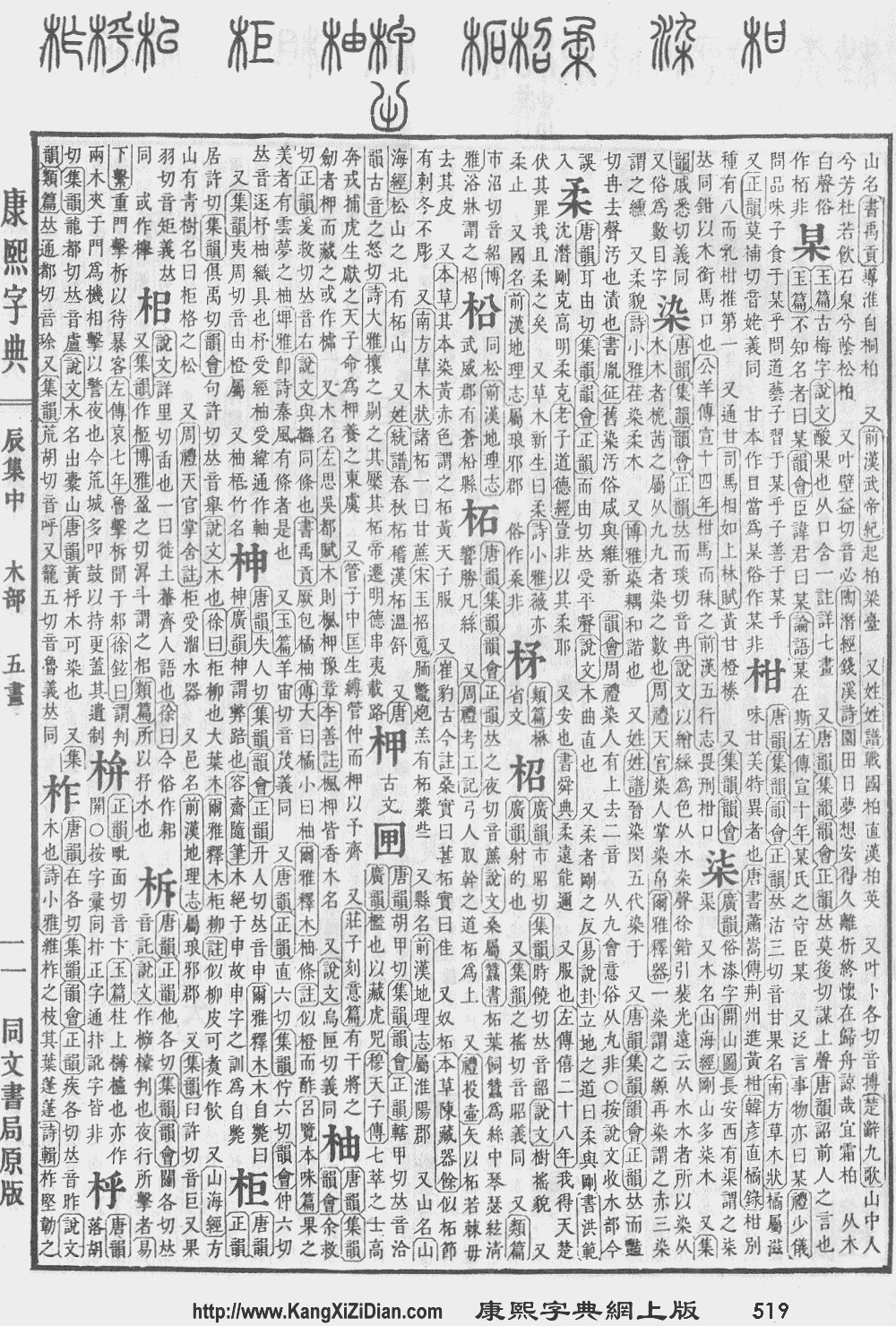
- Kangxi Dictionary: page 519, character 4
- Dai Kanwa Jiten: character 14621
- Dae Jaweon: page 907, character 3
- Hanyu Da Zidian (first edition): volume 2, page 1188, character 7
- Unihan data for U+67D3
Chinese
| trad. | 染 | |
|---|---|---|
| simp. # | 染 | |
Glyph origin
| Historical forms of the character 染 | |||||||
|---|---|---|---|---|---|---|---|
| Shuowen Jiezi (compiled in Han) | Liushutong (compiled in Ming) | ||||||
| Small seal script | Transcribed ancient scripts | ||||||
 |
 | ||||||
|
|
References: Mostly from Richard Sears' Chinese Etymology site (authorisation),
| |||||||


Ideogrammic compound (會意/会意) : 氵 (“water”) + 九 (“hook”) + 木 (“tree”) – to hang (on a hook 九) from a tree (木) into water (氵), so as to dye.
Earlier forms more often graphically 氵 + 杂; in the modern form, the water radical is moved upward to the upper-left corner.
Etymology
Coblin (1986) compares this to Tibetan ཉམས་པ (nyams pa, “be stained, tarnished, spoiled”); Pan (1987) also notes Proto-Tai *ɲuɔmᴬ as well as Vietnamese nhuộm, both meaning "to dye".
Schuessler (2007) cites Downer (1986)'s opinion that form with 上 (shàng) tone is the verb, while form with 去 (qù) tone is the noun meaning "kind of cloth" (Lǐjì).
Pronunciation
Compounds
- 一塵不染/一尘不染 (yīchénbùrǎn)
- 不染纖塵/不染纤尘
- 二次感染
- 二次汙染/二次污染
- 交叉感染 (jiāochā gǎnrǎn)
- 作染
- 傳染/传染 (chuánrǎn)
- 傳染來源/传染来源
- 傳染力/传染力 (chuánrǎnlì)
- 傳染原/传染原
- 傳染病/传染病 (chuánrǎnbìng)
- 傳染途徑/传染途径
- 印染 (yìnrǎn)
- 合成染料
- 命染黃沙/命染黄沙
- 噪音汙染/噪音污染 (zàoyīn wūrǎn)
- 土壤汙染/土壤污染 (tǔrǎng wūrǎn)
- 塵埃傳染/尘埃传染
- 大氣汙染/大气污染
- 媒染劑/媒染剂
- 尿道感染
- 性染色體/性染色体 (xìng rǎnsètǐ)
- 愛染/爱染
- 感染 (gǎnrǎn)
- 感染症
- 接觸傳染/接触传染
- 操觚染翰
- 放射汙染/放射污染
- 日漸月染/日渐月染
- 日濡月染
- 有染 (yǒurǎn)
- 染人
- 染化
- 染坊
- 染干
- 染指 (rǎnzhǐ)
- 染指垂涎
- 染指於鼎/染指于鼎
- 染料 (rǎnliào)
- 染汙/染污
- 染渲
- 染畫/染画
- 染疫 (rǎnyì)
- 染病 (rǎnbìng)
- 染紅/染红 (rǎnhóng)
- 染絲之變/染丝之变
- 染缸
- 染習/染习
- 染翰
- 染翰操紙/染翰操纸
- 染翰操觚
- 染色 (rǎnsè)
- 染色體/染色体 (rǎnsètǐ)
- 染革
- 染風習俗/染风习俗
- 染髮/染发 (rǎnfà)
- 核汙染/核污染
- 水汙染/水污染 (shuǐwūrǎn)
- 汙染/污染 (wūrǎn)
- 汙染物/污染物 (wūrǎnwù)
- 沾染 (zhānrǎn)
- 油汙染/油污染
- 浸染 (jìnrǎn)
- 海水汙染/海水污染
- 渲染 (xuànrǎn)
- 滃染
- 漂染 (piǎorǎn)
- 漸染/渐染 (jiānrǎn)
- 潛伏感染/潜伏感染
- 濡染
- 火染旛竿
- 烘染
- 熏染 (xūnrǎn)
- 熱汙染/热污染
- 環境汙染/环境污染 (huánjìng wūrǎn)
- 病染膏肓
- 目擩耳染 (mùrù'ěrrǎn)
- 目染耳濡 (mùrǎn'ěrrú)
- 空氣傳染/空气传染 (kōngqì chuánrǎn)
- 空氣汙染/空气污染 (kōngqì wūrǎn)
- 紡染/纺染
- 紮染/扎染
- 絞染/绞染
- 纖塵不染/纤尘不染
- 習染/习染
- 耳染目濡 (ěrrǎnmùrú)
- 耳濡目染 (ěrrúmùrǎn)
- 荏染
- 薰染 (xūnrǎn)
- 蠟染/蜡染 (làrǎn)
- 見聞習染/见闻习染
- 軋染/轧染
- 遷染/迁染
- 院內感染/院内感染 (yuànnèi gǎnrǎn)
- 陶染
- 隱性傳染/隐性传染
- 霑染/沾染
- 青蠅染白/青蝇染白
- 面染
- 飛文染翰/飞文染翰
- 飛沫傳染/飞沫传染
- 香染
- 點染/点染
- 點染雲煙/点染云烟
References
- “染”, in 漢語多功能字庫 (Multi-function Chinese Character Database), 香港中文大學 (the Chinese University of Hong Kong), 2014–
Japanese
Korean
Etymology
From Middle Chinese 染 (MC nyemX|nyemH).
| Historical readings |
|---|
|
Pronunciation
- (SK Standard/Seoul) IPA(key): [jɘ(ː)m]
- Phonetic hangul: [염(ː)]
- Though still prescribed in Standard Korean, most speakers in both Koreas no longer distinguish vowel length.