汏
| ||||||||
Translingual
Han character
汏 (Kangxi radical 85, 水+3, 6 strokes, cangjie input 水大 (EK), four-corner 34130, composition ⿰氵大)
- (dialect) to wash
References
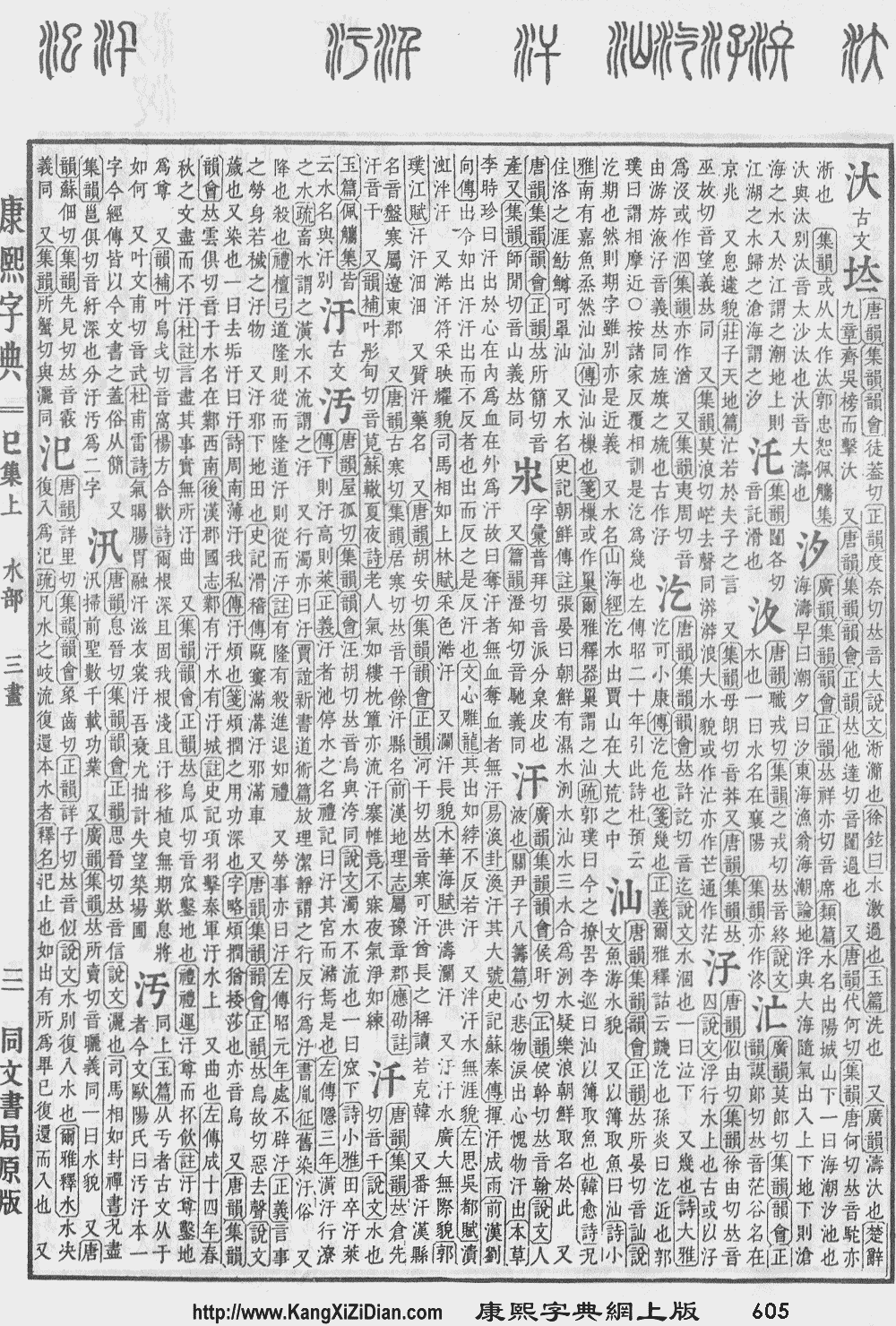
- Kangxi Dictionary: page 605, character 1
- Dai Kanwa Jiten: character 17121
- Dae Jaweon: page 998, character 11
- Hanyu Da Zidian (first edition): volume 3, page 1552, character 1
- Unihan data for U+6C4F
Chinese
Etymology 1
| simp. and trad. |
汏 | |
|---|---|---|
From Proto-Sino-Tibetan *r-labs (“wave”) (provisional); cognate with Tibetan རླབས (rlabs) (STEDT; Bodman, 1980; Schuessler, 2007).
Glyph origin
Characters in the same phonetic series (大) (Zhengzhang, 2003)
Phono-semantic compound (形聲/形声, OC *daːds, *tʰaːd) : semantic 水 (“water”) + phonetic 大 (OC *daːds, *daːds)
Pronunciation
Definitions
汏
- (Wu, including Shanghainese and Suzhounese) to rinse; to wash
- 汏手 [Shanghainese] ― 6da 5seu [Wugniu] ― to wash one's hands
- great wave
Synonyms
Dialectal synonyms of 洗 (“to wash”) [map]
Japanese
Kanji
汏
- This term needs a translation to English. Please help out and add a translation, then remove the text
{{rfdef}}.
Korean
Hanja
汏 (eum 대 (dae))
- This term needs a translation to English. Please help out and add a translation, then remove the text
{{rfdef}}.
Zhuang
Glyph origin
Phono-semantic compound (形聲/形声, OC *daːds, *tʰaːd) : semantic 氵 (“water”) + phonetic 大 (OC *daːds, *daːds)
This article is issued from Wiktionary. The text is licensed under Creative Commons - Attribution - Sharealike. Additional terms may apply for the media files.