游

See also: 遊 and 逰
游 U+6E38, 游
CJK UNIFIED IDEOGRAPH-6E38
← 渷
[U+6E37]
CJK Unified Ideographs 渹 →
[U+6E39]

Translingual

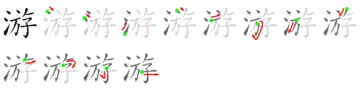
Stroke order
12 strokes

Han character

游 (Kangxi radical 85, 水+9, 12 strokes, cangjie input 水卜尸木 (EYSD), four-corner 38147, composition ⿰氵斿)

Derived characters

  • 𣛦, 𪆎

References

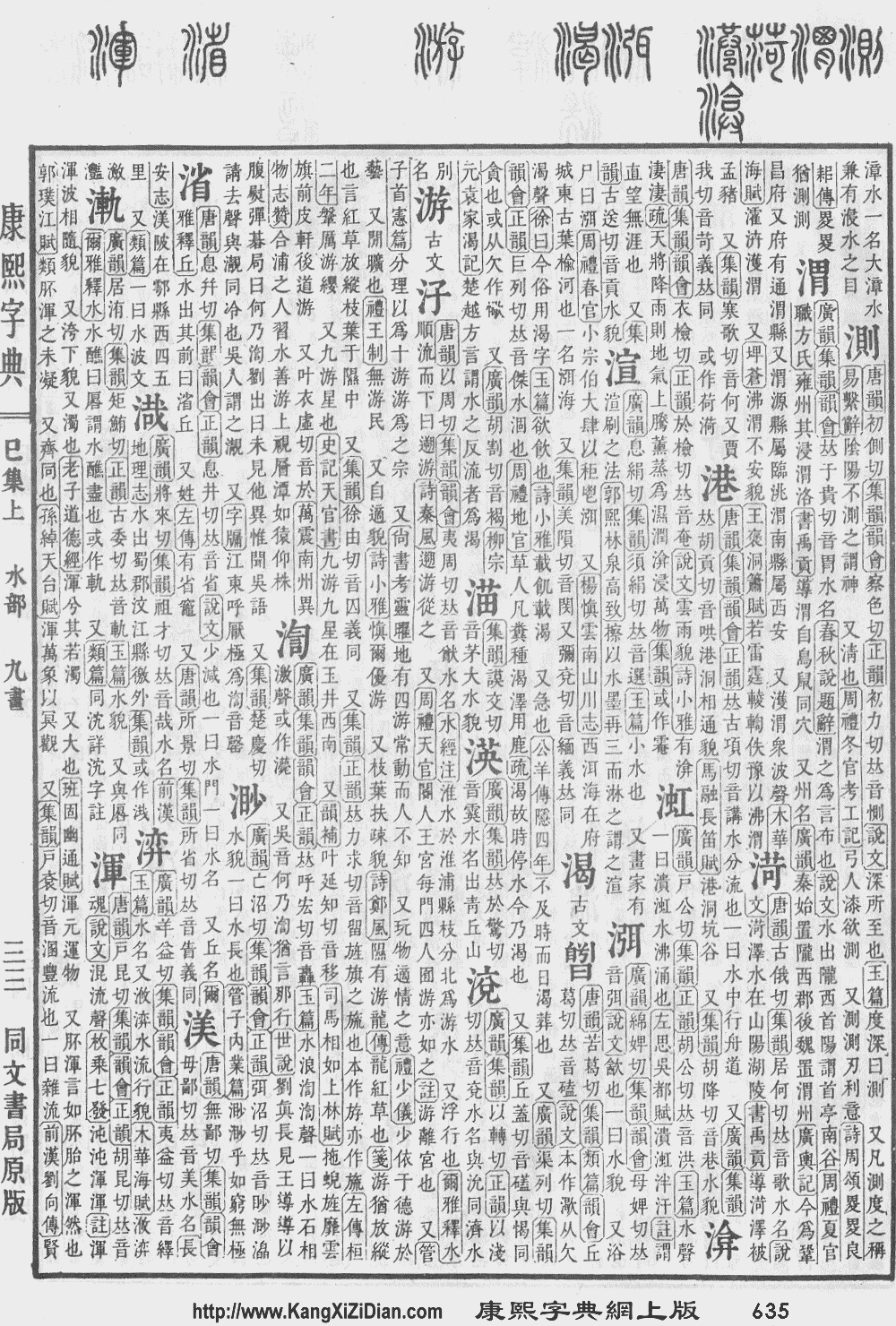
  • Kangxi Dictionary: page 635, character 14
  • Dai Kanwa Jiten: character 17792
  • Dae Jaweon: page 1042, character 10
  • Hanyu Da Zidian (first edition): volume 3, page 1684, character 8
  • Unihan data for U+6E38

Chinese

simp. and trad.
游
2nd round simp. 沋

Glyph origin

Phono-semantic compound (形聲/形声, OC *lu) : semantic 水 (“water”) + phonetic 斿 (OC *lu).

Etymology 1

From Sino-Tibetan. Cognate with Tibetan རྒྱུ་བ (rgyu ba, “to walk; to wander”), Lepcha ᰚᰪᰌᰦ (yŭ-da, “to flow”), Rawang yø (“to flow”) (Schuessler, 2007).

Same word as 遊 (OC *lu, “to roam; to travel”). Cognate with 流 (OC *ru, “to flow”), 泅 (OC *lju). Probably unrelated to 油 (OC *lɯw, “abundant”), 滺 (“flowing”).

Pronunciation


Rime
Character 游
Reading # 1/1
Initial (聲) 以 (36)
Final (韻) 尤 (136)
Tone (調) Level (Ø)
Openness (開合) Open
Division (等) III
Fanqie 以周切
Baxter yuw
Reconstructions
Zhengzhang
Shangfang
/jɨu/
Pan
Wuyun
/jiu/
Shao
Rongfen
/iəu/
Edwin
Pulleyblank
/juw/
Li
Rong
/iu/
Wang
Li
/jĭəu/
Bernard
Karlgren
/i̯ə̯u/
Expected
Mandarin
Reflex
yóu
Expected
Cantonese
Reflex
jau4
Baxter–Sagart system 1.1 (2014)
Character 游 游
Reading # 1/2 2/2
Modern
Beijing
(Pinyin)
yóu yóu
Middle
Chinese
‹ yuw › ‹ yuw ›
Old
Chinese
/*[N-]ru/ /*[N-]ru/
English float, swim float, swim

Notes for Old Chinese notations in the Baxter–Sagart system:

* Parentheses "()" indicate uncertain presence;
* Square brackets "[]" indicate uncertain identity, e.g. *[t] as coda may in fact be *-t or *-p;
* Angle brackets "<>" indicate infix;
* Hyphen "-" indicates morpheme boundary;

* Period "." indicates syllable boundary.
Zhengzhang system (2003)
Character 游
Reading # 1/1
No. 15545
Phonetic
component
斿
Rime
group
幽
Rime
subdivision
1
Corresponding
MC rime
猷
Old
Chinese
/*lu/

Definitions

游

  1. to swim
    他游得最遠。/他游得最远。  ―  Tā yóu dé zuì yuǎn.  ―  He swam the furthest.
    他們一起游向那艘船。 [MSC, trad.]
    他们一起游向那艘船。 [MSC, simp.]
    Tāmen yīqǐ yóu xiàng nà sōu chuán. [Pinyin]
    Together they swam to the ship.
  2. reach; part of a river
    上游  ―  shàngyóu  ―  upper reach, upstream
    下游  ―  xiàyóu  ―  lower reach, downstream
  3. a surname

Compounds

Etymology 2

For pronunciation and definitions of 游 – see 遊 (“to travel; to tour; to wander; to roam; etc.”).
(This character is the simplified form of 遊).
Notes:

Japanese

Kanji

游

(uncommon “Hyōgai” kanji)

  1. to float
  2. to swim

Readings

Korean

Hanja

游 • (yu) (hangeul 유)

  1. This term needs a translation to English. Please help out and add a translation, then remove the text {{rfdef}}.

Vietnamese

Han character

游: Hán Nôm readings: du

  1. This term needs a translation to English. Please help out and add a translation, then remove the text {{rfdef}}.
This article is issued from Wiktionary. The text is licensed under Creative Commons - Attribution - Sharealike. Additional terms may apply for the media files.