亠
| ||||||||
| ||||||||
Translingual
| Stroke order | |||
|---|---|---|---|
 | |||
Alternative forms
Although the character itself is written with a slanting 丶 dot in the Kangxi dictionary, most of its derived characters in the Ming typeface used in Japanese Kanji, Korean Hanja as well as the Kangxi dictionary uses a vertical dot for the upper component of 亠. This is slightly different from modern Chinese scripts, which use a slanting 丶 dot for the upper component of 亠 in its derived characters.
Han character
亠 (Kangxi radical 8, 亠+0, 2 strokes, cangjie input 難卜 (XY), four-corner 00000, composition ⿱丶一(GHTK) or ⿱丨一(J))
- Kangxi radical #8, ⼇.
Derived characters
See also
References
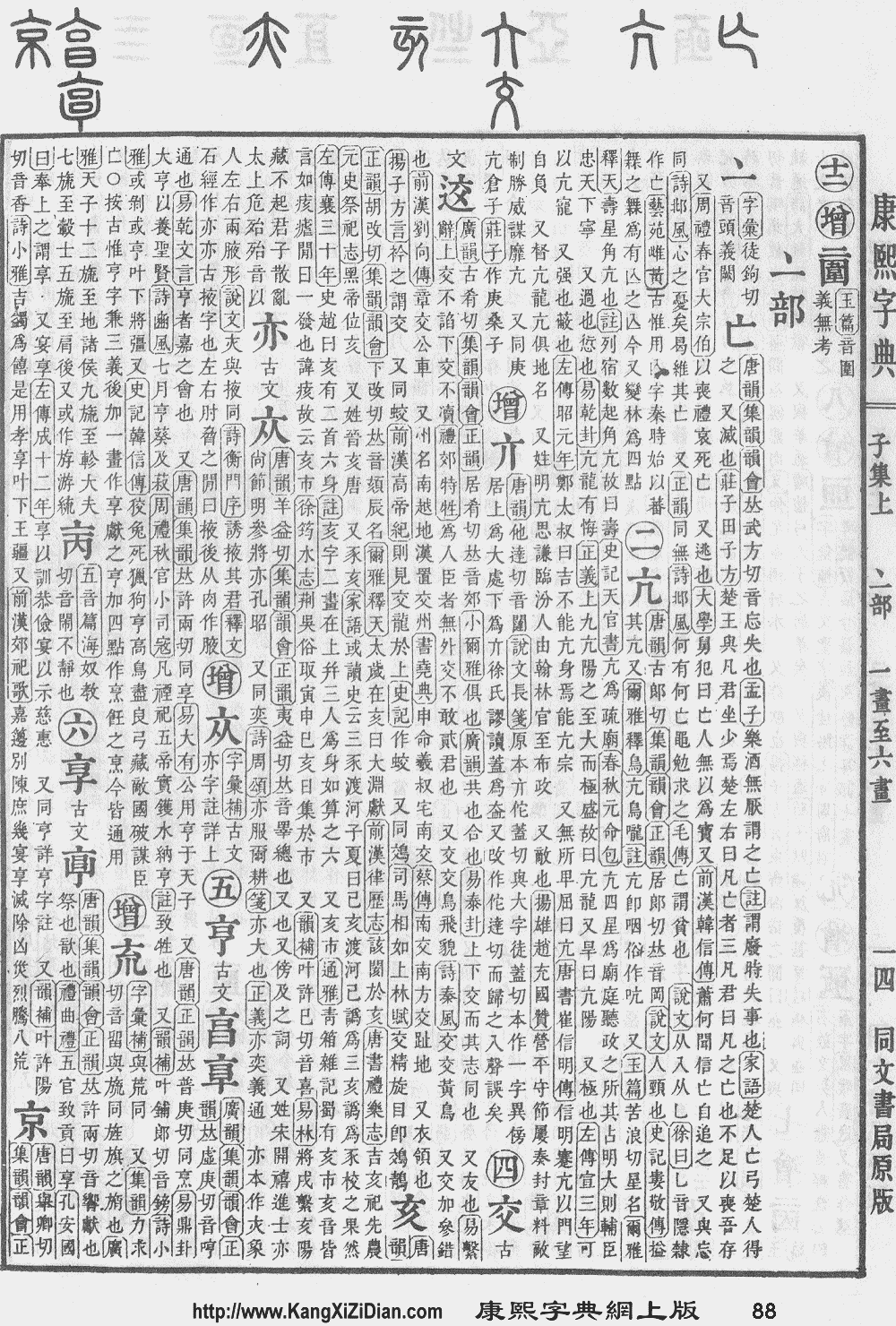
- Kangxi Dictionary: page 88, character 2
- Dai Kanwa Jiten: character 286
- Dae Jaweon: page 184, character 12
- Hanyu Da Zidian (first edition): volume 1, page 279, character 4
- Unihan data for U+4EA0
Chinese
| simp. and trad. |
亠 | |
|---|---|---|
Glyph origin
| Historical forms of the character 亠 |
|---|
| Shuowen Jiezi (compiled in Han) |
| Small seal script |
 |
Pronunciation
Japanese
Korean
Hanja
亠 (eum 두 (du))
- This term needs a translation to English. Please help out and add a translation, then remove the text
{{rfdef}}.
Vietnamese
Han character
- This term needs a translation to English. Please help out and add a translation, then remove the text
{{rfdef}}.
References
This article is issued from Wiktionary. The text is licensed under Creative Commons - Attribution - Sharealike. Additional terms may apply for the media files.