企

See also: 쇼
企 U+4F01, 企
CJK UNIFIED IDEOGRAPH-4F01
← 伀
[U+4F00]
CJK Unified Ideographs 伂 →
[U+4F02]
㈽ U+323D, ㈽
PARENTHESIZED IDEOGRAPH ENTERPRISE
← ㈼
[U+323C]
Enclosed CJK Letters and Months ㈾ →
[U+323E]

Translingual

Stroke order

Han character

企 (Kangxi radical 9, 人+4, 6 strokes, cangjie input 人卜中一 (OYLM), four-corner 80101, composition ⿱𠆢止)

Derived characters

References

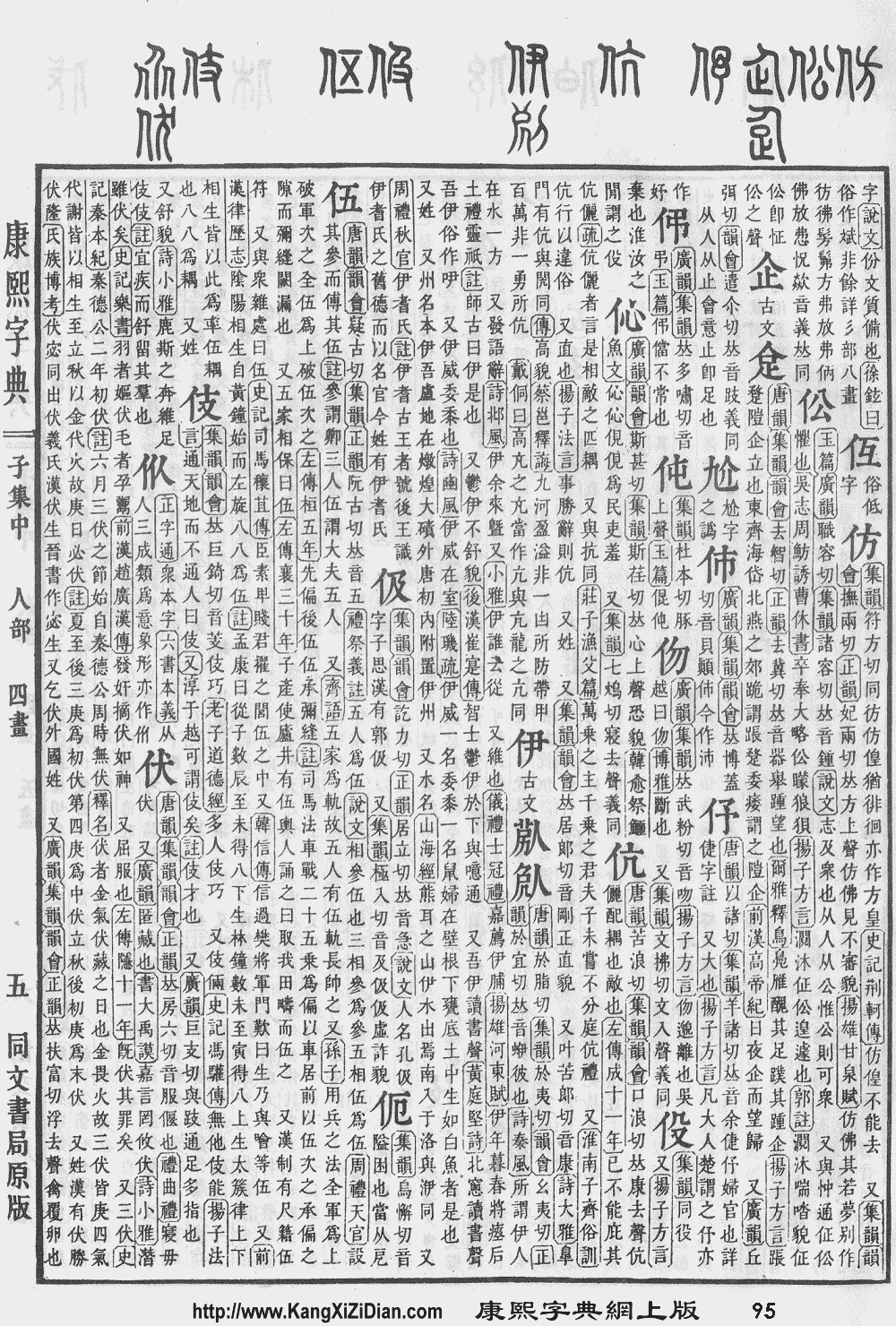
  • Kangxi Dictionary: page 95, character 4
  • Dai Kanwa Jiten: character 422
  • Dae Jaweon: page 201, character 6
  • Hanyu Da Zidian (first edition): volume 1, page 116, character 6
  • Unihan data for U+4F01

Chinese

simp. and trad.
企

Glyph origin

Historical forms of the character 企
Shang Shuowen Jiezi (compiled in Han) Liushutong (compiled in Ming)
Bronze inscriptions Oracle bone script Small seal script Transcribed ancient scripts


References:

Mostly from Richard Sears' Chinese Etymology site (authorisation),
which in turn draws data from various collections of ancient forms of Chinese characters, including:

  • Shuowen Jiezi (small seal),
  • Jinwen Bian (bronze inscriptions),
  • Liushutong (Liushutong characters) and
  • Yinxu Jiaguwen Bian (oracle bone script).

Pronunciation


Note:
  • kei1 - literary and "to stand";
  • kei2 - home.

Rime
Character 企 企
Reading # 1/2 2/2
Initial (聲) 溪 (29) 溪 (29)
Final (韻) 支 (13) 支 (11)
Tone (調) Rising (X) Departing (H)
Openness (開合) Open Open
Division (等) III III
Fanqie 丘弭切 去智切
Baxter khjeX khjieH
Reconstructions
Zhengzhang
Shangfang
/kʰˠiᴇX/ /kʰiᴇH/
Pan
Wuyun
/kʰᵚiɛX/ /kʰiɛH/
Shao
Rongfen
/kʰiɛX/ /kʰjɛH/
Edwin
Pulleyblank
/kʰjiə̆X/ /kʰiə̆H/
Li
Rong
/kʰjeX/ /kʰieH/
Wang
Li
/kʰǐeX/ /kʰǐeH/
Bernard
Karlgren
/kʰie̯X/ /kʰie̯H/
Expected
Mandarin
Reflex
qǐ qì
Expected
Cantonese
Reflex
hei2 hei3
Baxter–Sagart system 1.1 (2014)
Character 企 企
Reading # 1/2 2/2
Modern
Beijing
(Pinyin)
qǐ qǐ
Middle
Chinese
‹ khjieX › ‹ khjieH ›
Old
Chinese
/*kʰeʔ/ /*kʰeʔ-s/
English stand on tiptoe stand on tiptoe

Notes for Old Chinese notations in the Baxter–Sagart system:

* Parentheses "()" indicate uncertain presence;
* Square brackets "[]" indicate uncertain identity, e.g. *[t] as coda may in fact be *-t or *-p;
* Angle brackets "<>" indicate infix;
* Hyphen "-" indicates morpheme boundary;

* Period "." indicates syllable boundary.
Zhengzhang system (2003)
Character 企 企
Reading # 1/2 2/2
No. 10098 10099
Phonetic
component
企 企
Rime
group
支 支
Rime
subdivision
0 0
Corresponding
MC rime
跬 企
Old
Chinese
/*kʰeʔ/ /*kʰes/

Definitions

企

  1. †(alternative form 跂) to stand on one's tiptoes
  2. (Cantonese, Hakka) to stand
  3. ⁜ to expect anxiously
    企望  ―  qǐwàng  ―  to hope for
  4. ⁜ to plan
    企劃/企划  ―  qǐhuà  ―  to plan; plan
  5. (chiefly in compounds) Short for 企業/企业 (qǐyè, “enterprise”).
    國企/国企  ―  guóqǐ  ―  state-owned enterprise
    私企  ―  sīqǐ  ―  private enterprise
    政企關係/政企关系  ―  zhèng-qǐ guānxì  ―  relationship between the government and the enterprises
  6. a surname
  7. (Shanghainese) straight; steep
    搿個山坡老企個,直接看得到地垟搭,當心覅摜下去。 [Shanghainese, trad.]
    搿个山坡老企个,直接看得到地垟搭,当心覅掼下去。 [Shanghainese, simp.]
    8geq-gheq 1se-phu 6lau 5ci 0gheq 8zeq-ciq 5khoe-teq-tau 6di-yan-taq 1taon-shin 6viau 6gue-gho-ci [Wugniu]
    This slope is very steep, you can see the ground from here, be careful not to fall.

Synonyms

  • (to stand):

Compounds

References

Japanese

Kanji

企

(common “Jōyō” kanji)

  1. plan, undertake, design

Readings

Compounds

Korean

Etymology

From Middle Chinese 企 (MC khjeX|khjieH).

Hanja

Wikisource 企 (eumhun 꾀할 기 (kkoehal gi))

  1. Hanja form? of 기 (“plan”).

Compounds

References

  • 국제퇴계학회 대구경북지부 (國際退溪學會 大邱慶北支部) (2007). Digital Hanja Dictionary, 전자사전/電子字典.

Vietnamese

Han character

企: Hán Nôm readings: xí

  1. This term needs a translation to English. Please help out and add a translation, then remove the text {{rfdef}}.
This article is issued from Wiktionary. The text is licensed under Creative Commons - Attribution - Sharealike. Additional terms may apply for the media files.