伓
| ||||||||
Translingual
Han character
伓 (Kangxi radical 9, 人+4, 6 strokes, cangjie input 人一火 (OMF), four-corner 21290, composition ⿰亻不)
References
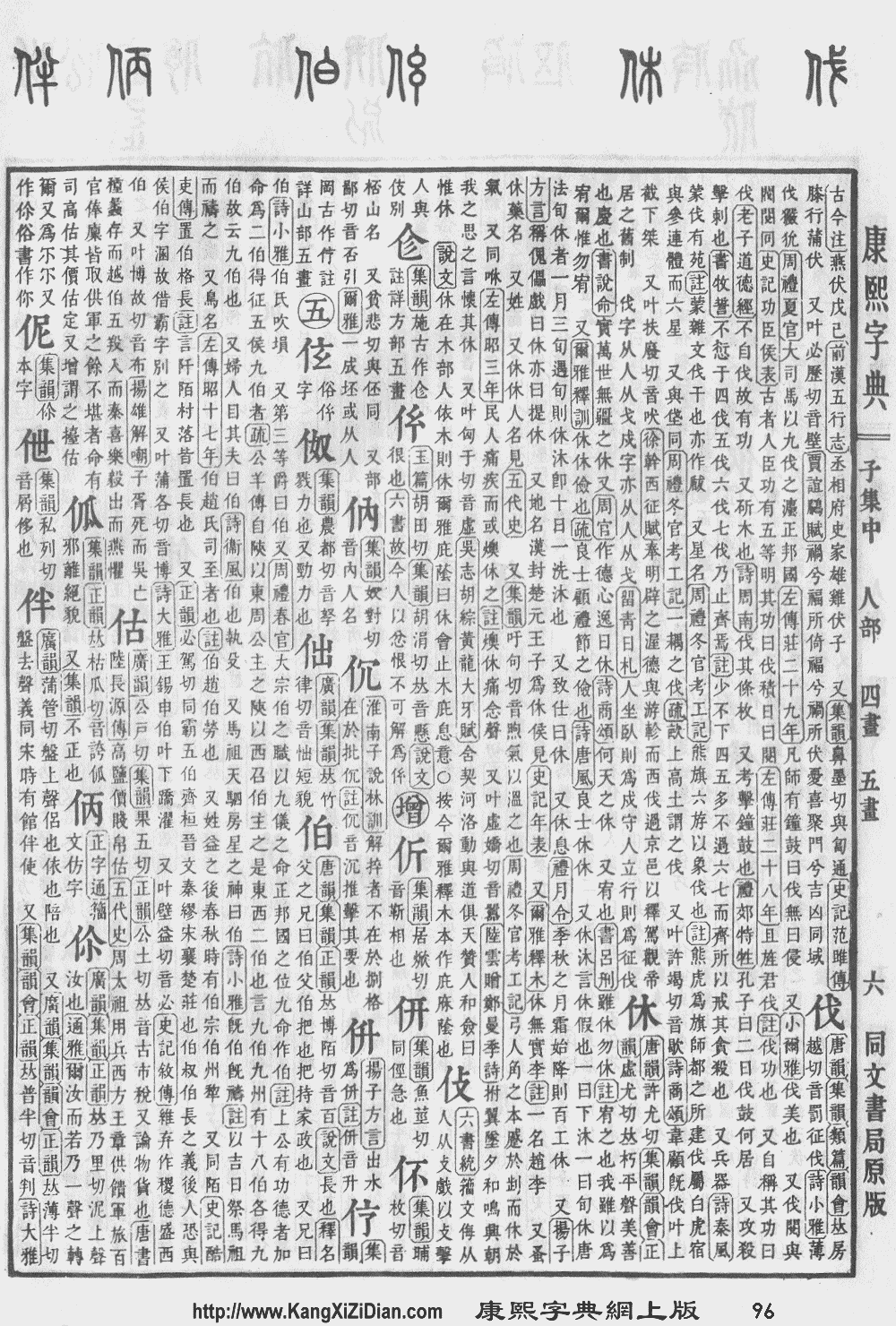
- Kangxi Dictionary: page 96, character 8
- Dai Kanwa Jiten: character 446
- Hanyu Da Zidian (first edition): volume 1, page 119, character 3
- Unihan data for U+4F13
Chinese
Etymology 1
| For pronunciation and definitions of 伓 – see 伾 (“mighty”). (This character is a variant form of 伾). |
Etymology 2
| For pronunciation and definitions of 伓 – see 不 (“no, not”). (This character is a variant form of 不). |
Etymology 3
| For pronunciation and definitions of 伓 – see 背 (“back; behind; betray”). (This character is a variant form of 背). |
Pronunciation
Definitions
伓
- (Min) not
- 伓講/伓讲 [Eastern Min] ― n̂g-gōng / [(ŋ̍-)ŋ̍²⁴²⁻⁵³ (k-)ŋouŋ³³] [Bàng-uâ-cê / IPA] ― not speak; not say; needless to say
- 伓成 [Eastern Min] ― n̂g-siàng / [(ŋ̍-)n̩²⁴²⁻⁵⁵ (s-)niaŋ⁵³] [Bàng-uâ-cê / IPA] ― inappropriate; unwilling
- 伓捌 [Eastern Min] ― n̂g-báik / [(ŋ̍-)m̩²⁴²⁻⁵³ (p-)maiʔ²⁴] [Bàng-uâ-cê / IPA] ― not know
- 去伓去? [Eastern Min, trad. and simp.]
- kó̤-n̂g-kó̤ / [kʰo²¹³⁻²¹ (ŋ̍-)ŋ̍²⁴²⁻⁵³ (kʰ-)ŋɔ²¹³] [Bàng-uâ-cê / IPA]
- Do you want to go?
Usage notes
- In Eastern Min, this particle changes its pronunciation depending on the initial of the following syllable: n̂g (velar and null initials); m̂ (labial initials); n̂ (dental initials). Orthographically, all the complementary pronunciations are written as ‹n̂g› (or ‹ng› in Maclay (1929)).
- In addition to this, all three forms have an emphatic form: îng.
- This particle is not used alone; its tone is inferred from tone sandhi patterns.
Synonyms
Dialectal synonyms of 不 (“not”) [map]
Japanese
Kanji
伓
- This term needs a translation to English. Please help out and add a translation, then remove the text
{{rfdef}}.
This article is issued from Wiktionary. The text is licensed under Creative Commons - Attribution - Sharealike. Additional terms may apply for the media files.