暴
| ||||||||
| ||||||||
Translingual
Han character
暴 (Kangxi radical 72, 日+11, 15 strokes, cangjie input 日廿金水 (ATCE), four-corner 60132, composition ⿱日㳟)
Derived characters
References
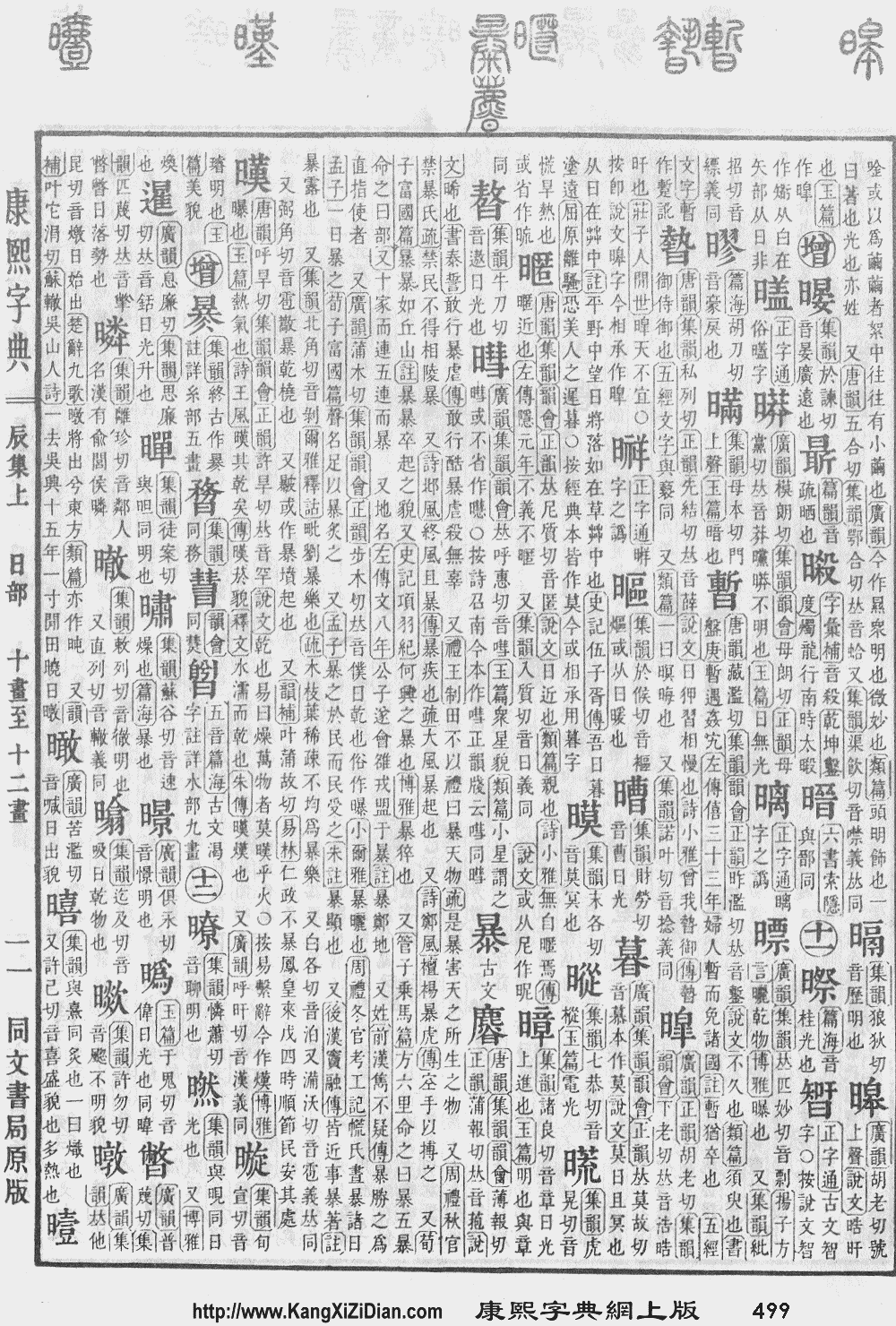
- Kangxi Dictionary: page 499, character 29
- Dai Kanwa Jiten: character 14137
- Dae Jaweon: page 868, character 35
- Hanyu Da Zidian (first edition): volume 2, page 1532, character 15
- Unihan data for U+66B4
- Unihan data for U+FA06
Chinese
Glyph origin
| Historical forms of the character 暴 | ||
|---|---|---|
| Shang | Shuowen Jiezi (compiled in Han) | Liushutong (compiled in Ming) |
| Oracle bone script | Small seal script | Transcribed ancient scripts |
 |
 |
 |
Ideogrammic compound (會意/会意) – originally (in oracle script) the antler of a buck (at bottom), indicating a savage attack. Subsequently significantly simplified and abstracted: in seal script analyzed as 日 + 出 + 廾 + 米, while in current form rather 日 + 共 + 水 (similar to unrelated 異); compare bottom component to bottom right of 様. In the Liushutong, it is analyzed as 日 + 鹿 + 火, a salivating savage deer.
Pronunciation
Definitions
暴
Compounds
- 不忙不暴
- 以暴制暴
- 以暴易亂/以暴易乱
- 以暴易暴
- 侵暴
- 凌暴
- 凶暴 (xiōngbào)
- 大風暴/大风暴
- 婚姻暴力
- 強暴/强暴 (qiángbào)
- 急風暴雨/急风暴雨 (jífēngbàoyǔ)
- 憑河暴虎/凭河暴虎
- 懆暴 (cǎobào)
- 抗暴 (kàngbào)
- 扭頭暴筋/扭头暴筋
- 振弱除暴
- 撥亂誅暴/拨乱诛暴
- 擒姦討暴/擒奸讨暴
- 操暴
- 施暴 (shībào)
- 昏暴
- 暴下
- 暴亂/暴乱 (bàoluàn)
- 暴內陵外/暴内陵外
- 暴冷
- 暴利 (bàolì)
- 暴力 (bàolì)
- 暴力滋擾/暴力滋扰
- 暴力犯罪
- 暴力革命
- 暴動/暴动 (bàodòng)
- 暴卒 (bàozú)
- 暴厲/暴厉 (bàolì)
- 暴厲之氣/暴厉之气
- 暴厲恣睢/暴厉恣睢
- 暴取豪奪/暴取豪夺
- 暴君 (bàojūn)
- 暴土 (bàotǔ)
- 暴增 (bàozēng)
- 暴室
- 暴客
- 暴富 (bàofù)
- 暴崩 (bàobēng)
- 暴師/暴师
- 暴徒 (bàotú)
- 暴忽
- 暴怒 (bàonù)
- 暴恣
- 暴懆
- 暴戾 (bàolì)
- 暴戾之氣/暴戾之气
- 暴戾恣睢
- 暴抗
- 暴投 (bàotóu)
- 暴掠
- 暴揚/暴扬
- 暴政 (bàozhèng)
- 暴斂/暴敛 (bàoliǎn)
- 暴斂橫徵/暴敛横征
- 暴斃/暴毙 (bàobì)
- 暴暴
- 暴桀
- 暴桑
- 暴橫/暴横
- 暴死 (bàosǐ)
- 暴殄 (bàotiǎn)
- 暴殄天物 (bàotiǎntiānwù)
- 暴殄輕生/暴殄轻生
- 暴民 (bàomín)
- 暴洪 (bàohóng)
- 暴漲/暴涨 (bàozhǎng)
- 暴漲暴跌/暴涨暴跌
- 暴潮
- 暴烈 (bàoliè)
- 暴燥
- 暴燥如雷
- 暴牙 (bàoyá)
- 暴病 (bàobìng)
- 暴疾
- 暴病身亡
- 暴發/暴发 (bàofā)
- 暴發戶/暴发户 (bàofāhù)
- 暴白 (bàobái)
- 暴穎/暴颖 (pok-íⁿ) (Min Nan)
- 暴脾氣/暴脾气
- 暴腮龍門/暴腮龙门
- 暴至
- 暴舉/暴举
- 暴虎
- 暴虎馮河/暴虎冯河 (bàohǔ-pínghé)
- 暴虐 (bàonüè)
- 暴虐浮躁
- 暴虐無道/暴虐无道
- 暴行
- 暴貴/暴贵
- 暴起暴落
- 暴跌 (bàodiē)
- 暴跳如雷 (bàotiào-rúléi)
- 暴躁 (bàozào)
- 暴躁如雷
- 暴醃/暴腌
- 暴雨 (bàoyǔ)
- 暴雷 (bàoléi)
- 暴雷也似
- 暴面
- 暴風/暴风 (bàofēng)
- 暴風半徑/暴风半径
- 暴風圈/暴风圈
- 暴風疾雨/暴风疾雨
- 暴風雨/暴风雨 (bàofēngyǔ)
- 暴風雪/暴风雪 (bàofēngxuě)
- 暴風驟雨/暴风骤雨 (bàofēngzhòuyǔ)
- 暴飲暴食/暴饮暴食 (bàoyǐnbàoshí)
- 暴骨
- 暴骨原野
- 栗暴 (lìbào)
- 橫征暴斂/横征暴敛
- 橫暴/横暴 (hèngbào)
- 橫科暴斂/横科暴敛
- 橫賦暴斂/横赋暴敛
- 止暴禁非
- 殘暴/残暴 (cánbào)
- 殘暴不仁/残暴不仁 (cánbàobùrén)
- 沙暴 (shābào)
- 炕暴
- 狂暴 (kuángbào)
- 狂風暴雨/狂风暴雨 (kuángfēngbàoyǔ)
- 疾風暴雨/疾风暴雨
- 磁暴 (cíbào)
- 禁暴誅亂/禁暴诛乱
- 禁暴靜亂/禁暴静乱
- 窮暴/穷暴
- 粗暴 (cūbào)
- 粗風暴雨/粗风暴雨
- 自暴自棄/自暴自弃 (zìbàozìqì)
- 荒時暴月/荒时暴月
- 藜暴
- 討惡剪暴/讨恶剪暴
- 討逆除暴/讨逆除暴
- 誅暴討逆/诛暴讨逆
- 誖暴
- 警暴 (jǐngbào)
- 變暴/变暴
- 躁暴
- 迅風暴雨/迅风暴雨
- 逆天暴物
- 逞暴
- 鈔暴/钞暴
- 鎮暴/镇暴 (zhènbào)
- 鎮暴警察/镇暴警察
- 鎮暴隊形/镇暴队形
- 除暴
- 除暴安良 (chúbào'ānliáng)
- 陵暴
- 雷暴 (léibào)
- 風暴/风暴 (fēngbào)
- 飄風暴雨/飘风暴雨
- 鬥暴/斗暴
Etymology 2
| simp. and trad. |
暴 | |
|---|---|---|
| 2nd round simp. | 𣅃 | |
Pronunciation 1
Definitions
暴
- Alternative form of 曝 (“to sun; to air in the sun”)
- 雖有天下易生之物也,一日暴之、十日寒之,未有能生者也。 [Classical Chinese, trad.]
- From: Mencius, c. 4th century BCE
- Suī yǒu tiānxià yì shēng zhī wù yě, yīrì pù zhī, shí rì hán zhī, wèiyǒu néng shēng zhě yě. [Pinyin]
- Suppose the case of the most easily growing thing in the world; if you expose it for one day to the sun, and then expose it for ten days to cold, it will not be able to grow.
虽有天下易生之物也,一日暴之、十日寒之,未有能生者也。 [Classical Chinese, simp.]
Compounds
- 一暴十寒 (yīpùshíhán)
Pronunciation 2
Descendants
Etymology 3
| simp. and trad. |
暴 | |
|---|---|---|
| 2nd round simp. | 𣅃 | |
Pronunciation 1
Compounds
- 暴暴
- 暴突
Pronunciation 2
Definitions
暴
- Used in 暴樂/暴乐 (bóluò).
Pronunciation 1
Pronunciation 2
References
- “暴”, in 漢語多功能字庫 (Multi-function Chinese Character Database), 香港中文大學 (the Chinese University of Hong Kong), 2014–
Japanese
Readings
Compounds
Inflection
| Stem forms | |||
|---|---|---|---|
| Imperfective (未然形) | 暴だろ | ぼうだろ | bō daro |
| Continuative (連用形) | 暴で | ぼうで | bō de |
| Terminal (終止形) | 暴だ | ぼうだ | bō da |
| Attributive (連体形) | 暴な | ぼうな | bō na |
| Hypothetical (仮定形) | 暴なら | ぼうなら | bō nara |
| Imperative (命令形) | 暴であれ | ぼうであれ | bō de are |
| Key constructions | |||
| Informal negative | 暴ではない 暴じゃない |
ぼうではない ぼうじゃない |
bō de wa nai bō ja nai |
| Informal past | 暴だった | ぼうだった | bō datta |
| Informal negative past | 暴ではなかった 暴じゃなかった |
ぼうではなかった ぼうじゃなかった |
bō de wa nakatta bō ja nakatta |
| Formal | 暴です | ぼうです | bō desu |
| Formal negative | 暴ではありません 暴じゃありません |
ぼうではありません ぼうじゃありません |
bō de wa arimasen bō ja arimasen |
| Formal past | 暴でした | ぼうでした | bō deshita |
| Formal negative past | 暴ではありませんでした 暴じゃありませんでした |
ぼうではありませんでした ぼうじゃありませんでした |
bō de wa arimasen deshita bō ja arimasen deshita |
| Conjunctive | 暴で | ぼうで | bō de |
| Conditional | 暴なら(ば) | ぼうなら(ば) | bō nara (ba) |
| Provisional | 暴だったら | ぼうだったら | bō dattara |
| Volitional | 暴だろう | ぼうだろう | bō darō |
| Adverbial | 暴に | ぼうに | bō ni |
| Degree | 暴さ | ぼうさ | bōsa |
References
- Matsumura, Akira, editor (2006), 大辞林 [Daijirin] (in Japanese), Third edition, Tōkyō: Sanseidō, →ISBN
- NHK Broadcasting Culture Research Institute, editor (1998), NHK日本語発音アクセント辞典 [NHK Japanese Pronunciation Accent Dictionary] (in Japanese), Tōkyō: NHK Publishing, →ISBN
Korean
Etymology 1
From Middle Chinese 暴 (MC buwk, “to expose to the sun”).
| Historical readings |
|---|
|
Pronunciation
- (SK Standard/Seoul) IPA(key): [pʰo̞k̚]
- Phonetic hangul: [폭]
Etymology 2
From a corrupted or unorthodox reading influenced by Middle Chinese 暴 (MC buwk). The original reading is 포 (po) based on Middle Chinese 暴 (MC bawH, “violent”).
Pronunciation
- (SK Standard/Seoul) IPA(key): [pʰo̞k̚]
- Phonetic hangul: [폭]
Hanja
Compounds
- 폭군 (暴君, pokgun)
- 폭도 (暴徒, pokdo)
- 폭동 (暴動, pokdong)
- 폭등 (暴騰, pokdeung)
- 폭락 (暴落, pongnak)
- 폭력 (暴力, pongnyeok)
- 폭리 (暴利, pongni)
- 폭망 (暴亡, pongmang)
- 폭발 (暴發, pokbal)
- 폭부 (暴富, pokbu)
- 폭사 (暴死, poksa)
- 폭설 (暴雪, pokseol)
- 폭식 (暴食, poksik)
- 폭압 (暴壓, pogap)
- 폭언 (暴言, pogeon)
- 폭염 (暴炎, pogyeom)
- 폭우 (暴雨, pogu)
- 폭음 (暴飮, pogeum)
- 폭정 (暴政, pokjeong)
- 폭주 (暴注, pokju)
- 폭주 (暴走, pokju)
- 폭주 (暴酒, pokju)
- 폭탈 (暴奪, poktal)
- 폭풍 (暴風, pokpung)
- 폭행 (暴行, pokhaeng)
Etymology 3
From Middle Chinese 暴 (MC bawH, “violent”).
| Historical readings |
|---|
|
Pronunciation
- (SK Standard/Seoul) IPA(key): [pʰo̞(ː)]
- Phonetic hangul: [포(ː)]
- Though still prescribed in Standard Korean, most speakers in both Koreas no longer distinguish vowel length.
Compounds
Etymology 4
From Middle Chinese 暴.
| Historical readings |
|---|
|
Hanja
Compounds
- 박락 (暴樂, bangnak)
- 박포 (暴布, bakpo)
Vietnamese
Han character
暴: Hán Việt readings: bạo (
暴: Nôm readings: bạo[1][2][3][4][6], bão[1][2][7], bộc[7][5], bậu[1], bẹo[3]
References
- Nguyễn (2014).
- Nguyễn et al. (2009).
- Trần (2004).
- Bonet (1899).
- Génibrel (1898).
- Taberd & Pigneau de Béhaine (1838).
- Hồ (1976).