凔
| ||||||||
Translingual
Han character
凔 (Kangxi radical 15, 冫+10, 12 strokes, cangjie input 戈一人戈口 (IMOIR), four-corner 38167, composition ⿰冫倉)
References
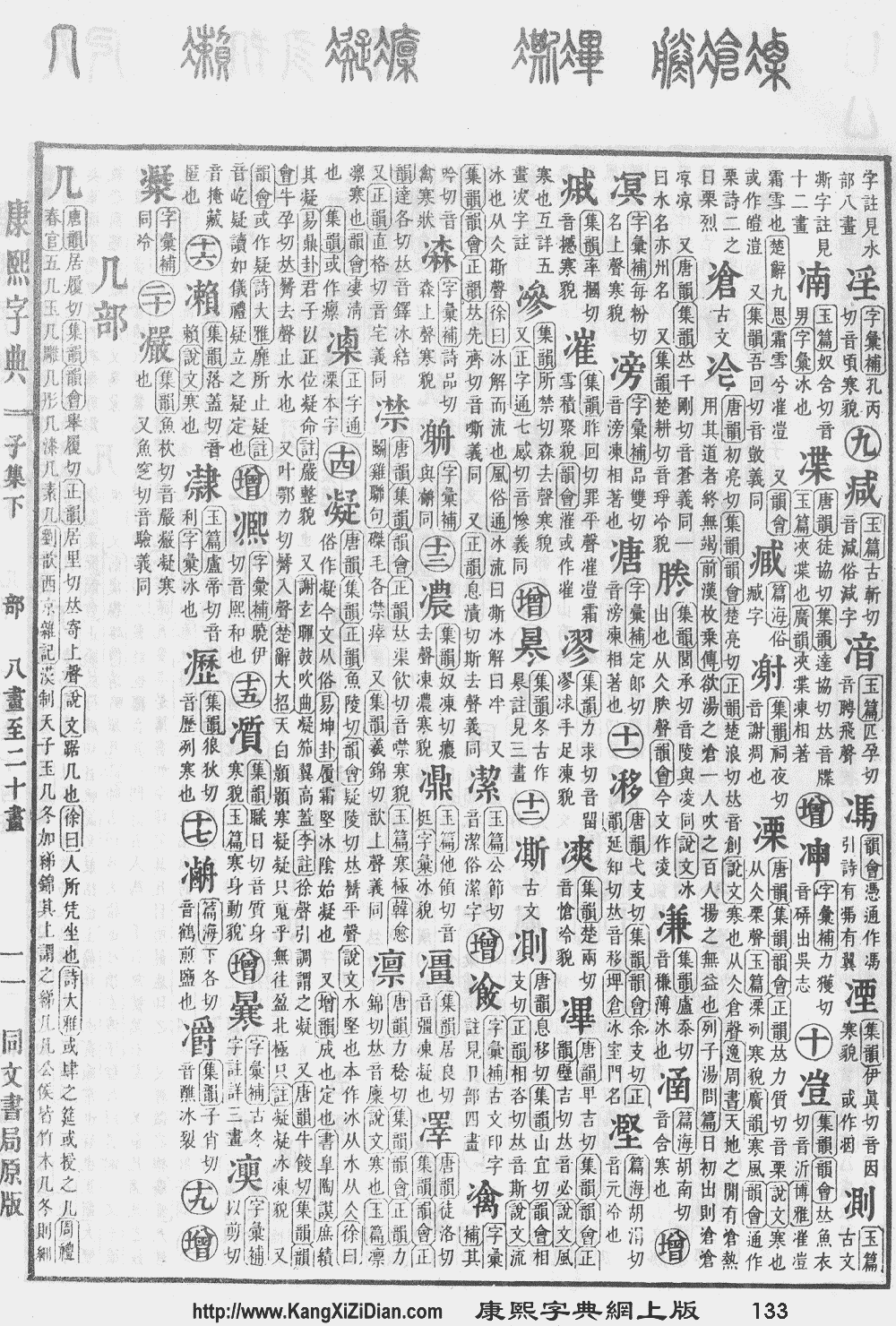
- Kangxi Dictionary: page 133, character 14
- Dai Kanwa Jiten: character 1688
- Dae Jaweon: page 297, character 22
- Hanyu Da Zidian (first edition): volume 1, page 300, character 7
- Unihan data for U+51D4
Chinese
| trad. | 凔 | |
|---|---|---|
| simp. | 𰃷 | |
| alternative forms | 滄/沧 𠖸 | |
Glyph origin
| Historical forms of the character 凔 |
|---|
| Shuowen Jiezi (compiled in Han) |
| Small seal script |
 |
Characters in the same phonetic series (倉) (Zhengzhang, 2003)
Phono-semantic compound (形聲/形声, OC *sʰaːŋ) : semantic 冫 (“ice”) + phonetic 倉 (OC *sʰaːŋ).
Etymology
Probably from 涼 (OC *ɡ·raŋ, *ɡ·raŋs, *ɡ·raŋs, “cold”). (This etymology is missing or incomplete. Please add to it, or discuss it at the Etymology scriptorium.)
Pronunciation
References
- “凔”, in 漢語多功能字庫 (Multi-function Chinese Character Database), 香港中文大學 (the Chinese University of Hong Kong), 2014–
Japanese
Kanji
凔
- This term needs a translation to English. Please help out and add a translation, then remove the text
{{rfdef}}.
Korean
Hanja
凔 • (chang) (hangeul 창, revised chang, McCune–Reischauer ch'ang)
- This term needs a translation to English. Please help out and add a translation, then remove the text
{{rfdef}}.
This article is issued from Wiktionary. The text is licensed under Creative Commons - Attribution - Sharealike. Additional terms may apply for the media files.