囋

囋 U+56CB, 囋
CJK UNIFIED IDEOGRAPH-56CB
← 囊
[U+56CA]
CJK Unified Ideographs 囌 →
[U+56CC]

Translingual

Han character

囋 (Kangxi radical 30, 口+19, 22 strokes, cangjie input 口竹山金 (RHUC), four-corner 64086, composition ⿰口贊)

References

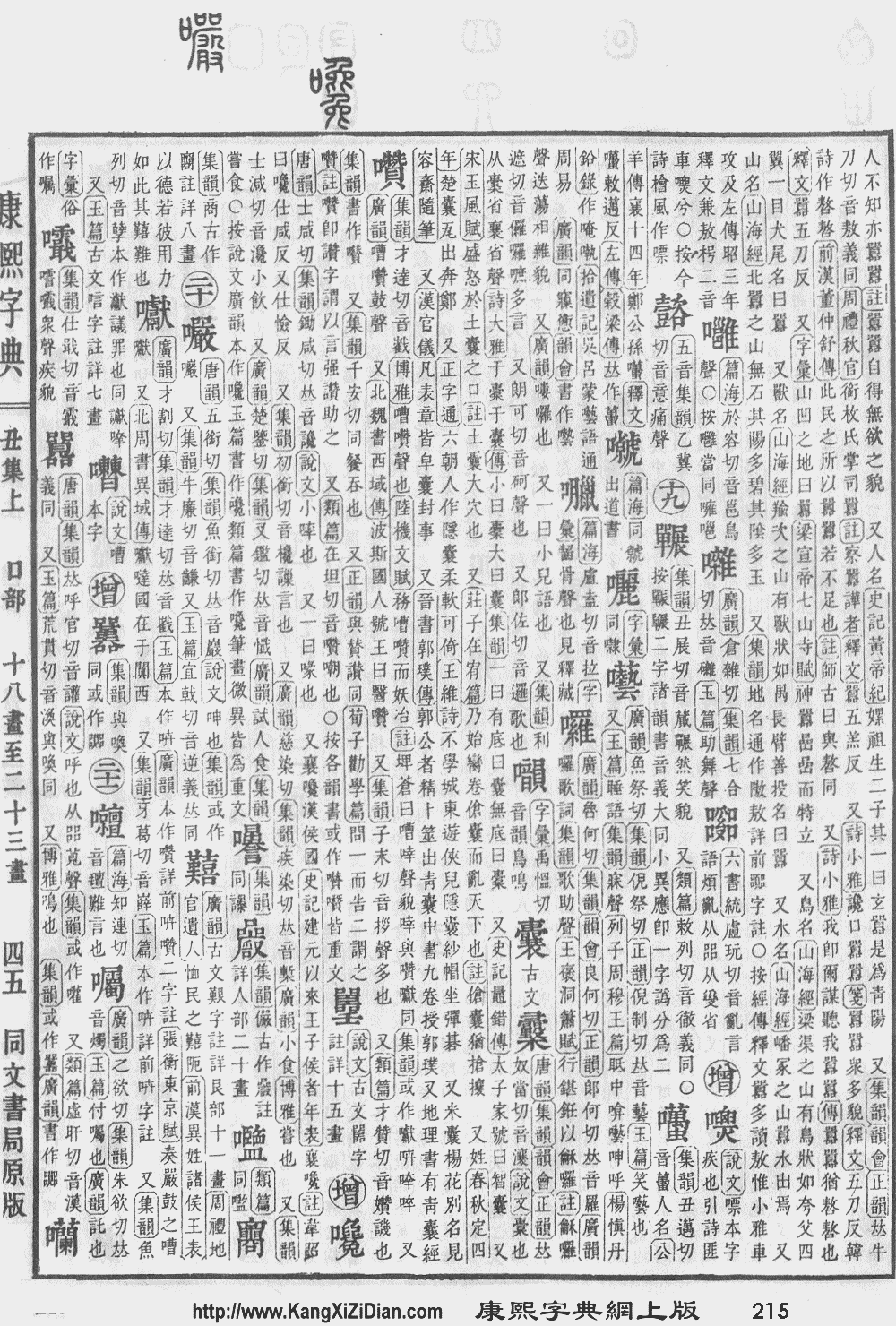
  • Kangxi Dictionary: page 215, character 16
  • Dai Kanwa Jiten: character 4634
  • Dae Jaweon: page 438, character 15
  • Hanyu Da Zidian (first edition): volume 1, page 708, character 5
  • Unihan data for U+56CB

Chinese

trad. 囋
simp. 𰉄
alternative forms
 
𡂐
囐/𰈯
啐
𠱥
𠵃
𡂐
囐/𰈯
啐
𠱥
𠵃
𠰙

Glyph origin

Pronunciation


Rime
Character 囋
Reading # 2/2
Initial (聲) 從 (15)
Final (韻) 曷 (63)
Tone (調) Checked (Ø)
Openness (開合) Open
Division (等) I
Fanqie 才割切
Baxter dzat
Reconstructions
Zhengzhang
Shangfang
/d͡zɑt̚/
Pan
Wuyun
/d͡zɑt̚/
Shao
Rongfen
/d͡zɑt̚/
Edwin
Pulleyblank
/d͡zat̚/
Li
Rong
/d͡zɑt̚/
Wang
Li
/d͡zɑt̚/
Bernard
Karlgren
/d͡zʱɑt̚/
Expected
Mandarin
Reflex
zá
Expected
Cantonese
Reflex
zaat6
Zhengzhang system (2003)
Character 囋
Reading # 2/2
No. 16543
Phonetic
component
贊
Rime
group
月
Rime
subdivision
1
Corresponding
MC rime
巀
Old
Chinese
/*zaːd/
Notes 見荀子

Definitions

囋

  1. (archaic) (Only used in 嘈囋/嘈𰉄.) noisy; clamorous

Compounds

  • 傲囋/傲𰉄
  • 嘈囋/嘈𰉄

Pronunciation


Rime
Character 囋
Reading # 1/2
Initial (聲) 從 (15)
Final (韻) 寒 (61)
Tone (調) Departing (H)
Openness (開合) Open
Division (等) I
Fanqie 徂賛切
Baxter dzanH
Reconstructions
Zhengzhang
Shangfang
/d͡zɑnH/
Pan
Wuyun
/d͡zɑnH/
Shao
Rongfen
/d͡zɑnH/
Edwin
Pulleyblank
/d͡zanH/
Li
Rong
/d͡zɑnH/
Wang
Li
/d͡zɑnH/
Bernard
Karlgren
/d͡zʱɑnH/
Expected
Mandarin
Reflex
zàn
Expected
Cantonese
Reflex
zaan6
Zhengzhang system (2003)
Character 囋
Reading # 1/2
No. 16526
Phonetic
component
贊
Rime
group
元
Rime
subdivision
1
Corresponding
MC rime
Old
Chinese
/*zaːns/
Notes 徂由祖校改巾箱本等不誤

Definitions

囋

  1. to laugh at; to tease; to sneer; to ridicule; to jeer

Etymology 3

For pronunciation and definitions of 囋 – see 讚 (“to praise; to commend; to eulogize”).
(This character is an ancient form of 讚).

Etymology 4

For pronunciation and definitions of 囋 – see 餐 (“to eat; meal; etc.”).
(This character is an ancient form of 餐).

Japanese

Kanji

囋

(uncommon “Hyōgai” kanji)

  1. This term needs a translation to English. Please help out and add a translation, then remove the text {{rfdef}}.

Readings

  • On (unclassified): さつ (satsu); ざち (zachi)
  • Kun: こえ (koe)

Korean

Hanja

囋 • (chal, chan) (hangeul 찰, 찬, revised chal, chan, McCune–Reischauer ch'al, ch'an)

  1. This term needs a translation to English. Please help out and add a translation, then remove the text {{rfdef}}.

Vietnamese

Han character

囋: Hán Nôm readings: toản

  1. This term needs a translation to English. Please help out and add a translation, then remove the text {{rfdef}}.

References

This article is issued from Wiktionary. The text is licensed under Creative Commons - Attribution - Sharealike. Additional terms may apply for the media files.