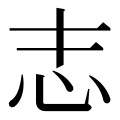
志
| ||||||||
 | ||||||||
Translingual
| Stroke order | |||
|---|---|---|---|
 | |||
Han character
志 (Kangxi radical 61, 心+3, 7 strokes, cangjie input 土心 (GP), four-corner 40331, composition ⿱士心)
Descendants
References
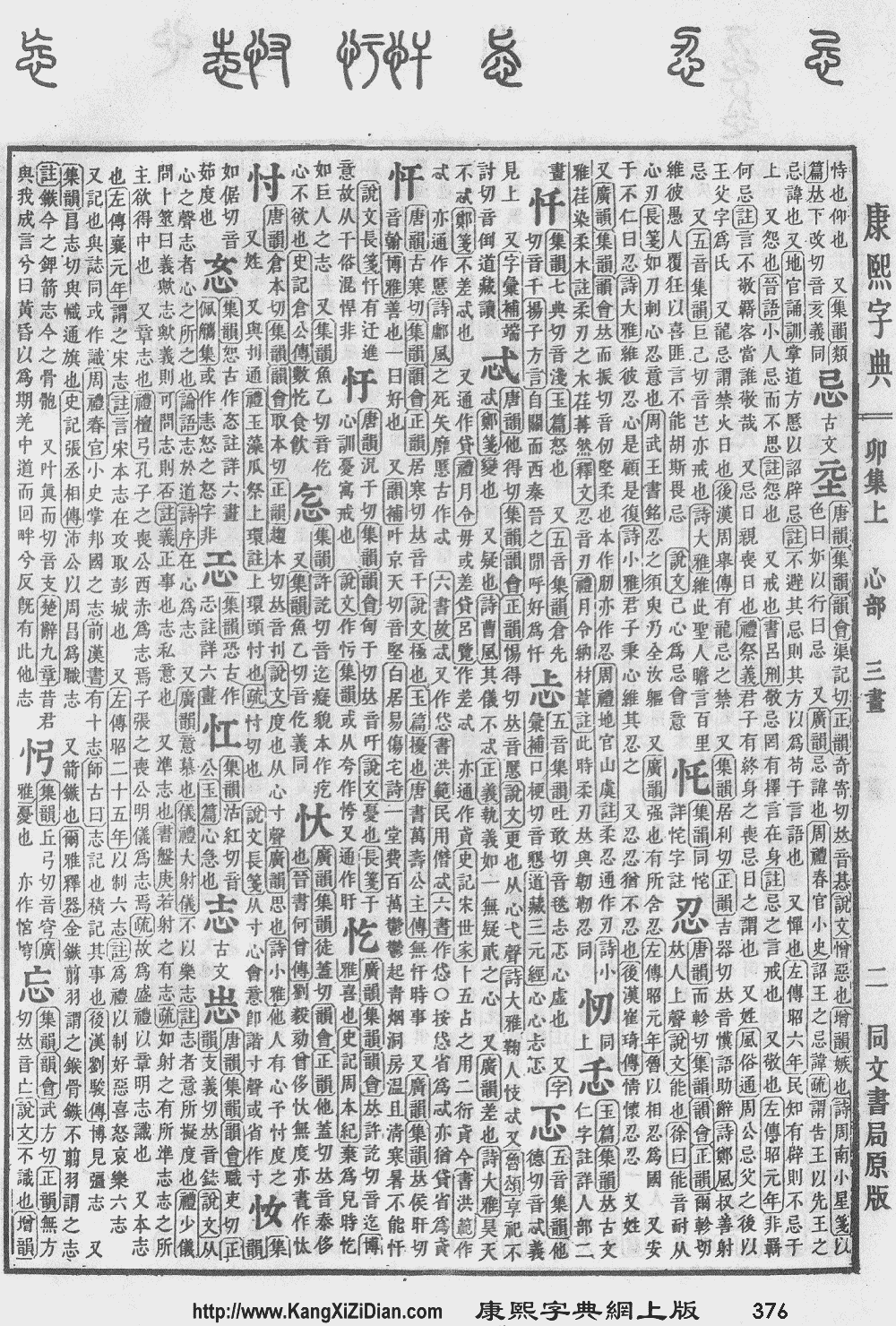
- Kangxi Dictionary: page 376, character 21
- Dai Kanwa Jiten: character 10331
- Dae Jaweon: page 703, character 7
- Hanyu Da Zidian (first edition): volume 4, page 2269, character 4
- Unihan data for U+5FD7
- Unihan data for U+2F89E
Chinese
Glyph origin
Phono-semantic compound (形聲/形声, OC *tjɯs) : phonetic 之 (OC *tjɯ) + semantic 心.
Note that the top has been simplified and is now graphically 士.
Etymology 1
| simp. and trad. |
志 | |
|---|---|---|
| alternative forms | ||
From 之 (OC *tjɯ, “to go; to proceed”) + endopassive suffix *-s, literally “what is being proceeded to” (Schuessler, 2007).
Pronunciation
Definitions
志
- will; determination; aspiration; ambition
- Alternative form of 誌 (zhì, “annals; records”)
- a surname
Compounds
- 一統志/一统志
- 三國志/三国志 (Sānguó Zhì)
- 不得志
- 二志 (èrzhì)
- 人各有志 (rén gè yǒuzhì)
- 人窮志短/人穷志短 (rénqióngzhìduǎn)
- 仁人志士 (rénrénzhìshì)
- 他志
- 以意逆志
- 伸志
- 先意承志
- 共通意志
- 凌雲壯志/凌云壮志
- 初志
- 前志 (qiánzhì)
- 創志/创志
- 勵志/励志 (lìzhì)
- 博物志
- 博聞彊志/博闻强志
- 各從其志/各从其志
- 同志 (tóngzhì, “comrade”)
- 同志合道
- 同志天地
- 同志酒吧
- 各行其志
- 喪志/丧志 (sàngzhì)
- 喬志/乔志
- 嗛志
- 地志
- 地方志 (dìfāngzhì)
- 壯志/壮志 (zhuàngzhì)
- 壯志凌雲/壮志凌云 (zhuàngzhìlíngyún)
- 壯志未酬/壮志未酬 (zhuàngzhìwèichóu)
- 夙心往志
- 大志 (dàzhì)
- 失張失志/失张失志
- 失志 (shīzhì)
- 夷堅志/夷坚志
- 奇志 (qízhì)
- 奪志/夺志
- 奮志/奋志 (fènzhì)
- 宏志
- 宣室志
- 宿志 (sùzhì)
- 寢丘之志/寝丘之志
- 專心一志/专心一志
- 專心致志/专心致志 (zhuānxīnzhìzhì)
- 小人得志 (xiǎoréndézhì)
- 尚志 (shàngzhì)
- 屈志
- 年少得志
- 張志/张志
- 彊志/强志
- 律曆志/律历志
- 得志 (dézhì)
- 心志 (xīnzhì)
- 心虔志誠/心虔志诚
- 志不可奪/志不可夺
- 志不可滿/志不可满
- 志事 (zhìshì)
- 志分
- 志向 (zhìxiàng)
- 志同心合
- 志同氣合/志同气合
- 志同道合 (zhìtóngdàohé)
- 志在千里
- 志在四方
- 志在必得 (zhìzàibìdé)
- 志堅/志坚 (zhìjiān)
- 志士 (zhìshì)
- 志士仁人 (zhìshìrénrén)
- 志大心高
- 志大才疏 (zhìdàcáishū)
- 志大才短
- 志學/志学 (zhìxué)
- 志尚
- 志工 (zhìgōng)
- 志度
- 志廣才疏/志广才疏
- 志得意滿/志得意满 (zhìdéyìmǎn)
- 志心
- 志怪 (zhìguài)
- 志怪小說/志怪小说
- 志意 (zhìyì)
- 志書/志书 (zhìshū)
- 志業/志业
- 志氣/志气 (zhìqì)
- 志氣凌雲/志气凌云
- 志沖斗牛
- 志滿氣得/志满气得
- 志留紀/志留纪 (Zhìliú Jì)
- 志略
- 志節/志节
- 志能之士
- 志行
- 志誠/志诚
- 志誠君子/志诚君子
- 志趣 (zhìqù)
- 志足意滿/志足意满
- 志量
- 志願/志愿 (zhìyuàn)
- 志願兵/志愿兵 (zhìyuànbīng)
- 志願卡/志愿卡
- 志願書/志愿书 (zhìyuànshū)
- 志願軍/志愿军 (Zhìyuànjūn)
- 志驕意滿/志骄意满
- 志高氣揚/志高气扬
- 惑志 (huòzhì)
- 情志 (qíngzhì)
- 意得志滿/意得志满
- 意志 (yìzhì, “will”) ( purpose)
- 意志消沉
- 意滿志得/意满志得
- 懷憂喪志/怀忧丧志
- 才疏志大
- 抗志
- 拔山志
- 摧志屈道
- 方志 (fāngzhì)
- 方言志
- 明志 (míngzhì)
- 有志 (yǒuzhì)
- 有志之士 (yǒuzhìzhīshì)
- 有志者事竟成 (yǒu zhì zhě shì jìng chéng)
- 有志難酬/有志难酬
- 有志竟成 (“where there's a will, there's a way”)
- 本志 (běnzhì)
- 未竟之志
- 材疏志大
- 東山之志/东山之志
- 桑蓬之志
- 楊志賣刀/杨志卖刀
- 歷代志/历代志 (Lìdàizhì)
- 民志 (mínzhì)
- 氣充志定/气充志定
- 氣充志驕/气充志骄
- 氣滿志得/气满志得
- 氣滿志驕/气满志骄
- 氣驕志滿/气骄志满
- 沒志氣/没志气
- 沒志行/没志行
- 沒意志/没意志
- 洗心革志
- 海國圖志/海国图志
- 清芬志
- 溺志
- 漢志/汉志
- 澹泊明志
- 玩物喪志/玩物丧志 (wànwùsàngzhì)
- 甘貧守志/甘贫守志
- 用志不分
- 異志/异志 (yìzhì)
- 眾志成城/众志成城 (zhòngzhìchéngchéng)
- 矢志 (shǐzhì)
- 砥志礪行/砥志砺行
- 碧雞漫志/碧鸡漫志
- 神分志奪/神分志夺
- 神志 (shénzhì)
- 稱心滿志/称心满志
- 立志 (lìzhì)
- 第一志願/第一志愿 (dì-yī zhìyuàn)
- 箕山之志
- 篤志/笃志 (dǔzhì)
- 篤志好學/笃志好学
- 篤志愛古/笃志爱古
- 素志 (sùzhì)
- 終焉之志/终焉之志
- 縣志/县志 (xiànzhì)
- 繼志/继志
- 繼志述事/继志述事
- 續通志/续通志
- 翰墨志
- 聊齋志異/聊斋志异
- 職志/职志 (zhízhì)
- 肆志
- 胡志明市 (Hú Zhìmíng Shì)
- 胸無大志/胸无大志 (xiōngwúdàzhì)
- 自由意志 (zìyóu yìzhì)
- 致志 (zhìzhì)
- 著志
- 華志/华志
- 華陽國志/华阳国志
- 蓄志
- 蕩志/荡志
- 藝文志/艺文志 (yìwénzhì)
- 螻蟻得志/蝼蚁得志
- 行志
- 覬覦之志/觊觎之志
- 詩以言志/诗以言志
- 誓無二志/誓无二志
- 豪情壯志/豪情壮志
- 貴志/贵志
- 賦詩言志/赋诗言志
- 蹈厲之志/蹈厉之志
- 躊躇滿志/踌躇满志 (chóuchúmǎnzhì)
- 輿地志/舆地志
- 輿志/舆志
- 辨志 (biànzhì)
- 通志
- 逞志
- 道同志合
- 道合志同
- 遠志/远志 (yuǎnzhì)
- 遜志時敏/逊志时敏
- 遺志/遗志 (yízhì)
- 銳志/锐志
- 降志辱身
- 雄心壯志/雄心壮志 (xióngxīnzhuàngzhì)
- 雜志/杂志 (zázhì)
- 青雲志/青云志
- 風雲之志/风云之志
- 食貨志/食货志
- 養志/养志
- 騁志/骋志
- 體物寫志/体物写志
- 高世志
- 高志
- 高昂鬥志/高昂斗志
- 鬥志/斗志 (dòuzhì)
- 鬥志昂揚/斗志昂扬 (dòuzhì'ángyáng)
- 鬥志高昂/斗志高昂
- 鴻鵠之志/鸿鹄之志 (hónghúzhīzhì)
- 鴻鵠大志/鸿鹄大志
- 齎志沒地/赍志没地
- 齎志而歿/赍志而殁
Descendants
Etymology 2
| For pronunciation and definitions of 志 – see 誌 (“records, annals; to memorize; etc.”). (This character is the simplified form of 誌). |
Notes:
|
Japanese
Readings
Compounds
Etymology 1
| Kanji in this term |
|---|
| 志 |
| こころざし Grade: 5 |
| kun’yomi |
The 連用形 (ren'yōkei, “continuative or stem form”) of verb 志す (kokorozasu, “to intend to do something, to aspire to do something”).
Usage notes
This is one of only four everyday kanji with a five-mora reading, and one of only two nouns. The only other kanji with five-mora readings are 承 in the verb 承る (uketamawaru), 慮 in the verb 慮る (omonpakaru), and 詔 (mikotonori). No kanji in common use has a six- or more mora reading. (Also see 謀 (hakarigoto))
The unusually long reading is due to two factors: 志 (kokorozashi) is a nominalization of the verb 志す (kokorozasu), which has a long reading (four morae, kokoroza-su), which itself is a noun-verb compound, 心指す (kokorozasu). The nominalization absorbs the okurigana, hence increasing the reading by one mora, yielding 4+1=5, or more finely 3+(1+1)=5 (compare common 話 (hanashi) 2+1=3, from 話す (hanasu)).
Etymology 2
Various name readings.
Proper noun
志 • (Yuki)
- a female given name
志 • (Koko)
- a female given name
志 • (Kokoro)
- a female given name
志 • (Nozomi)
- a female given name
志 • (Shii)
- a female given name
志 • (Nozomu)
- a male given name
志 • (Shi)
- a surname
References
- Matsumura, Akira, editor (2006), 大辞林 [Daijirin] (in Japanese), Third edition, Tōkyō: Sanseidō, →ISBN
Korean
Compounds
- 의지 (意志, uiji, “determination”)