忍
| ||||||||
| ||||||||
Translingual
| Traditional | 忍 |
|---|---|
| Simplified | 忍 |
| Japanese | 忍 |
| Korean | 忍 |
Han character
忍 (Kangxi radical 61, 心+3, 7 strokes, cangjie input 尸戈心 (SIP), four-corner 17332, composition ⿱刃心)
Derived characters
References
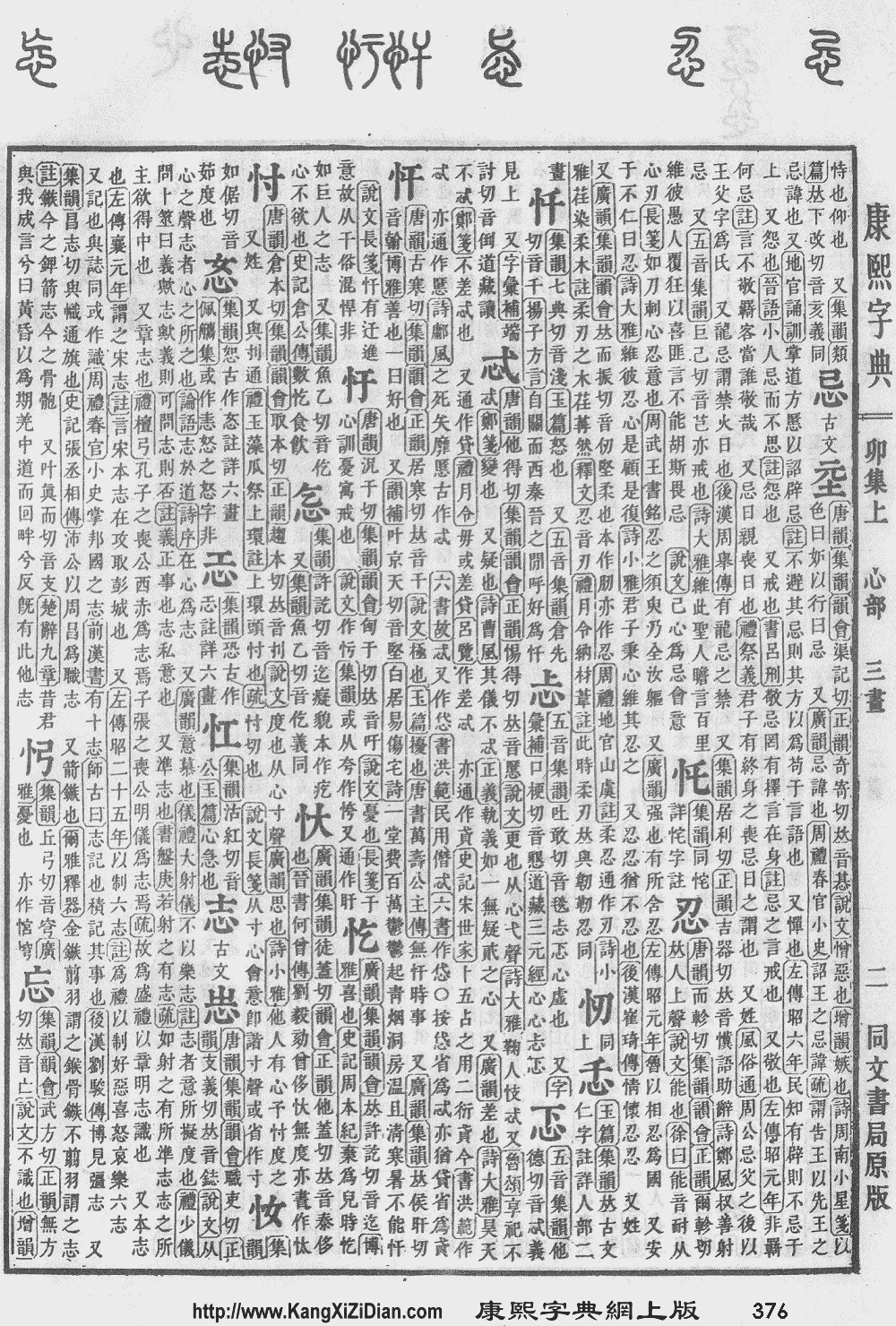
- Kangxi Dictionary: page 376, character 4
- Dai Kanwa Jiten: character 10312
- Dae Jaweon: page 702, character 12
- Hanyu Da Zidian (first edition): volume 4, page 2271, character 3
- Unihan data for U+5FCD
- Unihan data for U+2F89D
Chinese
| trad. | 忍 | |
|---|---|---|
| simp. # | 忍 | |
Glyph origin
| Historical forms of the character 忍 | |||
|---|---|---|---|
| Warring States | Shuowen Jiezi (compiled in Han) | ||
| Bronze inscriptions | Chu slip and silk script | Qin slip script | Small seal script |
 |
 |
 |
 |
Characters in the same phonetic series (刃) (Zhengzhang, 2003)
Phono-semantic compound (形聲/形声, OC *njɯnʔ) : phonetic 刃 (OC *njɯns, “blade”) + semantic 心 (“heart”).
Etymology
- “to bear, to endure, to suffer”
- From Sino-Tibetan; cognate with Tibetan ཉན་པ (nyan pa, “to be able”) (Schuessler (2007))
- “cruel”
- From Sino-Tibetan; cognate with Tibetan གཉན་པ (gnyan pa, “cruel, fierce, severe”) (ibid.).
Pronunciation
Definitions
忍
- to endure; to bear; to suffer
- 人皆有所不忍,達之於其所忍,仁也。人皆有所不為,達之於其所為,義也。 [Classical Chinese, trad.]
- From: Mencius, c. 4th century BCE, translated based on James Legge's version
- Rén jiē yǒu suǒbùrěn, dá zhī yú qí suǒrěn, rén yě. Rén jiē yǒu suǒbùwéi, dá zhī yú qí suǒwéi, yì yě. [Pinyin]
- All men have some things which they cannot bear; extend that feeling to what they can bear, and humaneness will be the result. All men have some things which they will not do; extend that feeling to the things which they do, and righteousness will be the result.
人皆有所不忍,达之于其所忍,仁也。人皆有所不为,达之于其所为,义也。 [Classical Chinese, simp.]
- to forbear
- 子曰:「巧言亂德,小不忍則亂大謀。」 [Classical Chinese, trad.]
- From: The Analects of Confucius, c. 475 – 221 BCE
- Zǐyuē: “Qiǎoyán luàn dé, xiǎobùrěn zé luàn dàmóu.” [Pinyin]
- The Master said, "Crafty words confound virtue. Want of forbearance in small matters confounds great plans."
子曰:「巧言乱德,小不忍则乱大谋。」 [Classical Chinese, simp.]
- to have the heart to; to be hardhearted enough to
- (literary) cruel; callous
- 維此良人、弗求弗迪。
- From: The Classic of Poetry, c. 11th – 7th centuries BCE, translated based on James Legge's version
- Wéi cǐ liángrén, fúqiú fúdí.
Wéi bǐ rěnxīn, shìgù shìfù. [Pinyin] - Here is a good man, but he is not sought out nor employed.
There is a cruel-hearted man, and he is thought of and promoted once and again.
維彼忍心、是顧是復。 [Pre-Classical Chinese, trad.]
维此良人、弗求弗迪。
维彼忍心、是顾是复。 [Pre-Classical Chinese, simp.]
Synonyms
- (to endure):
- (to have the heart to): 忍心 (rěnxīn)
- (cruel):
- 兇惡/凶恶 (xiōng'è)
- 兇殘/凶残 (xiōngcán)
- 兇狠/凶狠 (xiōnghěn)
- 兇猛/凶猛 (xiōngměng)
- 兇險/凶险 (xiōngxiǎn)
- 凶暴 (xiōngbào)
- 厲害/厉害 (lìhài)
- 嚴酷/严酷 (yánkù)
- 強暴/强暴 (qiángbào)
- 惡勢/恶势 (Xiamen Hokkien)
- 惡毒/恶毒 (èdú)
- 惡狠狠/恶狠狠 (èhěnhěn)
- 慘/惨 (cǎn) (literary, or in compounds)
- 暴力 (bàolì)
- 暴戾 (bàolì) (literary)
- 暴虐 (bàonüè)
- 暴躁 (bàozào)
- 殘/残 (cán) (literary,or in compounds)
- 殘忍/残忍 (cánrěn)
- 殘暴/残暴 (cánbào)
- 殘酷/残酷 (cánkù)
- 毒辣 (dúlà)
- 烏心/乌心 (Min Nan)
- 狠心 (hěnxīn)
- 狠毒 (hěndú)
- 狠狠 (hěnhěn)
- 猙獰/狰狞 (zhēngníng)
- 粗殘/粗残 (Xiamen Hokkien)
- 辣 (là)
- 酷烈 (kùliè)
- 野蠻/野蛮 (yěmán)
- 陰功/阴功 (jam1 gung1) (Cantonese)
- 險惡/险恶 (xiǎn'è)
- 黑心 (hēixīn)
Compounds
- 不忍 (bùrěn)
- 不忍下手
- 不忍人之心 (bù rěn rén zhī xīn)
- 不忍坐視/不忍坐视 (bùrěnzuòshì)
- 不忍心
- 不忍言 (bùrěnyán)
- 不忍釋手/不忍释手
- 動心忍性/动心忍性
- 包羞忍恥/包羞忍耻
- 含垢忍恥/含垢忍耻
- 含垢忍辱
- 含悲忍淚/含悲忍泪
- 含羞忍辱
- 吞聲忍氣/吞声忍气
- 吞聲忍讓/吞声忍让
- 堅忍/坚忍 (jiānrěn)
- 堅忍不拔/坚忍不拔
- 容忍 (róngrěn)
- 弘忍
- 強忍/强忍 (qiǎngrěn)
- 忍不住 (rěnbùzhù)
- 忍俊不禁 (rěnjùnbùjīn)
- 忍冬 (rěndōng)
- 忍受 (rěnshòu)
- 忍垢
- 忍垢偷生
- 忍尤含詬/忍尤含诟
- 忍心 (rěnxīn)
- 忍心害理
- 忍性
- 忍恥偷生/忍耻偷生
- 忍恥含垢/忍耻含垢
- 忍恥含羞/忍耻含羞
- 忍氣吞聲/忍气吞声 (rěnqìtūnshēng)
- 忍無可忍/忍无可忍 (rěnwúkěrěn)
- 忍田
- 忍痛 (rěntòng)
- 忍石
- 忍者 (rěnzhě)
- 忍者龜/忍者龟
- 忍耐 (rěnnài)
- 忍術/忍术 (rěnshù)
- 忍讓/忍让 (rěnràng)
- 忍辱 (rěnrǔ)
- 忍辱偷生 (rěnrǔtōushēng)
- 忍辱含垢
- 忍辱含羞
- 忍辱求全
- 忍辱負重/忍辱负重 (rěnrǔfùzhòng)
- 忍飢挨餓/忍饥挨饿
- 忍饑受渴/忍饥受渴
- 忍饑受餓/忍饥受饿
- 忮忍
- 愛不忍釋/爱不忍释
- 慘不忍睹/惨不忍睹 (cǎnbùrěndǔ)
- 慘不忍聞/惨不忍闻
- 於心不忍/于心不忍
- 於心何忍/于心何忍 (yúxīnhérěn)
- 殘忍/残忍 (cánrěn)
- 氣忍聲吞/气忍声吞
- 濡忍
- 猜忍
- 痛不堪忍
- 百忍
- 目不忍睹
- 目不忍視/目不忍视
- 相忍為國/相忍为国
- 聲吞氣忍/声吞气忍
- 能忍自安
- 落忍
- 隱忍/隐忍 (yǐnrěn)
- 難以忍受/难以忍受
- 難忍/难忍 (nánrěn)
Descendants
- → Vietnamese: nhịn
References
- “忍”, in 漢語多功能字庫 (Multi-function Chinese Character Database), 香港中文大學 (the Chinese University of Hong Kong), 2014–
Japanese
| Shinjitai | 忍 | |
| Kyūjitai [1] |
忍󠄁 忍+ 󠄁?(Adobe-Japan1) |
 |
| 忍󠄄 忍+ 󠄄?(Hanyo-Denshi) (Moji_Joho) | ||
| The displayed kanji may be different from the image due to your environment. See here for details. | ||
Readings
Compounds
- 勘忍 (kannin)
- 堅忍 (kennin)
- 堅忍不抜 (kenninfubatsu)
- 堪え忍ぶ (taeshinobu)
- 堪忍 (kannin)
- 堪忍袋 (kanninbukuro)
- 忍ばせる (shinobaseru)
- 忍びやか (shinobiyaka)
- 忍び入る (shinobiiru)
- 忍び声 (shinobigoe)
- 忍び寄る (shinobiyoru)
- 忍び泣き (shinobinaki)
- 忍び泣く (shinobinaku)
- 忍び笑い (shinobiwarai)
- 忍び足 (shinobiashi)
- 忍び込む (shinobikomu)
- 忍び逢い (shinobiai)
- 忍び難い (shinobigatai)
- 忍び音 (shinobine)
- 忍ぶ (shinobu)
- 忍従 (ninjū)
- 忍法 (ninpō)
- 忍者 (ninja)
- 忍耐 (nintai)
- 忍耐力 (nintairyoku)
- 忍耐強い (nintaizuyoi)
- 忍苦 (ninku)
- 忍術 (ninjutsu)
- 恋い忍ぶ (koishinobu)
- 押忍 (osu), 押忍 (ossu)
- 残忍 (zannin)
- 耐え忍ぶ (taeshinobu)
- 隠忍 (innin)
Etymology
| Kanji in this term |
|---|
| 忍 |
| しの(ぶ) Grade: S |
| kun’yomi |
References
- “忍”, in 漢字ぺディア (Kanjipedia) (in Japanese), 日本漢字能力検定協会, 2015–2024
Korean
Etymology
(This etymology is missing or incomplete. Please add to it, or discuss it at the Etymology scriptorium. Particularly: “Middle Korean readings, if any”)
Pronunciation
- (SK Standard/Seoul) IPA(key): [in]
- Phonetic hangul: [인]
Hanja
Wikisource 忍 (eumhun 참다 인 (chamda in))
- This term needs a translation to English. Please help out and add a translation, then remove the text
{{rfdef}}.
Vietnamese
This article is issued from Wiktionary. The text is licensed under Creative Commons - Attribution - Sharealike. Additional terms may apply for the media files.