抓
| ||||||||
Translingual
Han character
抓 (Kangxi radical 64, 手+4, 7 strokes, cangjie input 手竹中人 (QHLO) or 難手竹中人 (XQHLO), four-corner 52030, composition ⿰扌爪)
References
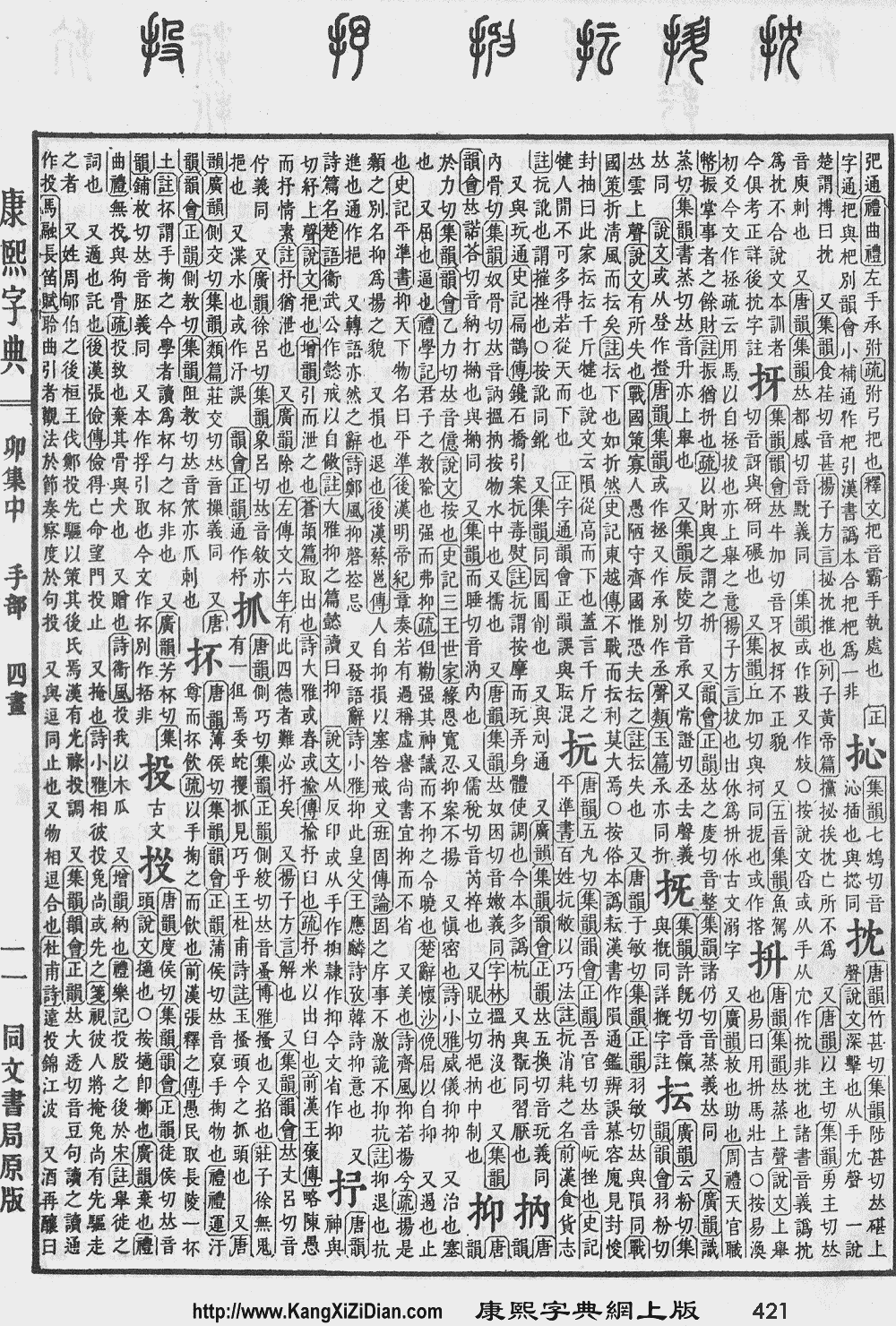
- Kangxi Dictionary: page 421, character 11
- Dai Kanwa Jiten: character 11885
- Dae Jaweon: page 768, character 11
- Hanyu Da Zidian (first edition): volume 3, page 1839, character 1
- Unihan data for U+6293
Chinese
| trad. | 抓 | |
|---|---|---|
| simp. # | 抓 | |
Glyph origin
Etymology
(This etymology is missing or incomplete. Please add to it, or discuss it at the Etymology scriptorium. Particularly: “Is /-ua/ irregular? How did it develop?”)
Pronunciation
Definitions
抓
Synonyms
- (to grab): (colloquial) 抄 (chāo)
- (to scratch):
Dialectal synonyms of 搔 (“to scratch (an itch)”) [map]
| Variety | Location | Words |
|---|---|---|
| Classical Chinese | 搔 | |
| Formal (Written Standard Chinese) | 搔, 撓 | |
| Mandarin | Taiwan | 搔, 抓 |
| Cantonese | Guangzhou | 𢯎, 搲 |
| Hong Kong | 𢯎, 搲 | |
| Taishan | 搲 | |
| Hakka | Meixian | 搲 |
| Miaoli (N. Sixian) | 爪 | |
| Pingtung (Neipu; S. Sixian) | 爪 | |
| Hsinchu County (Zhudong; Hailu) | 爪 | |
| Taichung (Dongshi; Dabu) | 爪 | |
| Hsinchu County (Qionglin; Raoping) | 爪 | |
| Yunlin (Lunbei; Zhao'an) | 爪 | |
| Eastern Min | Fuzhou | 扒 |
| Southern Min | Xiamen | 扒 |
| Quanzhou | 扒 | |
| Zhangzhou | 扒 | |
| Tainan | 扒 | |
| Singapore (Hokkien) | 扒 | |
| Manila (Hokkien) | 扒 | |
| Shantou (Chaoyang) | 扒 | |
| Wu | Shanghai | 抓 |
| Suzhou | 抓 | |
| Wenzhou | 抓 | |
- (to be responsible for): 主管 (zhǔguǎn)
- (to attract):
- (to catch):
Dialectal synonyms of 捉 (“to catch; to capture”) [map]
| Variety | Location | Words |
|---|---|---|
| Formal (Written Standard Chinese) | 捉, 抓, 捕, 捕捉 | |
| Mandarin | Taiwan | 抓, 捉 |
| Malaysia | 捉 | |
| Singapore | 捉, 抓 | |
| Cantonese | Guangzhou | 捉 |
| Hong Kong | 捉 | |
| Kuala Lumpur (Guangfu) | 捉 | |
| Singapore (Guangfu) | 捉 | |
| Hakka | Meixian | 捉 |
| Miaoli (N. Sixian) | 捉 | |
| Pingtung (Neipu; S. Sixian) | 捉 | |
| Hsinchu County (Zhudong; Hailu) | 捉 | |
| Taichung (Dongshi; Dabu) | 捉 | |
| Hsinchu County (Qionglin; Raoping) | 捉 | |
| Yunlin (Lunbei; Zhao'an) | 捉 | |
| Southern Min | Xiamen | 掠 |
| Xiamen (Tong'an) | 掠 | |
| Quanzhou | 掠 | |
| Zhangzhou | 掠 | |
| Zhangzhou (Longhai) | 掠 | |
| Tainan | 掠 | |
| Penang (Hokkien) | 掠 | |
| Singapore (Hokkien) | 掠 | |
| Manila (Hokkien) | 掠 | |
| Chaozhou | 掠 | |
| Raoping | 掠 | |
| Shantou | 掠 | |
| Singapore (Teochew) | 掠 | |
| Wenchang | 掠 | |
| Qionghai | 掠 | |
| Wu | Shanghai | 捉 |
| Suzhou | 捉 | |
| Hangzhou | 抲 | |
| Shaoxing | 抲 | |
| Ningbo | 抲 | |
- (to arrest):
- 俘獲/俘获 (fúhuò)
- 俘虜/俘虏 (fúlǔ)
- 囚俘 (qiúfú) (literary)
- 抓獲/抓获 (zhuāhuò)
- 拘捕 (jūbǔ)
- 拿獲/拿获 (náhuò)
- 捉 (zhuō)
- 捉拿 (zhuōná)
- 捕捉 (bǔzhuō)
- 捕獲/捕获 (bǔhuò)
- 搜捕 (sōubǔ)
- 搏 (bó) (literary, or in compounds)
- 擒拿 (qínná)
- 擒獲/擒获 (qínhuò)
- 攝/摄 (literary, or in compounds)
- 查獲/查获 (cháhuò)
- 緝拿/缉拿 (jīná)
- 緝捕/缉捕 (jībǔ)
- 緝獲/缉获 (qìhuò) (literary)
- 被捕 (bèibǔ) (to be arrested)
- 被逮 (bèidǎi) (to be arrested)
- 訪拿/访拿 (fǎngná) (literary)
- 訪緝/访缉 (fǎngjī) (literary)
- 跴緝/跴缉 (cǎijī) (literary)
- 踩緝/踩缉 (cǎijī) (literary)
- 巡捕 (xúnbǔ)
- 追拿 (zhuīná)
- 追捕 (zhuībǔ)
- 追擊/追击 (zhuījī) (to pursue and attack)
- 追索 (zhuīsuǒ) (literary)
- 追緝/追缉 (zhuījī)
- 逮捕
Dialectal synonyms of 逮捕 (“to arrest”) [map]
| Variety | Location | Words |
|---|---|---|
| Formal (Written Standard Chinese) | 逮捕, 拘捕, 捕捉, 緝捕, 捉拿 | |
| Mandarin | Beijing | 逮, 抓 |
| Taiwan | 捉, 抓 | |
| Singapore | 捉, 抓 | |
| Cantonese | Guangzhou | 拉 |
| Hong Kong | 拉 | |
| Singapore (Guangfu) | 拉 | |
| Hakka | Meixian | 捉 |
| Southern Min | Xiamen | 緝掠 |
| Quanzhou | 網, 網董 | |
| Tainan | 掠 | |
| Penang (Hokkien) | 掠 | |
| Singapore (Hokkien) | 掠 | |
| Manila (Hokkien) | 掠 | |
| Singapore (Teochew) | 掠 | |
| Wu | Shanghai | 捕 |
| Ningbo | 揢 | |
| Wenzhou | 拔 | |
Compounds
- 一把抓 (yībǎzhuā)
- 抓一把
- 抓乖
- 抓乖賣俏/抓乖卖俏
- 抓住 (zhuāzhù)
- 抓哏
- 抓大頭/抓大头
- 抓子兒/抓子儿
- 抓尋/抓寻
- 抓尖兒/抓尖儿
- 抓尖要強/抓尖要强
- 抓工夫
- 抓弄
- 抓彩
- 抓抓掗掗/抓抓挜挜
- 抓抓撓撓/抓抓挠挠
- 抓撓/抓挠 (zhuānao)
- 抓撓兒/抓挠儿
- 抓權/抓权
- 抓牢
- 抓狂 (zhuākuáng)
- 抓癢/抓痒 (zhuāyǎng)
- 抓瞎 (zhuāxiā)
- 抓破臉兒/抓破脸儿
- 抓碴兒/抓碴儿
- 抓緊/抓紧 (zhuājǐn)
- 抓耳搔腮
- 抓耳撓腮/抓耳挠腮
- 抓膘
- 抓舉/抓举 (zhuājǔ)
- 抓著癢處/抓著痒处
- 抓藥/抓药 (zhuāyào)
- 抓角兒/抓角儿
- 抓辮子/抓辫子 (zhuābiànzi)
- 抓週/抓周 (zhuāzhōu)
- 抓頭挖耳/抓头挖耳
- 抓髻
- 抓鬮/抓阄 (zhuājiū)
- 拐抓
- 搔耳抓腮
- 搔首抓耳
- 照方兒抓/照方儿抓
- 瞎抓 (xiāzhuā)
- 隔靴抓癢/隔靴抓痒
- 飛抓/飞抓
- 鷹抓燕雀/鹰抓燕雀
Japanese
Kanji
抓
- This term needs a translation to English. Please help out and add a translation, then remove the text
{{rfdef}}.
Korean
Hanja
抓 • (jo) (hangeul 조)
- This term needs a translation to English. Please help out and add a translation, then remove the text
{{rfdef}}.
Vietnamese
This article is issued from Wiktionary. The text is licensed under Creative Commons - Attribution - Sharealike. Additional terms may apply for the media files.