擅
| ||||||||
Translingual
Han character
擅 (Kangxi radical 64, 手+13, 16 strokes, cangjie input 手卜田一 (QYWM), four-corner 50016, composition ⿰扌亶)
- monopolize
- claim
- arbitrarily
- to dare
- to be good at
References
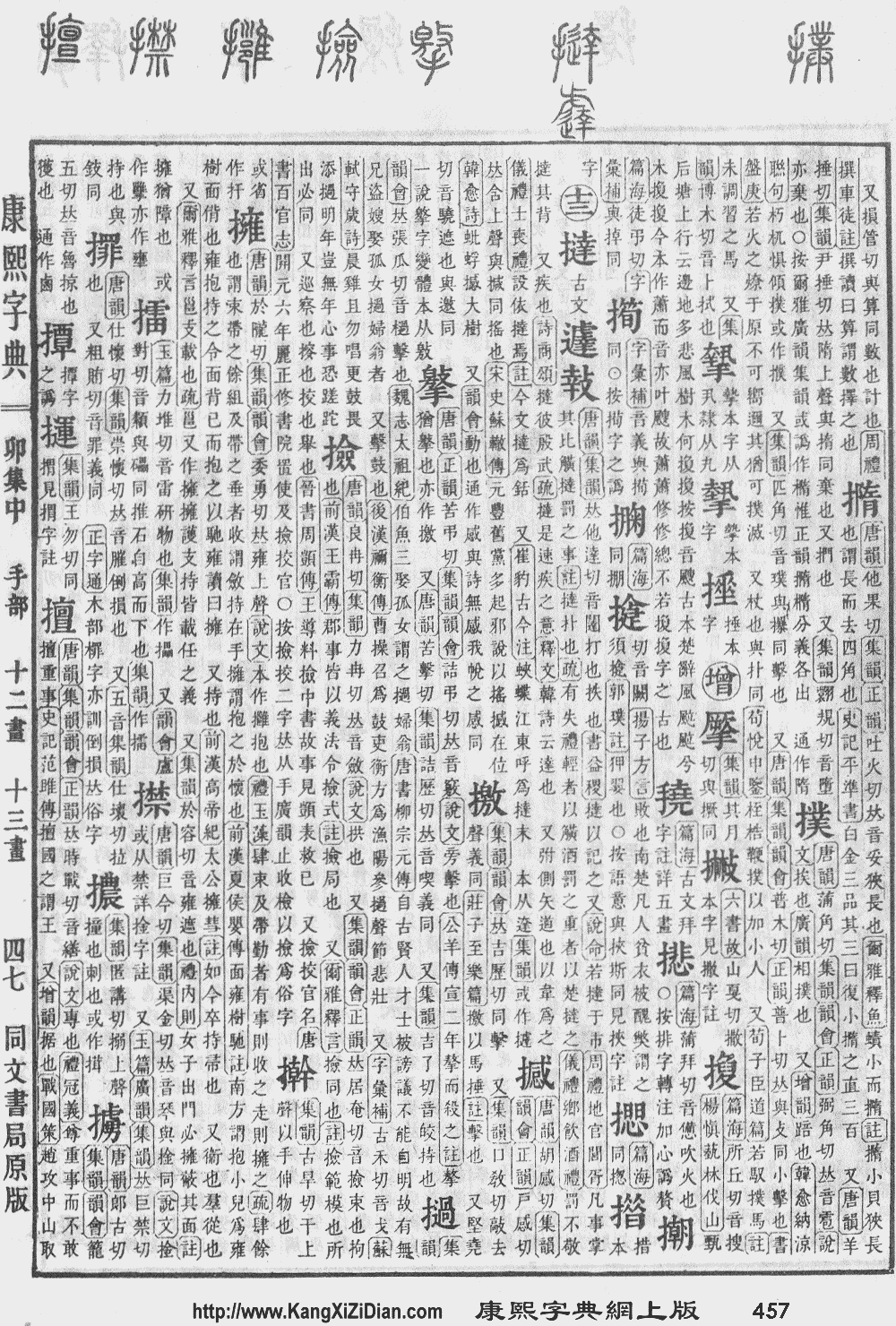
- Kangxi Dictionary: page 457, character 34
- Dai Kanwa Jiten: character 12790
- Dae Jaweon: page 806, character 16
- Hanyu Da Zidian (first edition): volume 3, page 1971, character 4
- Unihan data for U+64C5
Chinese
| simp. and trad. |
擅 | |
|---|---|---|
| 2nd round simp. | 𢩳 | |
Glyph origin
| Historical forms of the character 擅 | |
|---|---|
| Shuowen Jiezi (compiled in Han) | Liushutong (compiled in Ming) |
| Small seal script | Transcribed ancient scripts |
 |
 |
Characters in the same phonetic series (旦) (Zhengzhang, 2003)
| Old Chinese | |
|---|---|
| 皽 | *tjaʀ, *tanʔ, *tjanʔ |
| 担 | *taːnʔ |
| 胆 | *daːn, *daːn |
| 疸 | *taːnʔ, *taːns |
| 觛 | *taːnʔ, *taːns, *daːnʔ |
| 亶 | *taːnʔ |
| 嬗 | *taːnʔ, *tʰaːn, *djans |
| 笪 | *taːnʔ, *taːns, *taːd |
| 狚 | *taːnʔ, *taːns, *taːd |
| 旦 | *taːns |
| 鴠 | *taːns |
| 譠 | *tʰaːn, *rteːn |
| 坦 | *tʰaːnʔ |
| 但 | *daːn, *daːnʔ, *daːns |
| 檀 | *daːn |
| 壇 | *daːn |
| 儃 | *daːn, *djan |
| 驙 | *daːn, *tan |
| 袒 | *daːnʔ, *rdeːns |
| 襢 | *daːnʔ, *tanʔ, *tans |
| 繵 | *daːnʔ |
| 膻 | *daːnʔ |
| 澶 | *daːns, *djan |
| 邅 | *tan, *danʔ, *dans |
| 鱣 | *tan |
| 饘 | *tjan, *tjanʔ |
| 旜 | *tjan |
| 氈 | *tjan |
| 鸇 | *tjan |
| 顫 | *tjans |
| 蟺 | *djanʔ |
| 擅 | *djans |
| 羶 | *hljan |
| 呾 | *taːd, *ʔraːd |
| 怛 | *taːd |
| 妲 | *taːd |
| 靼 | *taːd, *tjad |
| 炟 | *taːd |
Phono-semantic compound (形聲/形声, OC *djans) : semantic 手 (“hands”) + phonetic 亶 (OC *taːnʔ).
Pronunciation
Definitions
擅
- to hold all in one's hands; to monopolize
- to own; to possess
- to be good at
- to do on one's own initiative; to do according to one's wishes
Japanese
Kanji
擅
- This term needs a translation to English. Please help out and add a translation, then remove the text
{{rfdef}}.
Compounds
Etymology 1
| Kanji in this term |
|---|
| 擅 |
| せん Hyōgaiji |
| kan’on |
(This etymology is missing or incomplete. Please add to it, or discuss it at the Etymology scriptorium.)
Pronunciation
- IPA(key): [sẽ̞ɴ]
This term needs a translation to English. Please help out and add a translation, then remove the text {{rfdef}}.
Korean
Hanja
擅 • (cheon) (hangeul 천, revised cheon, McCune–Reischauer ch'ŏn, Yale chen)
- This term needs a translation to English. Please help out and add a translation, then remove the text
{{rfdef}}.
Vietnamese
This article is issued from Wiktionary. The text is licensed under Creative Commons - Attribution - Sharealike. Additional terms may apply for the media files.